PARP
poly ADP ribose polymerase
PARP is a family of proteins involved in a number of cellular processes involving mainly DNA repair and programmed cell death. The PARP family comprises 17 members. They have all very different structures and functions in the cell. PARP1, PARP2, VPARP (PARP4), Tankyrase-1 and -2 (PARP-5a or TNKS, and PARP-5b or TNKS2) have a confirmed PARP activity. Others include PARP3, PARP6, TIPARP (or PARP7), PARP8, PARP9, PARP10, PARP11, PARP12, PARP14, PARP15, and PARP16. PARP is found in the cell’s nucleus. The main role is to detect and signal single-strand DNA breaks (SSB) to the enzymatic machinery involved in the SSB repair.
PARP Isoform Specific Products
-
PARP
(303)
View all products
-
PARP1
(204)
View all products
-
PARP2
(82)
View all products
-
PARP3
(22)
View all products
-
PARP4
(11)
View all products
-
TNKS1/PARP5A
(40)
View all products
-
TNKS2/PARP5B
(37)
View all products
-
PARP7
(24)
View all products
-
PARP10
(20)
View all products
-
PARP14
(17)
View all products
-
PARP15
(14)
View all products
-
PARP12
(4)
View all products
-
PARP16
(3)
View all products
All Product Categories
-
PARP Inhibitors
(456)
View all products
-
PARP Agonists
(4)
View all products
-
PARP Activators
(104)
View all products
-
PARP Modulators
(11)
View all products
-
PARP Inducers
(20)
View all products
-
PARP Degraders
(23)
View all products
-
PARP Substrate
(1)
View all products
-
PARP Ligands
(4)
View all products
-
PARP Related Products (680)
Related Products (680)

-
Antibodies (11)
-
PARP Isoform Comparison
-
PARP1-IN-21
 0 ImagesCat. No.: HY-158680CAS No.: 2855979-51-8PARP1-IN-21 (example 16) is a potent inhibitor of PARP1, with the IC50 of < 10 nM.
-
TH-407a
 0 ImagesCat. No.: HY-184273CAS No.: 1903103-73-0TH-407a is an orally active and selective USP15 inhibitor with an IC50 of 0.76 μM. As an allosteric modulator, TH-407a binds to a non-catalytic site to block deubiquitinating activity. TH-407a inhibits cell growth, proliferation, clonogenicity and migration, regulates the p53 signaling pathway, and reduces the stability of PARP1. TH-407a exhibits anti-tumor activity in breast cancer xenograft mouse models. TH-407a can be used for the research of breast cancer.
-
MC2050
 0 ImagesCat. No.: HY-182246CAS No.: 1301757-19-6MC2050 is a selective PARP-1 inhibitor with an IC50 of 119 nM. MC2050 functionally inhibits PARP-1 activity, including hyperactivation induced by oxidative stress, and reduces the poly (ADP-ribosyl) ation level of histone H1. MC2050 protects neuroblastoma cells from oxidative stress-mediated cell death induced by hydrogen peroxide. MC2050 is applicable to research related to neuroblastoma and Burkitt lymphoma.

-
PARP1-IN-43
 0 ImagesCat. No.: HY-175482CAS No.: 3066798-40-8PARP1-IN-43 (Compound 5350) is a blood-brain barrier (BBB) permeable PARP1 inhibitor, with an IC50 of 5 nM. PARP1-IN-43 can be used for the study of homologous recombination (HR)-deficient central nerve system (CNS) cancers.
-
Anticancer agent 64
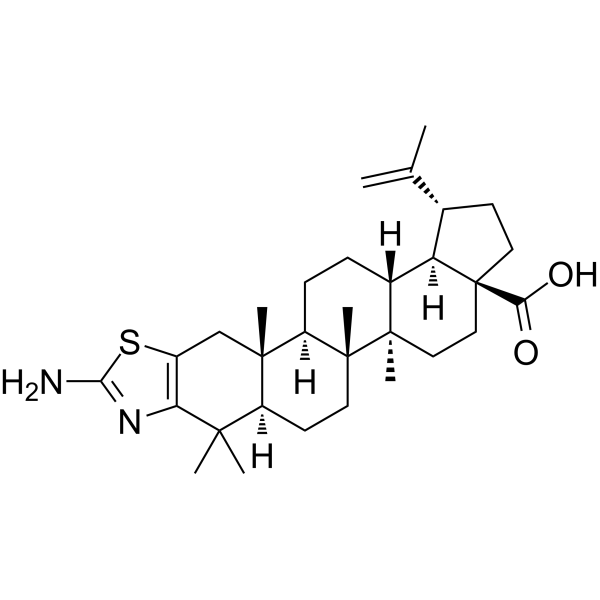 0 ImagesCat. No.: HY-147514CAS No.: 2387902-92-1Anticancer agent 64 (compound 5m) shows cytotoxic activity in CCRF-CEM cells, with IC50 of 2.4 μM. Anticancer agent 64 shows good anticancer activity through apoptosis induction. Anticancer agent 64 induces caspase 3 and 7 activation and PARP cleavage. Anticancer agent 64 induces significant effect of mitochondria depolarization.
-
4,4′-Secalonic acid D
 0 ImagesCat. No.: HY-N15380CAS No.: 2265910-52-74,4′-Secalonic acid D (Compound 12) is a PARP1 inhibitor. 4,4′-Secalonic acid D induces the accumulation of ROS and DNA damage, activates the caspase-3/GSDME pathway, and triggers apoptosis and pyroptosis of tumor cells by inhibiting PARP1. 4,4′-Secalonic acid D has anti-tumor activity.
-
Cimicifugic acid A
 0 ImagesCat. No.: HY-N17665CAS No.: 205114-65-4Cimicifugic acid A is a cytotoxic caffeic acid derivative that can be isolated from the rhizomes of Cimicifuga heracleifolia. Cimicifugic acid A shows cytotoxic activity against cancer cells, and increases expression of cleaved PARP, thereby exhibiting pro-apoptotic activity. Cimicifugic acid A can be used for colon cancer research.
-
Anticancer agent 358
 0 ImagesCat. No.: HY-187679CAS No.: 3087062-38-9Anticancer agent 358 is a PARP inhibitor with antiproliferative activity against lung cancer cells and low toxicity to normal hepatocytes. Anticancer agent 358 binds to the active site of PARP via hydrogen bonds and π-π interactions with key residues, thereby promoting the accumulation of DNA damage. Anticancer agent 358 induces DNA damage, apoptosis, and autophagy in lung cancer cells. Anticancer agent 358 can be used for the research of non-small cell lung cancer.
-
PARP1-IN-39
 0 ImagesCat. No.: HY-174446CAS No.: 3054988-47-2
-
PARP1-IN-52
 0 ImagesCat. No.: HY-181158PARP1-IN-52 is a poly(ADP-ribose) polymerase-1 (PARP-1) inhibitor that forms stable interactions with the PARP-1 active site. PARP1-IN-52 exerts anticancer activity against breast cancer cells. PARP1-IN-52 can be used for the research of breast cancer.
-
PC8
 0 ImagesCat. No.: HY-181999PC8 is a selective dual inhibitor of PARP1/CDK6, with an IC50 of 0.126 μM for PARP1 and 0.197 μM for CDK6. PC8 does not alter PARP1 expression, but reduces the expression of its downstream target PAR. PC8 inhibits the canonical Wnt/β-catenin signaling pathway. PC8 induces intracellular ROS accumulation and exacerbates DNA damage. PC8 inhibits the proliferation of triple-negative breast cancer (TNBC) cells. PC8 can be used for the research of triple-negative breast cancer.
-
Antitumor agent-169
 0 ImagesCat. No.: HY-162643Antitumor agent-169 (Compound B3) is a dual inhibitor PD-1/PD-L1 interaction and PARP7, with IC50s of 0.426 μM and 2.50 nM. Antitumor agent-169 exhibits an affinity to human PD-L1, with Ki of 20.2 nM. Antitumor agent-169 restores the T cell function, increases IFN-γ secretion. Antitumor agent-169 inhibits cell viability of MDA-MB-231 and Jurkat T, exhibits antitumor efficacy against melanoma in mouse model and good pharmacokinetic characteristics.
-
TNKS 22
 0 ImagesCat. No.: HY-12601CAS No.: 1507362-00-6Synonyms: TNKS-IN-22TNKS 22 (compound 22) is an orally active and selective tankyrase inhibitor. TNKS 22 inhibits TNKS1 and TNKS2 with IC50s of 0.1 and 4.1 nM, respectively.
-
TNKS-IN-4
 0 ImagesCat. No.: HY-12602CAS No.: 1507362-06-2TNKS-IN-4 (compound 49) is an orally active tankyrase (TNKS) inhibitor with IC50 values of 0.1 nM and 7.6nM for TNKS1 and TNKS2, respectively. TNKS-IN-4 can be used for study of APC-mutant colorectal cancer.
-
INH2BP
 0 ImagesCat. No.: HY-136778CAS No.: 137881-27-7INH2BP is a poly(ADP-ribose) polymerase (PARP) inhibitor with antioxidant and anti-apoptotic activities. INH2BP reduces the production of intracellular reactive oxygen species (ROS), modulates the expression of apoptosis-related proteins such as Bax, Bcl-2 and cleaved caspase-3 and enhances cell survival through the activation of the ERK1/2 and p38 MAPK signaling pathways. INH2BP is promising for research of cardiovascular diseases.
-
STK899704
 0 ImagesCat. No.: HY-120339CAS No.: 1578247-29-6STK899704 is a tubulin polymerization inhibitor. STK899704 exhibits broad-spectrum inhibitory activity against various cancer cell lines with IC50 values ranging from 0.2 to 1.0 μM. STK899704 disrupts the mitotic spindle structure, inducing G2/M phase cell cycle arrest. STK899704 inhibits the migration ability of HT29 cells by downregulating the FAK-MEK-ERK signaling pathway, thereby suppressing the expression and activity of MMP-2 and MMP-9. STK899704 activates caspase-3/7/8/9, leading to PARP cleavage and inducing apoptosis. STK899704 induces cellular senescence through the p53 pathway. STK899704 can be used in research on skin cancer, lung cancer, colon cancer, and other cancers.
-
KCL-440
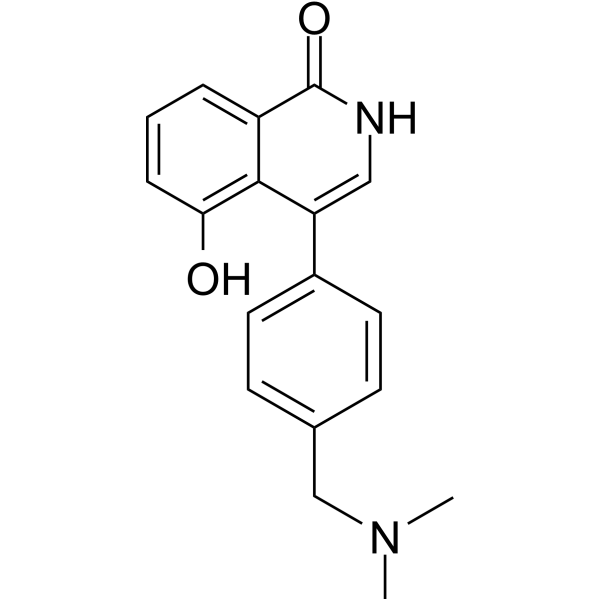 0 ImagesCat. No.: HY-15050CAS No.: 651029-09-3KCL-440 is a CNS-penetrated PARP inhibitor, with an IC50 of 68 nM. KCL-440 has strong inhibition of PARP-1.