



Fluorescent Dye
Fluorescence is a phenomenon of photoluminescence in luminescence. When an atom is irradiated by light, some electrons around the nucleus jump from their original orbitals to higher energy orbitals under the influence of light energy, i.e., from the ground state to the first or second excited single-line state, etc. Due to the instability of the first or second excited singlet state, the electron returns from the excited singlet state to the ground state accompanied by released energy, resulting in fluorescence.
Fluorescent dyes can be covalently bound or physically adsorbed in the structure of the substance. The fluorescence properties allow for the characterization, localization and quantitative analysis of the labeled object. Fluorescent dyes have shown great potential for the detection of proteins, nucleic acids, cells, and immunoassays, attributed to the advantages in non-radioactive contamination, simple experimental operation and easy observation.
Fluorescent dyes have penetrated many fields such as pharmacology, physiology, environmental science, and information science, as well as functional studies of proteins and drug screening.
All Product Categories
-
Fluorescent Dye Related Products (4914)
Related Products (4914)

-
Antibodies (4)
-
RB-PEG600-FA
 0 ImagesCat. No.: HY-D2888ASynonyms: Rhodamine B-PEG600-FARB-PEG600-FA (Rhodamine B-PEG600-FA) is a fluorescent dye composed of Rhodamine B (HY-Y0016), PEG and Folic acid (FA) (HY-16637). RB-PEG600-FA can be used for cell imaging, folate receptor targeting and detection (Ex/Em=546/610 nm).
-
4-Methyl-7-(2-nitrophenoxy)-2H-chromen-2-one
 0 ImagesCat. No.: HY-158616CAS No.: 1286479-53-54-Methyl-7-(2-nitrophenoxy)-2H-chromen-2-one (compound 2f) is a selenol fluorescent probe designed based on a nucleophilic aromatic substitution mechanism. It can selectively recognize selenols in neutral aqueous solution without significant interference from biological thiols, amines or alcohols. It can be used to quantify the selenium content in selenoenzymes and to image the activity of endogenous selenols in living cells.
-
Solvent violet 38
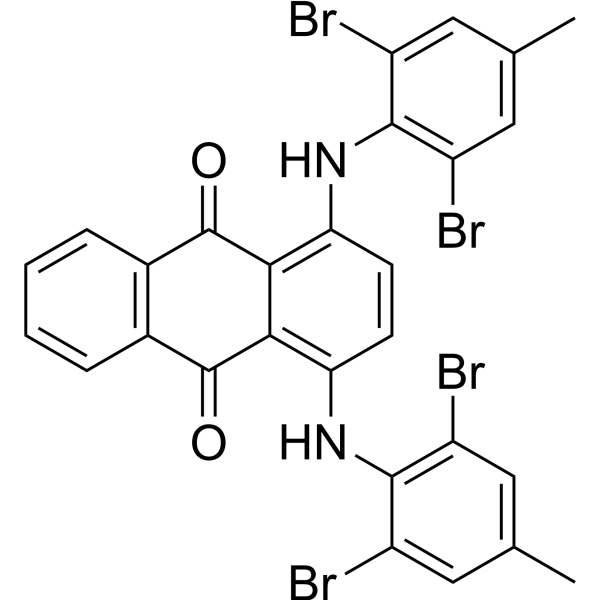 0 ImagesCat. No.: HY-D1179CAS No.: 68239-76-9Solvent violet 38 is a violet dye. Its series of products, such as Solvent orange 60 (HY-D1177), has been used in dyeing applications of plastic materials.
-
5-(6)-Carboxy SNAFL-1 SE
 0 ImagesCat. No.: HY-D30365-(6)-Carboxy SNAFL-1 SE is an amine-reactive succinimidyl ester pH indicator. 5-(6)-Carboxy SNAFL-1 SE can be readily conjugated to peptides, antibodies and other amino-containing molecules such as amino-modified oligos. 5-(6)-Carboxy SNAFL-1 SE can be used for measurement of pH changes between 7-8 (Ex/Em = 490/513 nm).

-
RAPID DiI
 0 ImagesCat. No.: HY-D3375RAPID DiI is a cyanine dye with orange-red fluorescenc (EX≈550 nm; Em≈565 nm). RAPID DiI is a lipophilic dye that labels cell membranes by inserting its two long hydrocarbon (C18 carbon) chains into the lipid bilayer. RAPID DiI is weakly fluorescent until incorporated into membranes. RAPID DiI diffuses laterally to stain the entire cell, allowing it to be used as an anterograde and retrograde tracer of neurons.
-
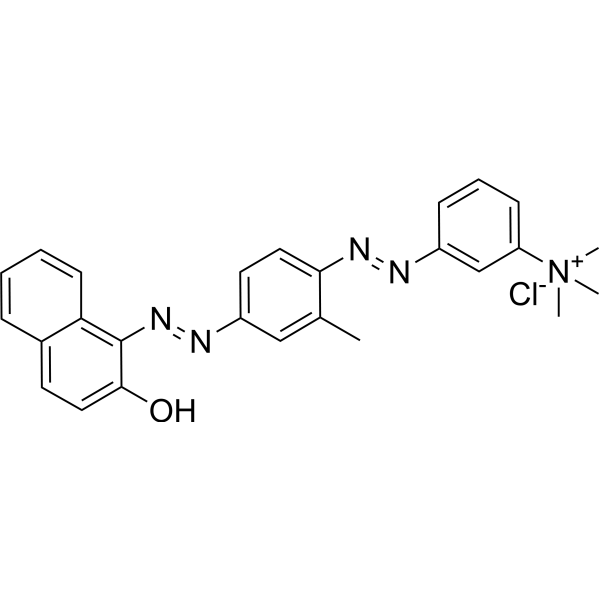
Chrysoidine G-d5 hydrochloride
 0 ImagesCat. No.: HY-D0303ASCAS No.: 1450729-16-4Synonyms: Solvent Orange 3-d5 hydrochlorideChrysoidine G-d5 hydrochloride (Solvent Orange 3-d5 hydrochloride) is the deuterium labeled Chrysoidine G (HY-D0303A). Chrysoidine G (Solvent Orange 3 hydrochloride) is an industrial azoic dye (cationic dye). Chrysoidine G (Solvent Orange 3 hydrochloride) is used for the construction of most textile dyestuffs and also in synthetic industrial compounds. Chrysoidine G (Solvent Orange 3 hydrochloride) concentration can be determined by UV-Vis spectroscopy.
-
TAMRA-C6-acid
 0 ImagesCat. No.: HY-D3531CAS No.: 2183473-11-0TAMRA-C6-acid is a derivative of TAMRA (tetramethylrhodamine) featuring a carboxylic acid group for use in amide coupling reactions. TAMRA-C6-acid is primarily used for further bioconjugation and derivatization (Ex/Em = 553/576 nm).

-
Styryl 6
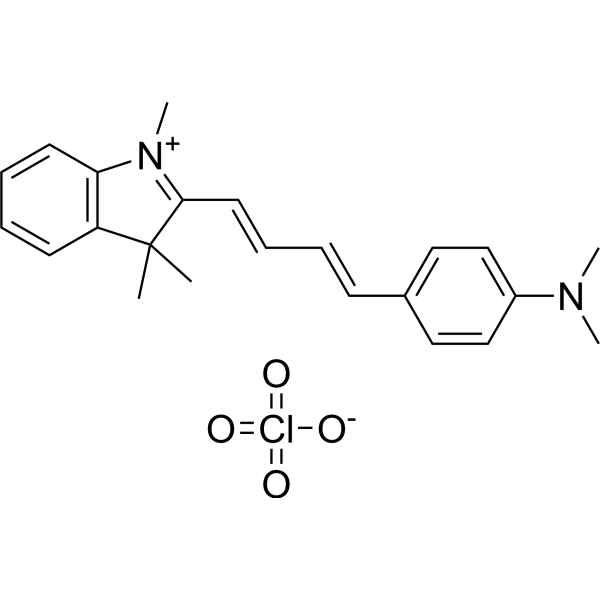 0 ImagesCat. No.: HY-D1762CAS No.: 76433-27-7Styryl 6 is a laser dye.
-
Meso-Cl cyanine 7 free acid chloride
 0 ImagesCat. No.: HY-N16316CAS No.: 3091879-84-1Meso-Cl cyanine 7 free acid chloride is a Meso-Cl cyanine fluorescent dye. Meso-Cl cyanine 7 free acid chloride can be used for labelling amine groups such as those on antibodies, nucleic acids, and proteins and can be detected using a variety of fluorescence detection techniques such as microscopy and flow cytometry (Ex/Em = 778/805 nm).
-
AF647-NHS ester tripotassium
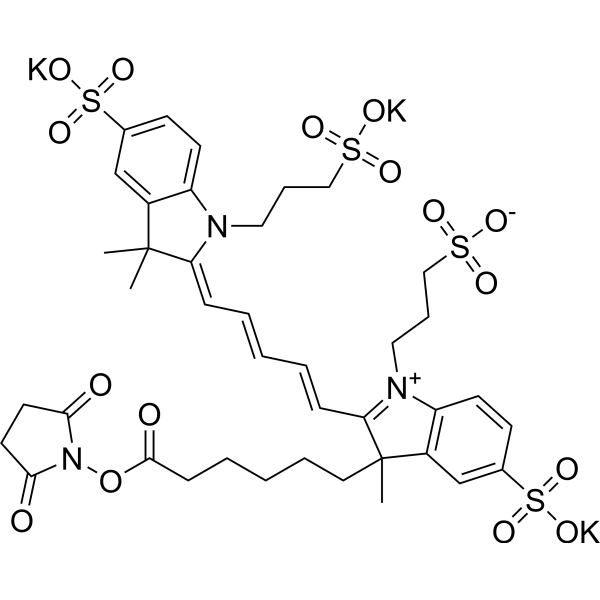 0 ImagesCat. No.: HY-D1119ACAS No.: 1453856-34-2AF647-NHS ester tripotassium is an analogue of Alexa Fluor 647 (AF647) (HY-D1119). NHS ester can covalently bind to molecules with amino groups (such as proteins, antibodies, etc.). AF647 is a bright, far-red fluorescent dye with an excitation wavelength (λex) of 635 nm (conventional fluorescence detection)/620 nm (instantaneous detection). Storage: protect from light.

-
3,3-Dibutylthiacarbocyanine iodide
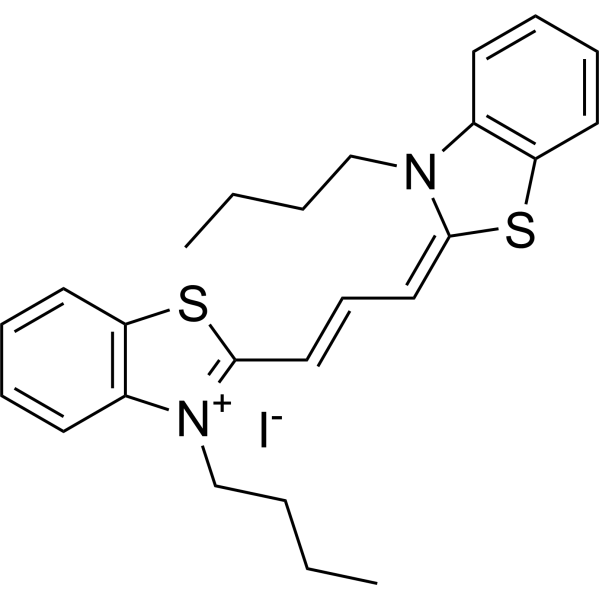 0 ImagesCat. No.: HY-D1483CAS No.: 53213-85-73,3-Dibutylthiacarbocyanine iodide is a fluorescent dye with an excitation of 559 nm and an emission 604 nm.
-
FAM labled Etidaligide sodium
 0 ImagesCat. No.: HY-177631CFAM labled Etidaligide sodiumis a FAM labled Etidaligide sodium.
-
Callose Staining Solution (Aniline Blue, Bright-Field Method)
 0 ImagesCat. No.: HY-DY2041Callose Staining Solution (Aniline Blue, Bright-Field Method) is a fluorescent dye used for detecting callose in plant tissues, green algal cell walls, plant cells, and protoplasts. Callose Staining Solution (Aniline Blue, Bright-Field Method) specifically binds to callose, a β-(1,3)-D-glucan polymer, and exhibits blue-green fluorescence under alkaline conditions with reduced background staining and non-toxicity to living cells. Callose Staining Solution (Aniline Blue, Bright-Field Method) is suitable for observation under UV or epifluorescence microscopy (Ex/Em = 365-370/397-509 nm). Callose Staining Solution (Aniline Blue, Bright-Field Method) can be used in studies related to the visualization of callose deposition in plants.
-
Alizarin Yellow R sodium
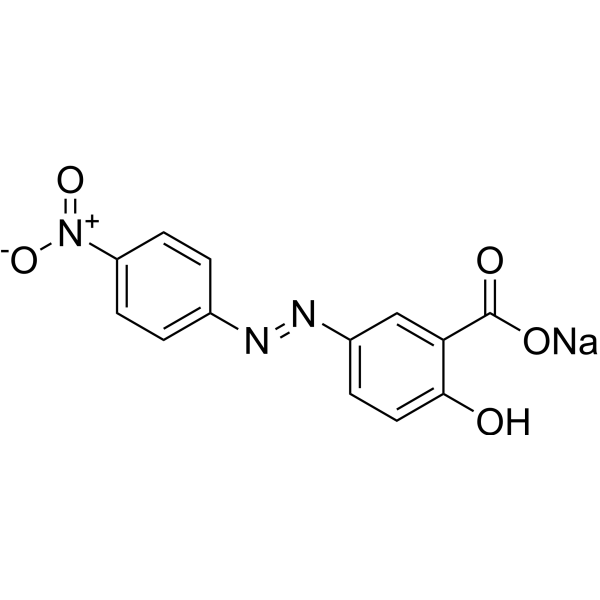 0 ImagesAlizarin Yellow R sodium is a multifunctional dye. Dyes are important tools in biological experiments. They can help researchers observe and analyze cell structures, track biomolecules, evaluate cell functions, distinguish cell types, detect biomolecules, study tissue pathology and monitor microorganisms. Their applications range from basic scientific research to clinical A wide range of diagnostics. Dyes are also widely used in traditional fields such as textile dyeing, as well as in emerging fields such as functional textile processing, food pigments and dye-sensitized solar cells.
-
Biotin-PEG2000-Alk
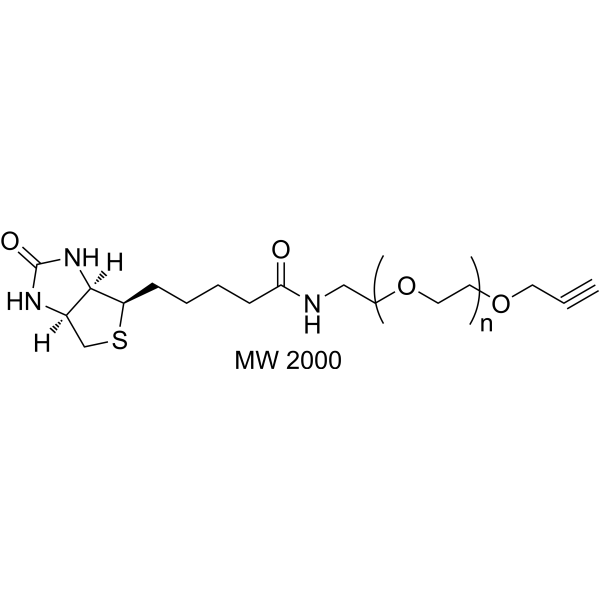 0 ImagesCat. No.: HY-147206BBiotin-PEG2000-Alk is a biotin labeled PEG derivative. Biotin is an enzyme co-factor, can be used for labeling protein; PEG is a hydrophilic and water-soluble polymer with low toxicity; Alk (Alkyne), acyclic (branched or unbranched) aliphatic hydrocarbon, can react with azido, which improve the efficiency of biotin binding targets. Biotin-PEG2000-Alk is a click chemistry reagent, it contains an Alkyne group and can undergo copper-catalyzed azide-alkyne cycloaddition (CuAAc) with molecules containing Azide groups.
-
Mitochondrial-targeted peptide BP19
 0 ImagesCat. No.: HY-P11637Mitochondrial-targeted peptide BP19 is a fluorescent probe for the selective measurement of labile iron in the mitochondriairon. Mitochondrial-targeted peptide BP19 exhibits iron-selective sensing activity with mitochondrial accumulation, reduced fluorescence in iron-loaded cells, and fluorescence reinstatement upon iron chelation. Mitochondrial-targeted peptide BP19 evaluates mitochondrial labile iron levels in cultured fibroblasts with Friedreich's ataxia.




