



Fluorescent Dye
Fluorescence is a phenomenon of photoluminescence in luminescence. When an atom is irradiated by light, some electrons around the nucleus jump from their original orbitals to higher energy orbitals under the influence of light energy, i.e., from the ground state to the first or second excited single-line state, etc. Due to the instability of the first or second excited singlet state, the electron returns from the excited singlet state to the ground state accompanied by released energy, resulting in fluorescence.
Fluorescent dyes can be covalently bound or physically adsorbed in the structure of the substance. The fluorescence properties allow for the characterization, localization and quantitative analysis of the labeled object. Fluorescent dyes have shown great potential for the detection of proteins, nucleic acids, cells, and immunoassays, attributed to the advantages in non-radioactive contamination, simple experimental operation and easy observation.
Fluorescent dyes have penetrated many fields such as pharmacology, physiology, environmental science, and information science, as well as functional studies of proteins and drug screening.
All Product Categories
-
Fluorescent Dye Related Products (4914)
Related Products (4914)

-
Antibodies (4)
-
Palladium meso-tetra(pentafluorophenyl)porphyrin
 0 ImagesCat. No.: HY-W112090CAS No.: 72076-09-6Synonyms: PdTFPP; 5,10,15,20-Tetrakis(pentafluorophenyl)-21H,23H-porphine palladium(II)Palladium meso-tetra(pentafluorophenyl)porphyrin (PdTFPP) derives from palladium(II), acting as a fluorescence-quenched optical probe and high-performance oxygen concentration sensor with outstanding photostability and antioxidant capacity. Palladium meso-tetra(pentafluorophenyl)porphyrin exhibits reduced luminescence intensity as dissolved oxygen concentration rises. Palladium meso-tetra(pentafluorophenyl)porphyrin can be applied for real-time monitoring of live-cell respiration, hypoxic tissue imaging, and nanofibrous organic semiconductors in photodetectors for ambient oxygen detection.
-
RBM1-151
 0 ImagesCat. No.: HY-N15826CAS No.: 3077081-47-8RBM1-151, a 1-deoxy derivative and vinilog of RBM14-C12 (HY-150163), as a fluorogenic substrate of Amidases (HY-P2736) (Ex/Em). RBM1-151 is hydrolyzed by acid ceramidase (AC) ((appKm = 7.0 μM; appVmax = 99.3 nM/min), N-acylethanolamine-hydrolyzing acid amidase (appKm = 0.73 μM; appVmax = 0.24 nM/min), and fatty Acid amide hydrolase (FAAH) (appKm = 3.6 μM; appVmax = 7.6 nM/min) but not by other ceramidases. RBM1-151 is applicable for basic biological studies of lipid amidase function, as well as potential diagnostic/prognostic evaluations of diseases involving dysregulated AC, NAAA, or FAAH (Farber disease, cancer).
-
BP Fluor 555 azide
 0 ImagesCat. No.: HY-W800702CAS No.: 2770422-53-0BP Fluor 555 Azide is a water-soluble, bright orange-fluorescent dye with excitation ideally suited for the 532 nm or 555 nm laser lines and visualized with TRITC (tetramethylrhodamine) filter sets. BP Fluor 555 conjugates of antibodies, peptides, and proteins are pH insensitive from pH 4 to pH 10. AF 555 conjugates ideally suited for detection of low abundance targets. BP Fluor 555 Azide can be reacted with terminal alkynes via a copper-catalyzed click reaction (CuAAC). It also reacts with strained cyclooctyne via a copper-free “click chemistry” reaction to form a stable triazole and does not require Cu-catalyst or elevated temperatures. The brightness and photostability of this dye are best suited to direct imaging of low-abundance targets.
-
Cy3 Dextran (MW 70000)
 0 ImagesCat. No.: HY-D2466Cy3 Dextran (MW 70000) is a fluorescent labeling reagent that conjugates the Cy3 (HY-D0822) fluorescent dye with Dextran (HY-112624). The Cy3 fluorophore is commonly used in applications such as immunolabeling, nucleic acid labeling, fluorescence microscopy, and flow cytometry. The maximum emission wavelength of Cy3 is approximately 562-570 nm. Dextran inhibits platelet aggregation and coagulation factors, and serves as a plasma volume expander.
-
BP Fluor 430 alkyne
 0 ImagesCat. No.: HY-W800698CAS No.: 2006309-79-9BP Fluor 430 Alkyne is a green-fluorescent alkyne-activated probe routinely used for imaging of moderate to high abundance azide-containing biomolecules. BP Fluor 430 Alkyne reacts with azides via a copper-catalyzed click reaction (CuAAC) to form a stable triazole linker. BP Fluor 430 is a bright, photostable, green-fluorescent probe optimally excited near 430 nm. This probe is water-soluble and its fluorescence is pH independent over a wide pH range.
-
C.I. Pigment red 23
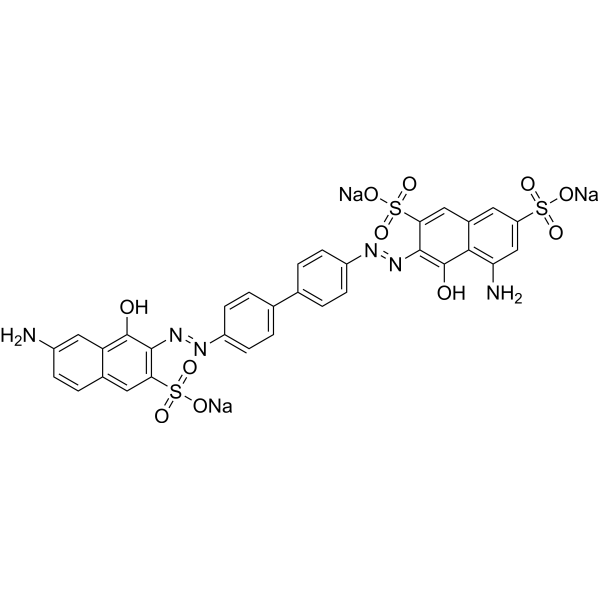
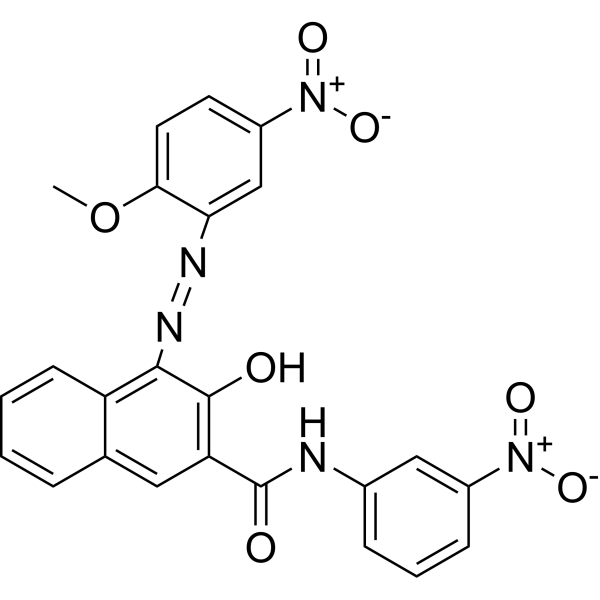 0 ImagesC.I. Pigment red 23 is the most important colorant used to add color or change the color of something and is chemically essentially unaffected by the carrier or medium into which it is incorporated. It can be widely used in textile, medicine, food, cosmetics, plastics, paint, ink, photography and paper industries.
-
DyLight 550 NHS ester
 0 ImagesCat. No.: HY-D2766CAS No.: 1340586-78-8BP Light 550 NHS ester is a vibrant orange-to-red fluorochrome with better performance than other rhodamine derivatives, including BP Fluor 555, TRITC, and Cy3 dye for fluorescent applications. The high water solubility of BP Light 550 means that a high dye-to-protein ratio can be attained without causing precipitation of the conjugates.
-
4-Methyl-7-(4-nitrophenoxy)-2H-chromen-2-one
 0 ImagesCat. No.: HY-158617CAS No.: 1644277-00-8
-
16:0-06:0 NBD PE
 0 ImagesCat. No.: HY-N16152CAS No.: 106918-69-8Synonyms: C6-NBD-PE16:0-06:0 NBD PE (C6-NBD-PE) is a commonly used fluorescent phospholipid analog and membrane-disrupting agent for investigating membrane lipid structure and dynamics. In aqueous buffers, the self-assembly of 16:0-06:0 NBD PE can be disrupted via binding to methylated α-, β-, and γ-cyclodextrins. 16:0-06:0 NBD PE can be selectively extracted from lipid vesicles upon the addition of methylated cyclodextrins, with an extraction efficiency lower than that of NBD-PC and NBD-SM analogs.

-
Cy7 HA (MW 7000)
 0 ImagesCat. No.: HY-D2674Cy7 HA (MW 7000) is a hyaluronic acid labeled with CY7 (HY-D0825). Cy7 HA (MW 7000) is widely used for cell imaging and in vivo imaging of shallow tissue (Ex/Em = 740/770 nm).
-
DY-680-NHS ester
 0 ImagesCat. No.: HY-D2761CAS No.: 1264737-80-5DY-680-NHS ester is an amine reactive hydrophilic fluorochrome. It can be conjugated to an antibody with higher D/P ratio without causing fluorescence quenching and conjugate precipitation, and it is widely used in applications including western blotting, microscopy, flow cytometry, and cell-based assays. The spectrum has an excitation of 690nm and emission at 709nm.
-
C.I. Disperse orange 37
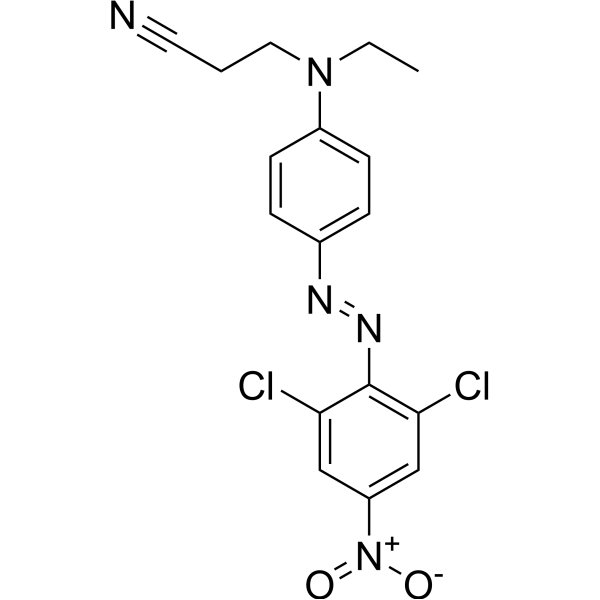 0 ImagesCat. No.: HY-D0497CAS No.: 13301-61-6C.I. Disperse orange 37 is an orange-orange dye commonly used for fiber dyeing.
-
Cy7.5-PEG1000-DSPE
 0 ImagesCat. No.: HY-D2592Cy7.5-PEG1000-DSPE is a PEG phospholipid with CY7.5 (HY-D0926) dye used in protein/nucelic acid labeling and fluorescence microscopy. Cy7.5-PEG1000-DSPE can self-assemble in aqueous solution to form micelles/lipid bilayer and used to prepare liposomes or nanoparticles for nutrients delivery such as mRNA or DNA vaccine (Ex/Em=770/820 nm).
-
Disperse Red 177
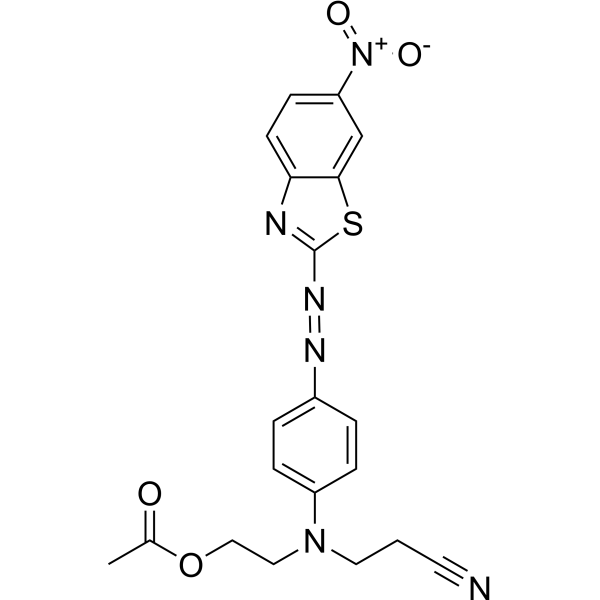 0 ImagesCat. No.: HY-D0625CAS No.: 68133-69-7Disperse Red 177 is a red dye derived from anthraquinone. It is used in plastics, textiles and cosmetics.
-
C.I. Pigment yellow 180
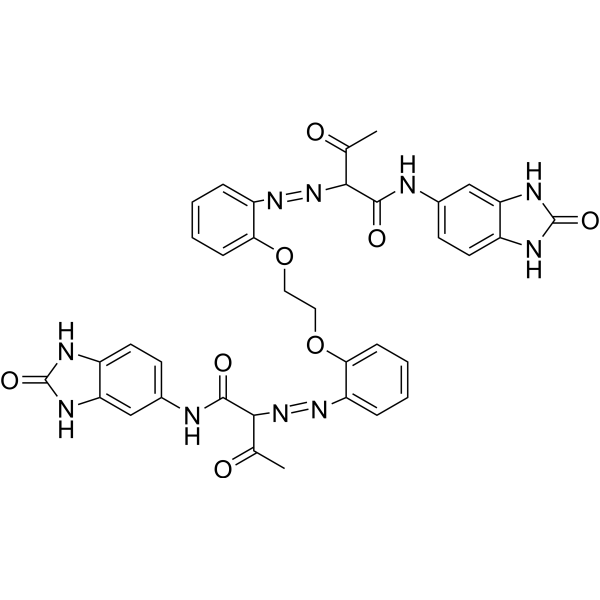 0 ImagesCat. No.: HY-D0725CAS No.: 77804-81-0C.I. Pigment yellow 180 is the most important colorant used to add color or change the color of something and is chemically essentially unaffected by the carrier or medium into which it is incorporated. It can be widely used in textile, medicine, food, cosmetics, plastics, paint, ink, photography and paper industries.
-
Cy5.5-SE potassium
 0 ImagesCat. No.: HY-D0925CCAS No.: 910482-46-1Synonyms: Cyanine5.5 NHS ester potassiumCy5.5-SE (Cyanine5.5 NHS ester) potassium is a CY dye. CY, short for Cyanine, is a compound consisting of two nitrogen atoms connected by an odd number of methyl units. Cyanine compounds have the characteristics of long wavelength, adjustable absorption and emission, high extinction coefficient, good water solubility and relatively simple synthesis. CY dyes are of en used for the labeling of proteins, antibodies and small molecular compounds. For the labeling of protein antibodies, the combination can be completed through a simple mixing reaction. Below, we introduce the labeling method of protein antibody labeling, which has certain reference significance.
-
C12 Lissamine-rhodamine galactosylceramide (d18:1/12:0)
 0 ImagesCat. No.: HY-175046CAS No.: 152881-13-5C12 Lissamine-rhodamine galactosylceramide (d18:1/12:0) (Lissamine-rhodamine B-dodecanoyl Galactosylceramide) is a fluorescently labeled version of C12 galactosylceramide.
-
Cy3 HA (MW 3000)
 0 ImagesCat. No.: HY-D2622Cy3 HA (MW 3000) is a hyaluronic acid labeled with CY3 (HY-D0822). Cy3 HA (MW 3000) is widely used for cell imaging and in vivo imaging of shallow tissue (Ex/Em = 550/570 nm).




