



Herbicide
Herbicide
Herbicides refer to the agents that can completely or selectively cause the death of weeds, and they are also known as weed killers. Herbicides are divided into inorganic compound types and organic synthetic types. Herbicides should possess characteristics such as high efficiency, selectivity, and convenience in use. Some herbicides, such as paraquat, can function by inhibiting the photosynthesis of weeds, blocking the photosynthetic electron transfer or inhibiting the synthesis of photosynthetic pigments. Some herbicides, such as naphthalene acetic acid, can interfere with the hormonal balance of plants, leading to abnormal growth and death of weeds. There are also some herbicides that can inhibit plant cell division or amino acid synthesis. Herbicides are widely applied in agricultural farmlands, garden green spaces, along roads and railways, industrial sites, etc., to control weeds, so as to ensure the growth of crops, maintain the landscape environment, and reduce potential safety hazards such as fires[1][2].
All Product Categories
-
Herbicide Related Products (550)
Related Products (550)

-
Alloxydim sodium
 0 ImagesCat. No.: HY-W747607CAS No.: 55635-13-7Alloxydim sodium is a cyclohexenone oxime herbicide. Alloxydim sodium exhibits cytotoxicity. Alloxydim sodium can be used to control grassy weeds in broadleaf crops.
-
Piperophos (Standard)
 0 ImagesCat. No.: HY-117096RCAS No.: 24151-93-7Synonyms: C-19490 (Standard)Piperophos (Standard) is the analytical standard of Piperophos. This product is intended for research and analytical applications. Piperophos (C-19490) is an herbicide.
-
Metsulfuron-methyl (Standard)
 0 ImagesCat. No.: HY-B1869RCAS No.: 74223-64-6Metsulfuron-methyl (Standard) is the analytical standard of Metsulfuron-methyl. This product is intended for research and analytical applications. Metsulfuron-methyl is a systemic sulfonylurea herbicide that has been widely used to control broadleaf weeds and annual grasses in rice, corn, wheat, and barley. Metsulfuron-methyl exhibits high herbicidal activity and low mammalian toxicity, with an LD50 for rats exceeding 5000 mg/kg.
-
Pentoxazone
 0 ImagesCat. No.: HY-W728891CAS No.: 110956-75-7Pentoxazone is a protoporphyrinogen IX oxidase (PPO)-inhibiting herbicide. Pentoxazone inhibits chlorophyll and heme synthesis, drives protoporphyrinogen IX accumulation and oxidation, and generates singlet oxygen to oxidize cell membranes and induce cell damage.Pentoxazone suppresses fresh weight growth of multiple weed species and shows low activity against weedy rice. Pentoxazone can be used for the research of direct-seeding rice field weed management.
-
Dimethenamid
 0 ImagesDimethenamid is an acetamide herbicide that is widely used on soybeans and corns to inhibit weed growth. Dimethenamid not only lead to morphological abnormalities in zebrafish larvae but also reduces their viability. ROS production and inflammation responses were promoted in zebrafish larvae.
-
IR5790
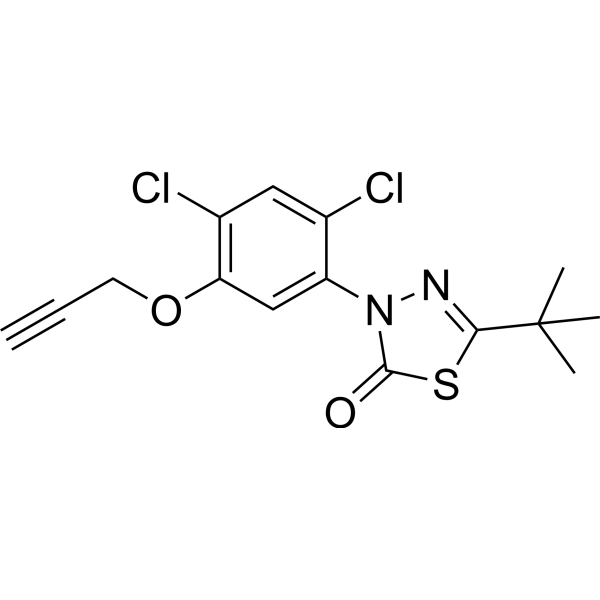 0 ImagesCat. No.: HY-157086CAS No.: 192809-26-0IR5790 is a herbicide. IR5790 strongly inhibits protoporphyrinogen oxidase with an IC50 of 3 nM.
-
Triazole sulcotrione
 0 ImagesCat. No.: HY-W754459CAS No.: 1911613-97-2Triazole sulcotrione is a triazole herbicide commonly used for weed control in cornfields.
-
Mevalocidin
 0 ImagesCat. No.: HY-N15443CAS No.: 887028-34-4Mevalocidin is a phytotoxin. Mevalocidin can inhibit the growth of many broadleaf and grass plants, showing significant herbicidal activity against weeds. Mevalocidin is promising for research of bioherbicides.
-
Fenpyrazone
 0 ImagesCat. No.: HY-W727532CAS No.: 1992017-55-6Fenpyrazone is a 4-hydroxyphenylpyruvate dioxygenase (HPPD) inhibitor as well as a post-emergence herbicide. By inhibiting the activity of HPPD, Fenpyrazone indirectly blocks carotenoid biosynthesis in plants, causing bleaching of new tissues in sensitive plants, followed by necrosis and eventual death. Fenpyrazone is used in studies on controlling annual monocotyledonous and dicotyledonous weeds in summer maize fields.
-
Herbicide safener-4
 0 ImagesCat. No.: HY-170920CAS No.: 3056059-99-2Herbicide safener-4 is a herbicide safener targeting acetolactate synthase (ALS). Herbicide safener-4 competitively binds to the active site of ALS, blocks the binding of Mesosulfuron-methyl (HY-126987), and simultaneously allows substrates to enter for catalytic reactions. Herbicide safener-4 increases the content/activity of glutathione (GSH), glutathione S-transferase (GST), cytochrome P450 monooxygenase (CYP450) and peroxidase (POD) in plants, and decreases the activity of superoxide dismutase (SOD).

-
Furilazole (Standard)
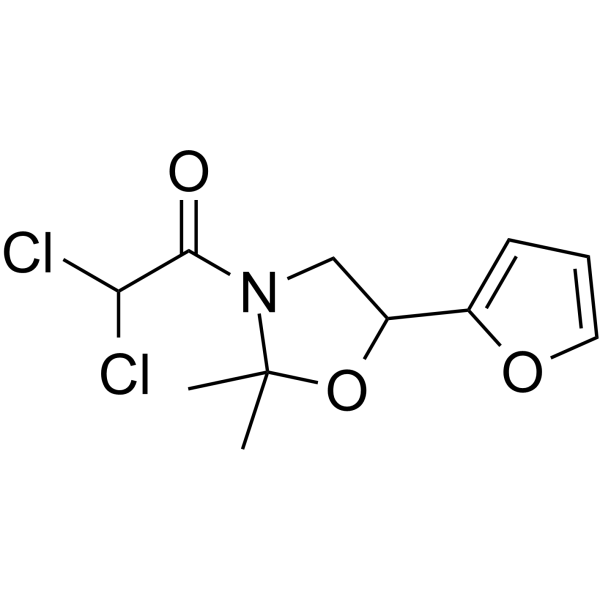
 0 ImagesCat. No.: HY-17534RCAS No.: 121776-33-8Synonyms: MON 13900 (Standard)Furilazole (Standard) is the analytical standard of Furilazole. This product is intended for research and analytical applications. 0
-
Epopromycin B
 0 ImagesCat. No.: HY-N14236CAS No.: 153540-56-8Epopromycin B inhibits the cell wall synthesis of lettuce protoplasts, thereby exhibiting herbicidal activity. Epopromycin B exhibits cytotoxicity in B16 melanoma cell with an IC50 of 0.003 µg/mL.
-
Beflubutamid (Standard)
 0 ImagesCat. No.: HY-114769RCAS No.: 113614-08-7Synonyms: UBH 820 (Standard)Beflubutamid (Standard) is the analytical standard of Beflubutamid. This product is intended for research and analytical applications. Beflubutamid is a chiral soil herbicide against dicotyledonous weeds in cereals.

-
Ethalfluralin
 0 ImagesCat. No.: HY-W714214CAS No.: 55283-68-6Ethalfluralin is a dinitroaniline herbicide and microtubule inhibitor. Ethalfluralin blocks nuclear division and cytokinesis of parasites by inhibiting intranuclear spindle formation. Ethalfluralin activates the phosphorylation levels of NF-κB and P38 MAPK, inhibits the PI3K/AKT signaling pathway, impairs mitochondrial function, and induces apoptosis, endoplasmic reticulum stress, autophagy, and ROS production. Ethalfluralin is applicable to research related to toxoplasmosis.

-
Flusulfinam
 0 ImagesCat. No.: HY-W1115537CAS No.: 2428458-82-4Flusulfinam is a HPPD inhibitor and herbicide, with an IC50 of 0.0181 μM against Arabidopsis thaliana HPPD. Flusulfinam inhibits the catalytic activity of recombinant Arabidopsis thaliana HPPD. Flusulfinam exhibits potent herbicidal activity against barnyard grass (Echinochloa crus-galli). Flusulfinam inhibits the growth of Digitaria sanguinalis.
-
Fluchloralin
 0 ImagesCat. No.: HY-W714212CAS No.: 33245-39-5Fluchloralin is a dinitroaniline herbicide that effectively controls annual gramineous and broadleaf weeds primarily by inhibiting tubulin synthesis and cell division. Fluchloralin exhibits cytotoxicity and genotoxicity, and promotes cell apoptosis by activating apoptotic signaling proteins, forming DNA ladder bands, inducing cell shrinkage and nuclear fragmentation.



