



Liposome
Liposomes (NPs typically 100–500 nm in diameter) are fabricated from the self-assembly of phospholipids, which consist of a polar phosphate head group and hydrophobic lipid tails. In aqueous environments, the hydrophobic tails self-orient, resulting in a spherical structure comprised of an aqueous core surrounded by a lipophilic bilayer membrane. Liposomes are both biocompatible and biodegradable (e.g., at certain pH and temperature), which can be controlled by modifying the lipid composition. Furthermore, liposomes are amenable to various modifications that improve their efficacy as drug delivery carriers.
All Product Categories
-
Liposome Related Products (1268)
Related Products (1268)

-
DPPE-PEG3400-N3
 0 ImagesCat. No.: HY-W1052051ASynonyms: DPPE-PEG3400-AzideDPPE-PEG3400-N3 (DPPE-PEG3400-Azide) is a conjugate composed of DPPE, PEG chains, and terminal azido groups (-N3). DPPE-PEG3400-Azide is a click chemistry reagent used for the targeted modification of liposomes/nanoparticles.
-
(S)-DSPC
 0 ImagesCat. No.: HY-W040193BCAS No.: 66701-63-1Synonyms: (S)-1,2-Distearoyl-sn-glycero-3-PC; (S)-1,2-Distearoyl-sn-glycero-3-phosphorylcholine(S)-DSPC ((S)-1,2-Distearoyl-sn-glycero-3-PC) is a (S)-enantiomer of DSPC (HY-W040193).
-
DSG-PEG1000-NHS
 0 ImagesCat. No.: HY-183104DSG-PEG1000-NHS is a conjugate composed of DSG, PEG chains, and terminal active esters (NHS). The NHS ester in DSG-PEG1000-NHS can rapidly covalently react with molecules containing primary amines (such as proteins, peptides, and small molecules modified with amino groups) to form stable amide bonds, enabling targeted modification of liposomes/nanoparticles.
-
3'-BPANeuGc
 0 ImagesCat. No.: HY-185658CAS No.: 1596134-81-43'-BPANeuGc is a high-affinity selective Siglec-G ligand. Lipid nanoparticles surface-modified with antigens and 3'-BPANeuGc inhibit BCR signal transduction. 3'-BPANeuGc is applicable to antigen-specific tolerance research.
-
DSG-PEG2000-Biotin
 0 ImagesCat. No.: HY-183170ADSG-PEG2000-Biotin is a conjugate composed of DSG, PEG chains, and biotin. DSG-PEG2000-Biotin combines the membrane compatibility of phospholipids with the high affinity of biotin for avidin/streptavidin, enabling applications such as targeted drug delivery systems and nanoparticle modification.
-
DSG-PEG2000-Mal
 0 ImagesCat. No.: HY-183126ADSG-PEG2000-Mal is a conjugate composed of DSG, PEG chains, and maleimide (Mal). The maleimide group in DSG-PEG2000-Mal can undergo a specific Michael addition reaction with thiol-containing (-SH) biomolecules (such as peptides, antibodies, and aptamers), enabling targeted modification of liposomes/nanoparticles.
-
DSPE-PEG2000-Ald
 0 ImagesCat. No.: HY-W440883DSPE-PEG2000-Ald is a phospholipid polyPEG which can self-assemble to form lipid bilayer in aqueous solution. The polymer can be used to prepare liposome as a drug delivery vehicle for administration of drugs or nutrients, such as mRNA vaccines. The aldehyde is reactive with aminooxy to form a stable oxime linkage or with amine at pH < 7 to form a reversible imine bond. Reagent grade, for research use only.
-
DSG-PEG5000-Galactose
 0 ImagesCat. No.: HY-183174CDSG-PEG5000-Galactose is a conjugate composed of DSG, a PEG chain, and terminal galactose. DSG-PEG5000-Galactose combines the membrane compatibility of phospholipids with the targeted recognition capabilities of galactose, making it suitable for research in biomaterial construction and drug delivery.

-
DSPE-PEG3400-LTLRWVGLMS
 0 ImagesCat. No.: HY-172485ADSPE-PEG3400-LTLRWVGLMS is a PEG compound which composed of DSPE and a decapeptide (LTLRWVGLMS). The chondroitin sulfate proteoglygan NG2 is a receptor for LTLRWVGLMS. LLRWVGLMS shows the homing of pericytes associated with tumor blood vessels. DSPE-PEG3400-LTLRWVGLMS can be used for drug delivery.
-
cKK-E15
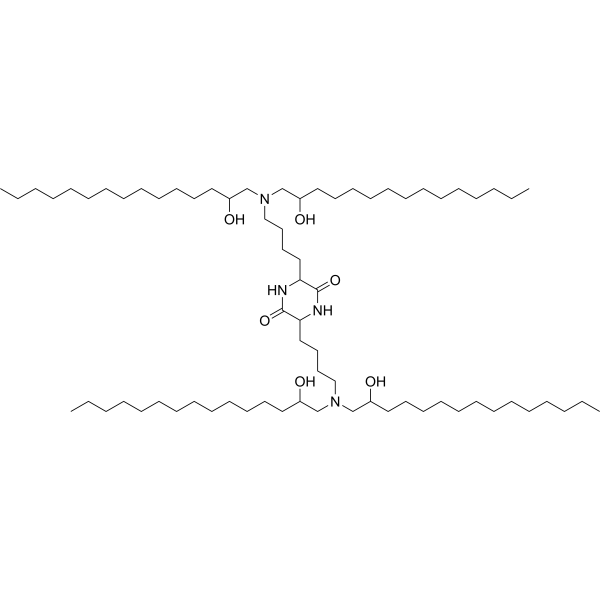 0 ImagesCat. No.: HY-160573CAS No.: 1432494-71-7cKK-E15 is a peptide-lipid that can be used to formulate LNP3 with C14PEG2000, unmodified cholesterol, and DOPE.
-
80-O18
 0 ImagesCat. No.: HY-159699CAS No.: 1638334-27-680-O18 is a lipidoid that promotes high total cellular uptake with promising delivery capabilities.
-
DSPE-SPDP
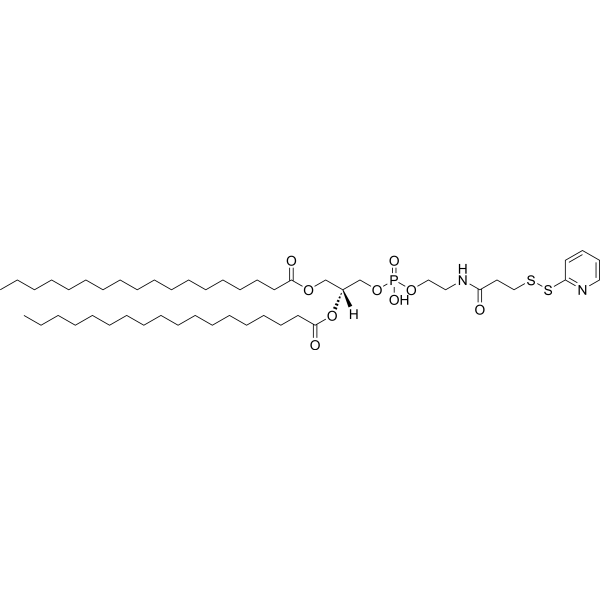 0 ImagesCat. No.: HY-W441017CAS No.: 144735-79-5DSPE-SPDP is a phospholipid molecule. DSPE-SPDP can orient itself to form lipid bilayer in water. DSPE-SPDP can be used for the research of various biochemical.
-
18:1 Caproylamine PE
 0 ImagesCat. No.: HY-W800790CAS No.: 110796-31-118:1 Caproylamine PE is a amine-functionalized lipid with a phosphoethanolamine linked to two oleic acid tails.

-
mPEG750-DMG
 0 ImagesCat. No.: HY-112764DCAS No.: 160743-62-4mPEG750-DMG is a PEGylated phospholipid containing DMG. mPEG750-DMG combines the membrane fusion capability of DMG with the stealth properties of PEG, and can be used for applications such as constructing targeted drug delivery systems and liposome preparation.
-
DSPE-PEG5000-Asp6
 0 ImagesCat. No.: HY-182092ADSPE-PEG5000-Asp6 is a PEG compound which composed of DSPE and a Asp6 peptide. DSPE-PEG5000-Asp6 achieves bone-targeted delivery of drugs or imaging agents by binding to bone tissue with the Asp6 peptide through high affinity.
-
Firefly luciferase circRNA-LNP
 0 ImagesCat. No.: HY-153230Firefly luciferase circRNA-LNP is a lipid nanoparticle (LNP) containing Firefly luciferase circRNA, suitable for assays of RNA delivery, translation efficiency, cell viability, etc. Luciferase is commonly used as a bioluminescent reporter gene for gene regulation and function studies. Firefly Luciferase circRNA will express firefly luciferase protein after entering the cells, which is often used for promoter activity detection or dual fluorescent molecular complementation experiments. Common luciferase are firefly luciferase and sea kidney luciferase.
-
1,2-PLPC
 0 ImagesCat. No.: HY-W590536CAS No.: 82765-47-7Synonyms: 1-Palmitoyl-2-Lauroyl-sn-glycero-3-Phosphatidylcholine; 1-Palmitoyl-2-Lauroyl-sn-glycero-3-Phosphocholine1,2-PLPC is a phospholipid containing palmitoyl (16:0) and lauryl (12:0) acyl substituents at the sn-1 and sn-2 positions, respectively. It can be used in the generation of micelles, liposomes, and other types of artificial membranes.
-
DSPE-PEG5000-NGR
 0 ImagesCat. No.: HY-172474DSPE-PEG5000-NGR is a PEG compound which composed of DSPE and an Asn-Gly-Arg (NGR) peptide. NGR peptide can target tumor vascular antigen CD13. DSPE-PEG5000-NGR can be used for drug delivery.



