



Molecular Glues
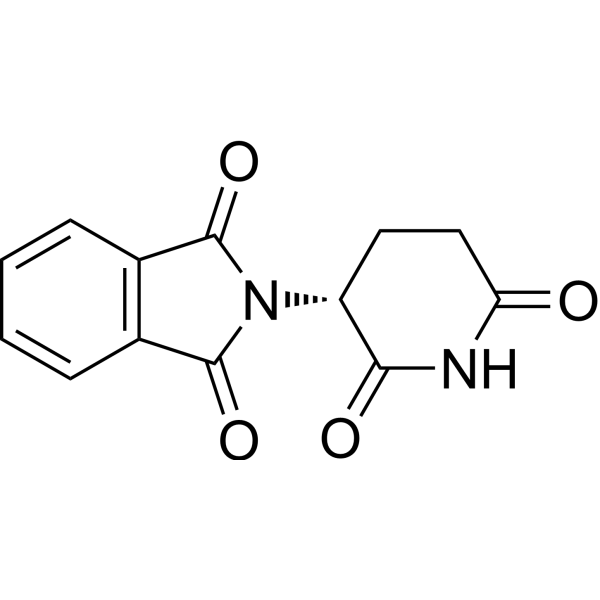
Protein degradation agents based on the ubiquitin-proteasome pathway include a part of molecular glues. Molecular glues are a class of small molecule compounds that can induce or stabilize the interaction between proteins. If one of the protein is ubiquitin ligase, molecular glue can cause another protein to undergo ubiquitin modification and degradation through the proteasome pathway, which is similar to PROTAC. However, these molecules are classified as ligand for E3 ligase as functional molecules in subsequent classification. Older drugs, thalidomide, lenalidomide, and pomalidomide, together with CC-90009 and CC-92480 reported later all belong to this category.
All Product Categories
-
Molecular Glues Related Products (347)
Related Products (347)

-
Related Compound Screening Libraries (1)
-
dWIZ-1
 0 ImagesCat. No.: HY-159098dWIZ-1 is an orally active molecular glue and chemical probe targeting the WIZ transcription factor, which based on an IMiD backbone, binding to human WIZ with an affinity of 3.5 μM. dWIZ-1 recruits WIZ to the cereblon-DDB1 complex via its ZF7 domain, thereby triggering proteasome-dependent degradation of WIZ. dWIZ-1 significantly induces fetal hemoglobin expression in erythroblasts while reducing the level of inhibitory H3K9 dimethylation at WIZ binding sites such as the β-globin locus. Meanwhile, dWIZ-1 does not affect the proliferation and differentiation of erythroblasts, and no cytotoxicity is observed in in vitro cells or cynomolgus monkey models. dWIZ-1 serves as a critical tool molecule for investigating the mechanism and underlying pathways of sickle cell disease.
-
CQ627
 0 ImagesCQ627 is a molecular glue targeting the degradation of RIOK2. It effectively induces the degradation of RIOK2 in the MOLT4 leukemia cell line via the ubiquitin-proteasome system (UPS) by recruiting the E3 ubiquitin ligase RNF126, with a DC50 value of 410 nM. CQ627 dose-dependently induces apoptosis in MOLT4 leukemia cells, blocks their cell cycle in the G2/M phase, and exhibits antiproliferative activities in various cancer cell lines. CQ627 also demonstrates in vivo anticancer activity in a MOLT4 xenograft mouse model.
-
JWZ-8-103 hydrochloride
 0 ImagesCat. No.: HY-180654APurity: 99.93%JWZ-8-103 hydrochloride is an orally active analog of PRLX-93936 (HY-119264) and a molecular glue targeting TRIM21. JWZ-8-103 hydrochloride increases the thermal stability of TRIM21. JWZ-8-103 hydrochloride promotes rapid and efficient interaction between TRIM21 and NUP98 (the apparent EC50 for ternary complex formation with the PRYSPRY domain of TRIM21 and the APD domain of NUP98 is approximately 20 μM), induces extensive ubiquitination and proteasomal degradation of numerous adjacent nucleoporins (NUPs, and thereby triggers cellular apoptosis. JWZ-8-103 hydrochloride can be used for the research of pancreatic cancer.
-
WIZ degrader 8
 0 ImagesWIZ degrader 8 (compound 10) is a potent and selective degrader of the transcription factor WIZ, which can potently induce HbF expression. WIZ degrader 8 can lead to WIZ degradation and induce HbF expression, and has the potential to be an inhibitor of sickle cell disease.
-
INNO-220
 0 ImagesINNO-220 is an orally active, CRBN-dependent molecular glue degrader targeting CK1α. INNO-220 induces cell cycle arrest at G0/G1 phase and triggers apoptosis by degrading CK1α. INNO-220 disrupts the assembly and function of the CARD11/BCL10/MALT1 complex, thereby inhibiting NF-κB signaling in stimulated T cells and lymphoma cells that harbor an activating mutation in CARD11. INNO-220 provides a new direction for lymphoma research.
-
VAV1 degrader-2
 0 ImagesVAV1 degrader-2 is a molecular glue degrader based on targeting Vav guanine nucleotide exchange factor 1 (VAV 1) with a DC50 of 4.41 nM. VAV1 degrader-2 can be used in the study of inflammatory and autoimmune diseases.
-
MS9024
 0 ImagesMS9024 is a selective DNMT1 Molecular glue degrader with a DC50 of 35 nM. MS9024 degrades DNMT1 in a concentration-, time- and proteasome-dependent manner without altering DNMT1 transcription. MS9024 mediates degradation via HECT E3 ligase and/or UHRF1, but not via lysosomes or Cullin RING E3 ligase. MS9024 can be used in the research of colorectal cancer, breast cancer and non-small cell lung cancer.
-
ABS-752 hydrochloride
 0 ImagesABS-752 hydrochloride is an orally active prodrug targeting CRBN-modulating molecular glue with selectivity in protein degradation. ABS-752 hydrochloride preferentially degrades GSPT1 and induces cytotoxicity through this degradation, while it also degrades NEK7, SALL4 and CK1α, with weaker degradation potency against CK1α. As a prodrug, ABS-752 hydrochloride requires metabolic activation to ABT-002 to form the active complex; VAP-1 mediates its conversion to an aldehyde intermediate. ABS-752 hydrochloride induces cell death, reduces cell viability, and exhibits antitumor activity, leading to regression and inhibition of tumor growth. ABS-752 hydrochloride shows no cytotoxicity in primary human hepatocytes. ABS-752 hydrochloride can be used in the research of hepatocellular carcinoma.
-
Rapamycin-13C,d3
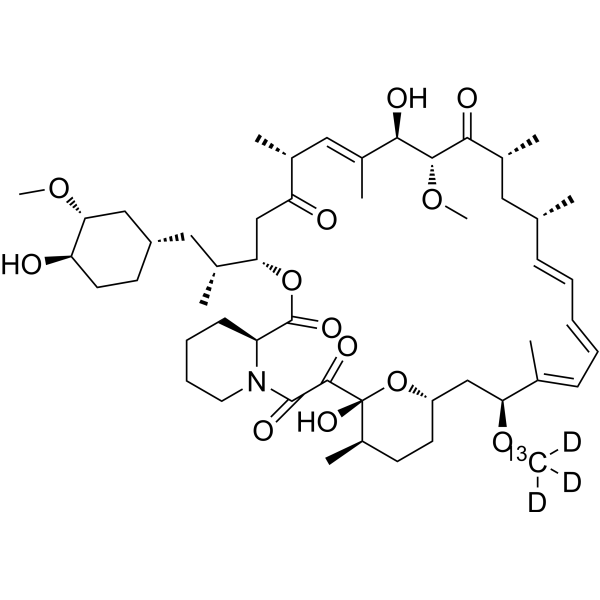 0 ImagesCat. No.: HY-10219S1Synonyms: Sirolimus-13C,d3; AY-22989-13C,d3 NSC 226080-13C,d3Rapamycin-13C,d3 (Sirolimus-13C,d3) is the 13C, deuterated-labeled Rapamycin (HY-10219). Rapamycin (Sirolimus; AY 22989) is a potent and specific blood-brain barrier-transmissible mTOR inhibitor with an IC50 of 0.1 nM in HEK293 cells. Rapamycin is a molecular glue that binds FKBP12 and mTOR proteins together, thereby inhibiting mTOR kinase activity. Rapamycin binds to FKBP12 and specifically acts as an allosteric inhibitor of mTORC1. Rapamycin is an autophagy activator, an immunosuppressant.
-
Acetyl-cyclosporin A aldehyde
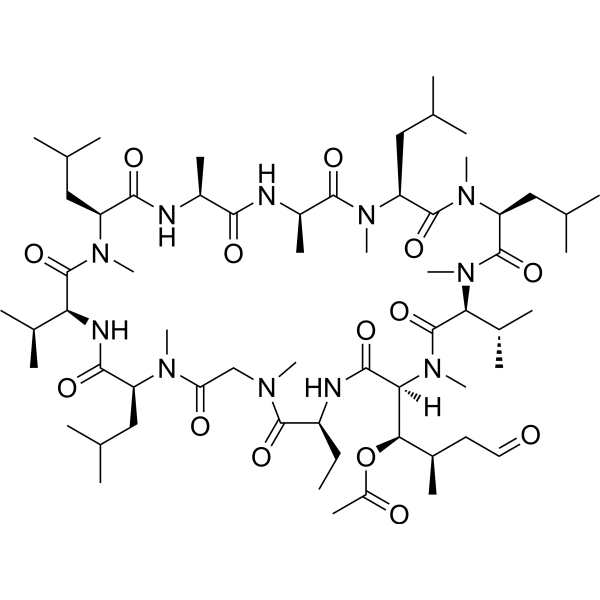 0 ImagesAcetyl-cyclosporin A aldehyde is an acetylated Cyclosporin A (HY-B0579) derivative with a reducing aldehyde group. Cyclosporin A is a potent calmodulin inhibitor and cyclophilin binder that can target the nuclear translocation of NF-AT and cause mitochondrial damage.
-
dCK1α-2
 0 ImagesSynonyms: LC-05-004dCK1α-2 is an orally active CK1α molecular glue degrader that targets p53 pathway-related targets. dCK1α-2 exhibits anti-tumor efficacy in mouse models and can increase the expression of p53-related genes..
-
BMS-986449
 0 ImagesCat. No.: HY-173630BMS-986449 is a potent and orally active CELMoD molecular glue and an IKZF2/IKZF4 degrader. BMS-986449 targets the degradation of transcription factors Helios (IKZF2) and Eos (IKZF4) in regulatory T (Treg) cells. BMS-986449 redirects the E3 ubiquitin ligase Cereblon to induce the degradation of Helios and Eos, reprogramming Treg cells and enhancing antitumor immunity. BMS-986449 is promising for research of advanced solid tumors.
-
QXG-6442
 0 ImagesQXG-6442 is a CK1α Molecular Glue Degrader. QXG-6442 exhibits CK1α degradation potency with a DC50 of 5.7 nM and a Dmax of 90%. QXG-6442 induces antiproliferative effects in MOLM-14 cell line.

-
AP-7-168
 0 ImagesAP-7-168, molecular glues, is a β-arrestin-biased negative allosteric modulator of the β2-adrenergic receptor (β2AR). AP-7-168 can promote β2AR homodimerization and inhibit GRK5-mediated β2AR phosphorylation. AP-7-168 can sustain bronchorelaxation in cell and tissue. AP-7-168 can be used for the researches of inflammation and immunology, such as asthma.

-
dGEM3
 0 ImagesCat. No.: HY-173366Purity: 99.22%dGEM3 is a selective GEMIN3 Molecular glue degrader with a DC50 of 680 nM. dGEM3 recruits GEMIN3 to the VHL E3 ligase, and mediates the targeted ubiquitination and degradation of GEMIN3 via the ubiquitin-proteasome system. dGEM3 induces extensive transcriptomic changes, including upregulation of ER stress response genes and downregulation of mRNA splicing genes. dGEM3 can be used in research related to amyotrophic lateral sclerosis, spinal muscular atrophy and neuromuscular dysfunction.
-
UNC8732 TFA
 0 ImagesUNC8732 (TFA) is a NSD2 inhibitor and degrader.
-
XYD049
 0 ImagesXYD049 is a CRBN-based molecular glue degrader targeting GSPT1, with a DC50 of 19 nM. XYD049 mediates the formation of a ternary complex between CRBN and GSPT1, thereby triggering CRBN- and proteasome-dependent degradation of GSPT1. By degrading GSPT1, XYD049 downregulates castration-resistant prostate cancer (CRPC)-related oncogenes, including BCL2, CDK2, E2F3, EGFR, HSP90B1, TMPRSS2, AR, AR-V7, PSA and c-Myc. XYD049 inhibits cancer cell growth and suppresses tumor growth in mice. XYD049 can be used for research on castration-resistant prostate cancer. XYD049 consists of a linker (black part) NH2-C5-NH-Boc (HY-W004710), a CRBN-based E3 ligase ligand (blue part) Thalidomide 4-fluoride (HY-41547), and a target protein ligand (red part) GSPT1 ligand-1 (HY-170821), among which the E3 ligase ligand plus linker forms the conjugate E3 Ligase Ligand-linker Conjugate 158 (HY-170822).



