



Molecular Glues
Protein degradation agents based on the ubiquitin-proteasome pathway include a part of molecular glues. Molecular glues are a class of small molecule compounds that can induce or stabilize the interaction between proteins. If one of the protein is ubiquitin ligase, molecular glue can cause another protein to undergo ubiquitin modification and degradation through the proteasome pathway, which is similar to PROTAC. However, these molecules are classified as ligand for E3 ligase as functional molecules in subsequent classification. Older drugs, thalidomide, lenalidomide, and pomalidomide, together with CC-90009 and CC-92480 reported later all belong to this category.
All Product Categories
-
Molecular Glues Related Products (380)
Related Products (380)

-
Related Compound Screening Libraries (1)
-
QXG-6442
 0 ImagesQXG-6442 is a CK1α Molecular Glue Degrader. QXG-6442 exhibits CK1α degradation potency with a DC50 of 5.7 nM and a Dmax of 90%. QXG-6442 induces antiproliferative effects in MOLM-14 cell line.

-
AP-7-168
 0 ImagesAP-7-168, molecular glues, is a β-arrestin-biased negative allosteric modulator of the β2-adrenergic receptor (β2AR). AP-7-168 can promote β2AR homodimerization and inhibit GRK5-mediated β2AR phosphorylation. AP-7-168 can sustain bronchorelaxation in cell and tissue. AP-7-168 can be used for the researches of inflammation and immunology, such as asthma.
-
AN5777
 0 ImagesAN5777 is a GSPT1 Molecular glue degrader with a DC50 of less than 10 μM. AN5777 degrades GSPT1 in a CRBN-dependent manner via the ubiquitin-proteasome system. AN5777 induces G1 phase arrest and Apoptosis in cancer cells. AN5777 is applicable to research related to acute myeloid leukemia, multiple myeloma, and chronic myeloid leukemia.
-
dGEM3
 0 ImagesCat. No.: HY-173366Purity: 99.22%dGEM3 is a selective GEMIN3 Molecular glue degrader with a DC50 of 680 nM. dGEM3 recruits GEMIN3 to the VHL E3 ligase, and mediates the targeted ubiquitination and degradation of GEMIN3 via the ubiquitin-proteasome system. dGEM3 induces extensive transcriptomic changes, including upregulation of ER stress response genes and downregulation of mRNA splicing genes. dGEM3 can be used in research related to amyotrophic lateral sclerosis, spinal muscular atrophy and neuromuscular dysfunction.
-
UNC8732 TFA
 0 ImagesUNC8732 (TFA) is a NSD2 inhibitor and degrader.
-
XYD049
 0 ImagesXYD049 is a CRBN-based molecular glue degrader targeting GSPT1, with a DC50 of 19 nM. XYD049 mediates the formation of a ternary complex between CRBN and GSPT1, thereby triggering CRBN- and proteasome-dependent degradation of GSPT1. By degrading GSPT1, XYD049 downregulates castration-resistant prostate cancer (CRPC)-related oncogenes, including BCL2, CDK2, E2F3, EGFR, HSP90B1, TMPRSS2, AR, AR-V7, PSA and c-Myc. XYD049 inhibits cancer cell growth and suppresses tumor growth in mice. XYD049 can be used for research on castration-resistant prostate cancer. XYD049 consists of a linker (black part) NH2-C5-NH-Boc (HY-W004710), a CRBN-based E3 ligase ligand (blue part) Thalidomide 4-fluoride (HY-41547), and a target protein ligand (red part) GSPT1 ligand-1 (HY-170821), among which the E3 ligase ligand plus linker forms the conjugate E3 Ligase Ligand-linker Conjugate 158 (HY-170822).
-
GR–14-3-3 stabilizer-1
 0 ImagesGR-14-3-3 stabilizer-1 is a molecular glue stabilizer for the protein-protein interaction between 14‑3‑3 and glucocorticoid receptor (GR), and functions by stabilizing the GR‑14‑3‑3 protein-protein interaction. GR-14-3-3 stabilizer-1 is applicable to research related to diseases such as tumors.
-
Pomalidomide-d3
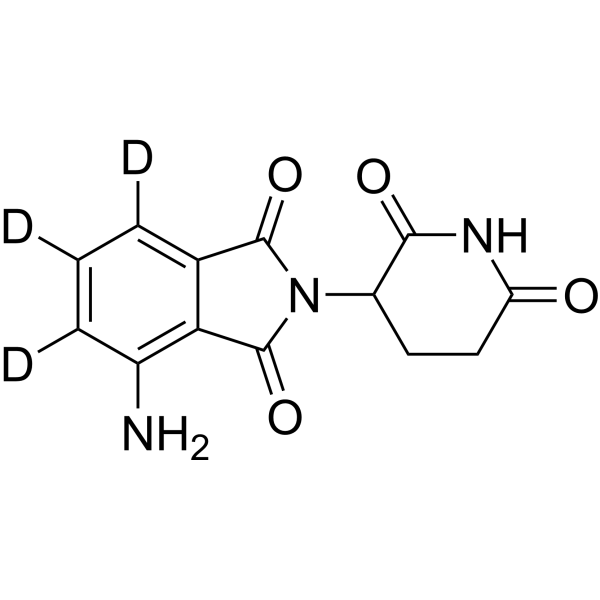 0 ImagesSynonyms: CC-4047-d3Pomalidomide-d3 is the deuterium labeled Pomalidomide. Pomalidomide, the third-generation immunomodulatory agent, acts as molecular glue. Pomalidomide interacts with the E3 ligase cereblon and induces degradation of essential Ikaros transcription factors.
-
CoREST/LSD1 degrader-1
 0 ImagesCat. No.: HY-176875Purity: 99.18%CoREST/LSD1 degrader-1 (Compound 4) is a molecular glue degrader targeting the KBTBD4 E3 ubiquitin ligase. CoREST/LSD1 degrader-1 is promising for research of KBTBD4-mutant driven cancers (e.g., medulloblastoma) and epigenetic dysregulation disorders.
-
(1S,2S,3R)-PLX-4545
 0 ImagesCat. No.: HY-159647BCAS No.: 2892066-42-9(1S,2S,3R)-PLX-4545 is the (1S,2S,3R) enantiomer of PLX-4545 (HY-159647). PLX-4545 is an orally active and selective cereblon-based molecular glue degrader of IKZF2 (zinc finger transcription factor Helios). PLX-4545 can reprogram immunosuppressive regulatory T cells into pro-inflammatory effector T cells, thereby enhancing anti-tumor immune responses.
-
MRT-23227
 0 ImagesMRT-23227 is a CRBN-recruiting molecular glue degrader targeting VAV1. MRT-23227 binds to the tryptophan triad pocket of CRBN, forms a ternary complex with the SH3c domain of VAV1, and induces proteasomal degradation of VAV1 through hydrogen-bond interactions between CRBN residues and the RT loop and side chains of VAV1. MRT-23227 can be used in the research of T-cell leukemia and lymphoma.
-
GSPT1 degrader-15
 0 ImagesCat. No.: HY-177761CAS No.: 3060504-66-4GSPT1 degrader-15 (Compound Lib-B-15O) is a potent and highly selective GSPT1 molecular gel degrader, with a DC50 of 154 nM. GSPT1 degrader-15 has almost no effect on the expression of other proteins. GSPT1 degrader-15 exhibits significant anti-proliferative activity against leukemia cells and lymphoma cells. GSPT1 degrader-15 can be used in leukemia and lymphoma research.
-
(R,R)-BMS-986397
 0 Images(R,R)-BMS-986397 is a CK1α degrader (DC50 between 0.1-0.5 pM). (R,R)-BMS-986397 can be used in anti-leukemia research.
-
Pomalidomide-d4
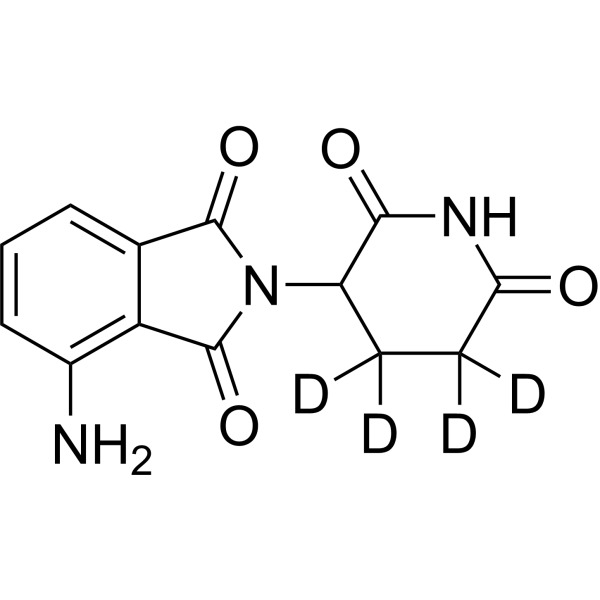 0 ImagesCat. No.: HY-10984S2CAS No.: 1416575-78-4Synonyms: CC-4047-d4Pomalidomide-d4 is the deuterium labeled Pomalidomide. Pomalidomide, the third-generation immunomodulatory agent, acts as molecular glue. Pomalidomide interacts with the E3 ligase cereblon and induces degradation of essential Ikaros transcription factors<
-
KT-333 ammonium
 0 ImagesKT-333 ammonium (Compound A) is a molecular glues that degrades STAT3 protein. KT-333 ammonium mediates the selective degradation of STAT3 through the ubiquitin-proteasome system by binding to STAT3 protein and E3 ubiquitin ligase von Hippel-Lindau protein (VHL). KT-333 ammonium has strong selectivity for STAT3 protein degradation and good antitumor activity. KT-333 ammonium can be used in the study of hematologic malignancies such as large granular lymphocytic leukemia (LGL-L), peripheral T-cell lymphoma (PTCL), and cutaneous T-cell lymphoma (CTCL).
-
BMS-986482
 0 ImagesCat. No.: HY-182467CAS No.: 3062993-48-7BMS-986482 is a CRBN-mediated IKZF1-4 (Ikaros family zinc finger 1-4) molecular glue degrader. BMS-986482's activity is driven by a non-traditional CELMoD core that selectively degrades the IKZF protein family. BMS-986482 can be used for the research of advanced solid tumors.
-
(Rac)-TNG961
 0 ImagesCat. No.: HY-183115ACAS No.: 3127008-95-8(Rac)-TNG961 is the rac isomer of TNG961 (HY-183115). TNG961 is a selective and orally active CRBN-mediated HBS1L molecular glue degrader. TNG961 induces formation of an HBS1L-TNG961-CRBN ternary complex, leading to potent degradation of HBS1L and secondary destabilization of its binding partner PELO. TNG961 can reduce HBS1L protein levels, thereby disrupting the PELO region involved in ribosome rescue. TNG961 can be used for the study of FOCAD-deficient cancers, such as pancreatic cancer.
-
(S)-CDK2 degrader 6
 0 Images(S)-CDK2 degrader 6 (Compound 8) is the S-enantiomer of CDK2 degrader 6 (HY-176444). (S)-CDK2 degrader 6 is a selective CDK2 molecular glue degrader with a DC50 of 166.7 nM in 24 h. (S)-CDK2 degrader 6 can be used for breast cancer research.
-
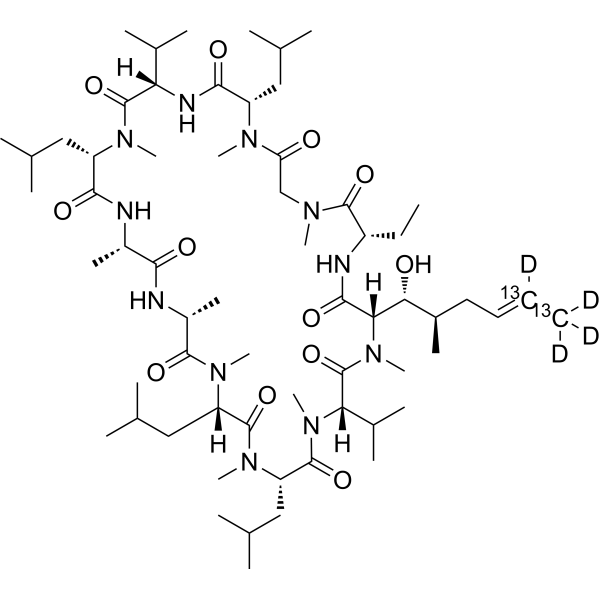
Cyclosporin A-13C2,d4
 0 ImagesCat. No.: HY-B0579S3Synonyms: Cyclosporine A-13C2,d4; Ciclosporin A-13C2,d4; CsA-13C2,d4Cyclosporin A-13C2,d4 (Cyclosporine A-13C2,d4) is the deuterated, 13C-labeled Cyclosporin A (HY-B0579). Cyclosporin A (Cyclosporine A) is an immunosuppressant which binds to the cyclophilin and inhibits phosphatase activity of protein phosphatase 2B (PP2B/calcineurin) with an IC50 of 5 nM. Cyclosporin A is a molecular glue, binds to cyclophilin and calcineurin, leading to inactivation of nuclear Factor of activated T Cells (NFAT) and a subsequent decrease in the immune response. Cyclosporin A also inhibits CD11a/CD18 adhesion.



