



CDK2 Degrader
- 1
-
PROTAC CDK2/9 Degrader-1
 0 Images
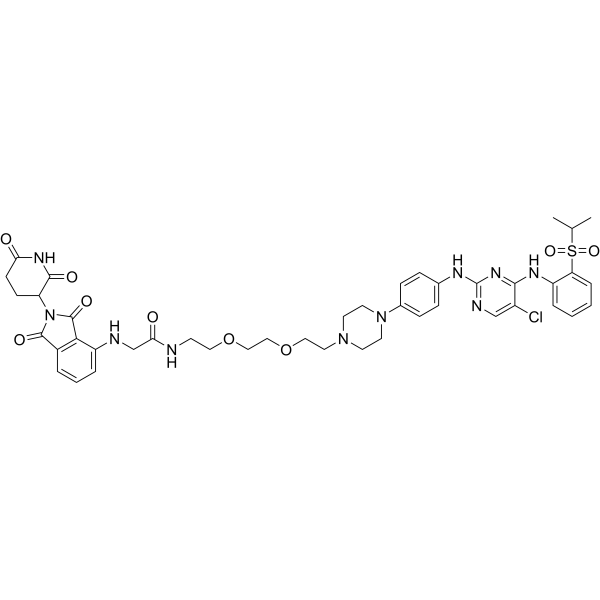
PROTAC CDK2/9 Degrader-1 (Compound F3) is a potent dual degrader for CDK2 (DC50=62 nM) and CDK9 (DC50=33 nM). PROTAC CDK2/9 Degrader-1 suppresses prostate cancer PC-3 cell proliferation (IC50=0.12 µM) by effectively blocking the cell cycle in S and G2/M phases. PROTAC CDK2/9 Degrader-1 is a PROTAC by tethering CDK inhibitor with Cereblon ligand.
-
CDK2 degrader 1
 0 Images
CDK2 degrader 1 is a selective CDK2 molecular glue degrader. CDK2 degrader 1 binds to cereblon, induces ubiquitination of CDK2 and subsequent degradation via the proteasomal pathway. CDK2 degrader 1 is applicable for cancer-related research.
-
CDK2 degrader 6
 0 Images
CDK2 degrader 6 is an orally active and potent CDK2 molecular glue degrader with a DC50 of 46.5 nM. CDK2 degrader 6 binds to cereblon and CDK2 to induce ubiquitination and subsequent proteasomal degradation of CDK2. CDK2 degrader 6 modulates cell cycle in breast cancer cells. CDK2 degrader 6 reduces proliferation of breast cancer cells. CDK2 degrader 6 exhibits in vivo antitumor activity in gastric cancer mouse models. CDK2 degrader 6 can be used for the research of breast cancer, gastric cancer.
-
PROTAC CDK2 Degrader-2
 0 Images
PROTAC CDK2 Degrader-2 is an orally active CDK2 PROTAC degrader, with DC50 values of 13 nM (MKN1cells) and 17 nM (TOV21G cells). PROTAC CDK2 Degrader-2 induces G1 phase arrest in MKN1 cells. PROTAC CDK2 Degrader-2 achieves tumor stasis in HCC1569 (CCNE1-amplified) xenograft models. PROTAC CDK2 Degrader-2 can be used for the study of CCNE1-amplified cancers.
-
CDK2 degrader 3
 0 Images
CDK2 degrader 3 is a selective CDK2 molecular glue-like degrader. CDK2 degrader 3 induces G1 cell cycle arrest in CCNE1-amplified cancer cells. CDK2 degrader 3 is applicable to breast cancer-related research.
-
TMX-2172
 0 Images
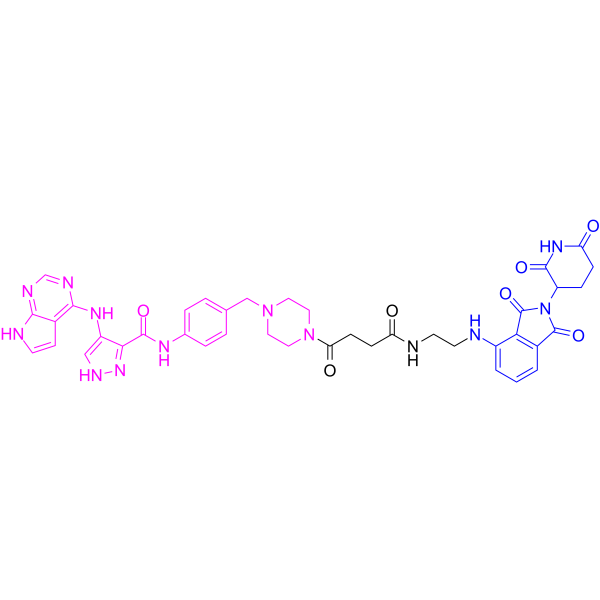
TMX-2172 is a selective bivalent cereblon-recruiting PROTAC-based dual CDK2 and CDK5 degrader with IC50 values of 6.5 nM and 6.8 nM, respectively. TMX-2172 shows selectivity for CDK2 and CDK5 over other cell cycle CDKs (CDK1, CDK4, and CDK6) and transcriptional CDKs (CDK7 and CDK9). TMX-2172 inhibits CDK2/CDK5 enzymatic activity, induces their proteasomal degradation, reduces ASCL1 protein levels and half-life, induces cancer cell death, and exerts antiproliferative effects. TMX-2172 can be used for the research of ovarian cancer and small cell lung cancer.
-
CDK2 degrader 5
 0 Images
CDK2 degrader 5 is a CRBN-binding CDK2 molecular glue degrader. CDK2 degrader 5 induces ubiquitination and subsequent proteasomal degradation of CDK2. CDK2 degrader 5 can be used for the research of cancer.
-
(R)-CDK2 degrader 6
 0 Images
(R)-CDK2 degrader 6 is the R-enantiomer of CDK2 degrader 6 (HY-176444), a cereblon-based molecular glue degrader of CDK2 with a DC50 of 27 nM. (R)-CDK2 degrader 6 induces ubiquitination and proteasomal degradation of CDK2 by bridging cereblon and CDK2. (R)-CDK2 degrader 6 is applicable for cancer research.

-
PROTAC CDK2/4/6 Degrader-2
 0 Images製品番号: HY-185121CAS 番号: 2541626-49-5
PROTAC CDK2/4/6 Degrader-2 is a CDK2/4/6 PROTAC degrader. PROTAC CDK2/4/6 Degrader-2. PROTAC CDK2/4/6 Degrader-2 can be converted into the prodrug PROTAC CDK2/4/6 Degrader-1 (HY-171826) through a one-step reaction with chloromethyl pivalate. PROTAC CDK2/4/6 Degrader-2 degrades CDK2/4/6 and their complex in malignant melanomas cells. PROTAC CDK2/4/6 Degrader-2 induces cell cycle arrest and cell apoptosis in various cancer cells, in particular for melanomas. PROTAC CDK2/4/6 Degrader-2 can be used for malignant melanomas research.
-
PROTAC FLT3/CDKs degrader-1
 0 Images
PROTAC FLT3/CDKs degrader-1 is a PROTAC degrader targeting CDKs and FLT3. PROTAC FLT3/CDKs degrader-1 degrades CDK2, CDK4, CDK6, CDK9 and FLT3 proteins via a ubiquitin-proteasome-dependent bivalent mechanism, with a DC50 of 18.73 nM against CDK2. PROTAC FLT3/CDKs degrader-1 promotes myeloid cell differentiation. PROTAC FLT3/CDKs degrader-1 inhibits leukemia cell proliferation. PROTAC FLT3/CDKs degrader-1 can be used for the research of acute myeloid leukemia.
-
TMX-2138
 0 Images
TMX-2138 is a CDK PROTAC degrader, with IC50 values against different targets as follows: CDK1 (IC50 = 8.7 nM), CDK2 (IC50 = 10.9 nM), CDK5 (IC50 = 7.0 nM), CDK4 (IC50 = 901.0 nM), CDK6 (IC50 = 465.0 nM), CDK7 (IC50 = 286.0 nM), and CDK9 (IC50 = 25.7 nM). TMX-2138 promotes the ubiquitination of CDK and induces its degradation via the proteasomal pathway. TMX-2138 can be used in ovarian cancer research.
-
CDK2 degrader 8
 0 Images製品番号: HY-178007CAS 番号: 3099145-52-2
CDK2 degrader 8 is a selective cyclin-dependent kinase 2 (CDK2) degrader. CDK2 degrader 8 can be used in studies related to CDK2 degradation and HR+ HER2- breast cancer.
-
CDK2 degrader 9
 0 Images製品番号: HY-181620
CDK2 degrader 9 (compound 1) is a CDK2-targeting Molecular Glue with selectivity for GSPT1 and CDK1. CDK2 degrader 9 promotes the ubiquitination and degradation of CDK2 via the ubiquitin ligase pathway. CDK2 degrader 9 is applicable to research related to cancer, solid tumors and hematologic malignancies.
-
FLT3/CDKs ligand-1
 0 Images製品番号: HY-161709CAS 番号: 2452019-67-7
FLT3/CDKs ligand-1 (Compound 14) is a ligand for target protein, which promotes the degradation of cyclin-dependent kinase (CDK) and the FMS-like tyrosine kinase 3 (FLT3), inhibits FLT3/CDK related proliferations and survivals of leukemia cells. LT3/CDKs ligand-1 can be used for synthesis of PROTAC FLT3/CDKs degrader-1 (HY-161708).
-
CDK2 degrader 10
 0 Images製品番号: HY-184657
CDK2 degrader 10 is an orally active, cereblon-based molecular glue degrader targeting CDK2, with a DC50 of 120 nM. CDK2 degrader 10 forms a ternary complex with cereblon and CDK2 via a non-canonical recruitment mode, thereby driving CDK2 degradation through the ubiquitin-proteasome system. CDK2 degrader 10 inhibits retinoblastoma protein phosphorylation, induces G1/S cell cycle arrest, and suppresses CDK2-dependent cell proliferation. CDK2 degrader 10 can be used in studies related to CDK2-dependent cancers.
-
CDK2 degrader 11
 0 Images製品番号: HY-187363CAS 番号: 3121124-92-0
CDK2 degrader 11 (Example 5) is a CDK2 degrader. CDK2 degrader 11 is applicable for cancer research.
-
PROTAC CDK2-pRb degrader-1
 0 Images製品番号: HY-186132CAS 番号: 3030276-48-0
PROTAC CDK2-pRb degrader-1 is an orally active PROTAC-class degrader of CDK2. PROTAC CDK2-pRb degrader-1 effectively inhibits the phosphorylation of retinoblastoma protein (Rb) at serine residues 807/811 by inducing ubiquitination and proteasomal degradation of CDK2. PROTAC CDK2-pRb degrader-1 exhibits significant activity against human cells (with EC50 values of 12 nM and 125 nM, respectively). In xenograft models, PROTAC CDK2-pRb degrader-1 effectively inhibits tumor growth and induces tumor stasis, making it suitable for research related to CCNE1-amplified cancers (such as ovarian cancer, gastric cancer, and breast cancer).
- 1



