



Reactive Oxygen Species (ROS)
Reactive oxygen species (ROS), such as superoxide anion (O2-), hydrogen peroxide (H2O2), and hydroxyl radical (HO•), consist of radical and non-radical oxygen species formed by the partial reduction of oxygen. Cellular ROS are generated endogenously during mitochondrial oxidative metabolism as well as in cellular response to xenobiotics, cytokines, and bacterial invasion.
ROS also activates MAPK pathways by the direct inhibition of MAPK phosphatases. Through PTEN, the PI3K pathway is subject to reversible redox regulation by ROS generated by growth factor stimulation. The activation of autophagy may be a cellular defense mechanism in response to ROS.
All Product Categories
-
Reactive Oxygen Species (ROS) Inhibitors
(1043)
View all products
-
Reactive Oxygen Species (ROS) Agonists
(37)
View all products
-
Reactive Oxygen Species (ROS) Antagonists
(2)
View all products
-
Reactive Oxygen Species (ROS) Activators
(506)
View all products
-
Reactive Oxygen Species (ROS) Modulators
(22)
View all products
-
Reactive Oxygen Species (ROS) MDM2 Inhibitor
(1)
View all products
-
Reactive Oxygen Species (ROS) Inducers
(621)
View all products
-
Reactive Oxygen Species (ROS) Controls
(5)
View all products
-
Reactive Oxygen Species (ROS) Substrates
(3)
View all products
-
Reactive Oxygen Species (ROS) Related Products (2767)
Related Products (2767)

-
Antibodies (8)
-
CD1530 (Standard)
 0 ImagesCat. No.: HY-108527RCAS No.: 107430-66-0CD1530 (Standard) is the analytical standard of CD1530 (HY-108527). This product is intended for research and analytical applications. CD1530 is an orally active, selective RARγ agonist and antibacterial agent. CD1530 reduces Smad1/5/8 phosphorylation and overall Smad levels. CD1530 reduces β-catenin, MMP9 protein, and ROS levels. CD1530 exhibits activities such as inhibiting heterotopic ossification, promoting Achilles tendon healing, and inhibiting muscle fatty infiltration. CD1530 can be used in the research of orthopedic diseases (such as heterotopic ossification, Achilles tendon injury), muscle diseases (such as muscle fatty infiltration-related diseases).
-
D-Ribose-L-cysteine
 0 ImagesD-Ribose-L-cysteine is an orally active cysteine analog. D-Ribose-L-cysteine improves cellular antioxidant capacity by enhancing intracellular glutathione (GSH) biosynthesis. In addition, D-Ribose-L-cysteine has a memory-enhancing effect and can reverse Scopolamine (HY-N0296)-induced memory impairment by inhibiting oxidative stress and acetylcholinesterase (AChE) activity. D-Ribose-L-cysteine can be used in the study of neurodegenerative and cardiovascular diseases.
-
Isorabaichromone
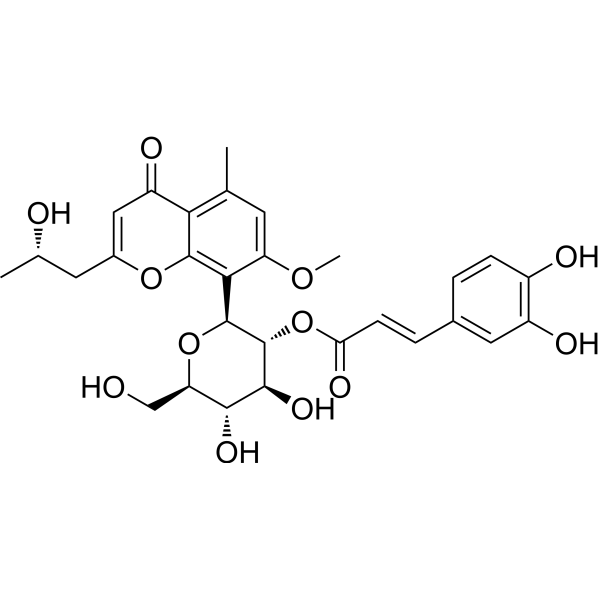 0 ImagesCat. No.: HY-N11895CAS No.: 194669-79-9Isorabaichromone is a potent antioxidant agent. Isorabaichromone shows a potent antioxidative activity and exhibits DPPH radical and superoxide anion scavenging activities.
-
L 012 sodium salt (Standard)
 0 ImagesCat. No.: HY-108537RCAS No.: 143556-24-5L 012 sodium salt (Standard) is the analytical standard of L 012 (sodium salt) (HY-108537). This product is intended for research and analytical applications. L 012 sodium salt is a luminal-based chemiluminescent probe. L 012 sodium salt can detect NADPH oxidase (Nox)-derived superoxide and nitrogen species (reactive oxygen species (ROS) and reactive nitrogen species (RNS)).
-
Moslosooflavone (Standard)
 0 ImagesMoslosooflavone (Standard) is the analytical standard of Moslosooflavone. This product is intended for research and analytical applications. Moslosooflavone is a flavonoid isolated from Andrographis paniculata. Moslosooflavone has an anti-hypoxia and anti-inflammatory activities.
-
Plastoquinone
 0 ImagesPlastoquinone (PQ-9) is a photosynthetic electron carrier as well as a redox sensor capable of regulating state transitions and gene expression. Plastoquinone transfers electrons to the cytochrome b6/f complex via the Q cycle, and participates in the establishment of the thylakoid transmembrane pH gradient. Plastoquinone can react with ROS. Plastoquinone is used in plant photosynthesis research.
-
Phthalazine (Standard)
 0 ImagesPhthalazine (Standard) is the analytical standard of Phthalazine. This product is intended for research and analytical applications. Phthalazine is a substrate for human aldehyde oxidase 1, which can lead to the production of ROS and subsequent enzyme inactivation. Phthalazine is a nitrogen-containing organic heterocyclic compound. Phthalazine exhibits antitumor activity in blood cancer, breast cancer, colon cancer, lung cancer and renal cancer.

-
1,3-Dicaffeoylquinic acid (Standard)
 0 ImagesCat. No.: HY-N1412RCAS No.: 19870-46-3Synonyms: 1,3-O-Dicaffeoylquinic acid (Standard); 1,5-Dicaffeoylquinic acid (Standard)1,3-Dicaffeoylquinic acid (Standard) is the analytical standard of 1,3-Dicaffeoylquinic acid. This product is intended for research and analytical applications. 1,3-Dicaffeoylquinic acid is a caffeoylquinic acid derivative that exhibits antioxidant activity and radical scavenging activity.
-
Trimethylamine N-oxide (Standard)
 0 ImagesTrimethylamine N-oxide (Standard) is the analytical standard of Trimethylamine N-oxide. This product is intended for research and analytical applications. Trimethylamine N-oxide is a gut microbe-dependent metabolite of dietary choline and other trimethylamine-containing nutrients. Trimethylamine N-oxide induces inflammation by activating the ROS/NLRP3 inflammasome. Trimethylamine N-oxide also accelerates fibroblast-myofibroblast differentiation and induces cardiac fibrosis by activating the TGF-β/smad2 signaling pathway.
-
TH16
 0 ImagesCat. No.: HY-175301TH16 is an antibacterial agent (MIC=2 μg/mL against methicillin-resistant Staphylococcus aureus, MRSA). TH16 disrupts bacterial cytoplasmic membrane integrity, elevating intracellular reactive oxygen species (ROS) levels to induce bacterial death. TH16 is promising for research of bacterial infection.
-
Vitamin E nicotinate
 0 ImagesCat. No.: HY-B0757CAS No.: 43119-47-7Vitamin E nicotinate is the derivative of Vitamin E. Vitamin E nicotinate exhibits antioxidant activity and prevents lipid peroxidation. Vitamin E nicotinate upregulates levels of CD4+ T cells and IL-2, exhibits immunomodulatory activity. Vitamin E nicotinate exhibits antiplatelet and antihypertensive activities, that can be used in atherosclerosis and thrombosis ressearch.
-
4',5,7,8-Tetrahydroxyflavanone
 0 ImagesCat. No.: HY-W975617CAS No.: 479-54-9Synonyms: Carthamidin4',5,7,8-Tetrahydroxyflavanone (Carthamidin) is a flavanone pigment. 4',5,7,8-Tetrahydroxyflavanone can be found in Carthamus tinctorius. 4',5,7,8-Tetrahydroxyflavanone induces ROS generation, oxidative stress, Apoptosis-mediated cell death, cell cycle arrest at G0/G1 phase, mitochondrial membrane potential collapse, and LDH leakage. 4',5,7,8-Tetrahydroxyflavanone exhibits anti-inflammatory, antioxidant, and neuroprotective effects, and acts as a reducing and capping agent for gold nanoparticles. 4',5,7,8-Tetrahydroxyflavanone can be used in breast cancer research.
-
Antimicrobial agent-41
 0 ImagesAntimicrobial agent-41 (Compound 19) is a thiazolidinedione derivative. Antimicrobial agent-41 exhibits excellent antioxidant activity (IC50 = 27.66 μg/mL). Antimicrobial agent-41 also exhibits antidiabetic activity (IC50 = 40.01 μg/mL). Antimicrobial agent-41 has antimicrobial activity again both bacterial and fungi.
-
BN80933
 0 ImagesCat. No.: HY-183944CAS No.: 214348-10-4BN80933 is a selective neuronal nitric oxide synthase (nNOS) inhibitor with a rat Ki of 0.92 μM. BN80933 inhibits lipid peroxidation, and blocks hypoxia-induced lactate dehydrogenase elevation and delayed 8-epiprostaglandin F2α elevation. BN80933 can be used for the research of stroke, and traumatic brain injury.
-
Yamogenin (Standard)
 0 ImagesYamogenin (Standard) is the analytical standard of Yamogenin. This product is intended for research and analytical applications. Yamogenin (Neodiosgenin) is a diastereomer of diosgenin. Yamogenin antagonizes the activation of the liver X receptor (LXR) in luciferase ligand assay. Yamogenin inhibits triacylglyceride (TG) accumulation through the suppression of gene expression of fatty acid synthesis in HepG2 hepatocytes. Yamogenin is a steroidal saponin that can be obtained from plant species with in vitro cytotoxicity, antioxidant, and antimicrobial properties. Yamogenin induces cell death via the extrinsic and intrinsic way of apoptosis. Yamogenin inhibits protein denaturation with an IC50 of 1421.92 μg/mL. Yamogenin can be studied in research on gastric cancer.
-
Histamine-d4
 0 ImagesCat. No.: HY-B1204S1CAS No.: 751471-48-4Synonyms: Ergamine-d4Histamine-d4 (Ergamine-d4) is deuterium labeled Histamine (HY-B1204). Histamine is the agonist for histamine receptor and a vasodilator. Histamine is an organic nitrogen compound that participates in local immune responses, regulates intestinal physiological functions, and acts as a neurotransmitter. Histamine affects p38 MAPK/Akt signaling pathway, exhibits antitumor, antioxidant and anti-inflammatory activities. Histamine can be used in the research of acute myeloid leukemia, malignant melanoma, and renal cell carcinoma.
-
Anticancer agent 260
 0 ImagesCat. No.: HY-170527CAS No.: 345994-70-9Anticancer agent 260 (Compound 3g/4d) is an orally active anticancer agent, that inhibits the proliferation of cancer cell HCT-116, MIA-PaCa2 and MDA-MB231 with IC50s of 98.7, 81.0, and 77.2 µg/mL, respectively. Anticancer agent 260 exhibits promotes ulcer formation and lipid peroxidation, anti-inflammatory and analgesic efficacy.
-
Fomesafen (Standard)
 0 ImagesCat. No.: HY-B2010RCAS No.: 72178-02-0Fomesafen (Standard) is the analytical standard of Fomesafen (HY-B2010). This product is intended for research and analytical applications. Fomesafen is an orally active herbicide. Fomesafen inhibits protoporphyrinogen oxidase (PPO). Fomesafen induces Apoptosis and increases ROS. Fomesafen exhibits developmental toxicity, immunotoxicity, and neurotoxicity. It induces precancerous lesions in the liver and hepaturoporphyria in mice. Fomesafen is used to control broadleaf weeds in soybean fields, rubber plantations, and orchards.
-
Antibacterial agent 273
 0 ImagesCat. No.: HY-173238Antibacterial Agent 273 (Compound 15e) is a membrane-targeting antimicrobial agent that disrupts bacterial cell membranes, exhibiting a MIC of 4 μg/mL against Staphylococcus aureus. By compromising membrane integrity, it induces leakage of intracellular nucleic acids and proteins, suppresses bacterial metabolic activity, and triggers the accumulation of reactive oxygen species (ROS). Antibacterial Agent 273 is suitable for research on infections caused by Staphylococcus aureus.




