



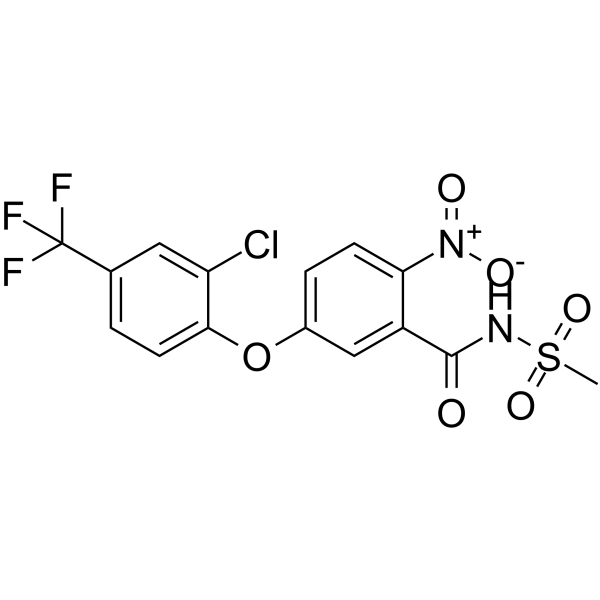
Fomesafen

Based on 1 Customer Validation
Fomesafen is an orally active herbicide. Fomesafen inhibits protoporphyrinogen oxidase (PPO). Fomesafen induces Apoptosis and increases ROS. Fomesafen exhibits developmental toxicity, immunotoxicity, and neurotoxicity. It induces precancerous lesions in the liver and hepaturoporphyria in mice. Fomesafen is used to control broadleaf weeds in soybean fields, rubber plantations, and orchards.
Nur für Forschungszwecke. Wir verkaufen nicht an Patienten.
- Reinheit : 99.81%
- CAS. Nr.: 72178-02-0
- Formel: C15H10ClF3N2O6S
- Molecular Weight:438.76
-
Speicherung:Powder -20°C, 3 years , 4°C, 2 years ; In solvent -80°C, 6 months , -20°C, 1 month

To place orders, for customer services and technical support, please contact: MedChemExpress USA
Tel: 609-228-6898 E-mail: [email protected] [email protected]


-
 Biologische Aktivität
-
Chemical Information
-
Lösungsmittel & Löslichkeit
- Protokoll
- Reinheit & Dokumentation
- Verweise
-
 Help & FAQs




Biologische Aktivität
Beschreibung
In Vitro
Fomesafen (50-300 μg/L; 3 days) causes dose-dependent meristematic cell damage in Allium cepa roots, including epidermis cell damage, flattened cell nucleus, cortex cell damage, and thickening of cortex cell wall[2].
Fomesafen (5-20 mg/L; from 6 h to 72 h post-fertilization) induces developmental toxicity, immunotoxicity, neurotoxicity, oxidative stress, and apoptosis in zebrafish embryos[3].
Fomesafen (10-500 μg/kg in artificial soil; exposure for 3-28 days) causes oxidative stress in Eisenia fetida in the early exposure stage (3-14 days), with increased ROS level, which gradually recover in the later stage (21-28 days)[6].
MedChemExpress (MCE) has not independently confirmed the accuracy of these methods. They are for reference only.
In Vivo
Fomesafen (0.23% in diet for C57BL/6J mice, 0.3% in diet for ICR mice; 14 months for C57BL/6J mice, 50 weeks for ICR mice) induces liver preneoplastic changes in mice[5].
MedChemExpress (MCE) has not independently confirmed the accuracy of these methods. They are for reference only.


Chemical Information
-
CAS. Nr. 72178-02-0
-
Appearance Solid
-
Molecular Weight 438.76
-
Formel C15H10ClF3N2O6S
-
Color White to off-white
-
SMILES
O=C(NS(=O)(C)=O)C1=CC(OC2=CC=C(C(F)(F)F)C=C2Cl)=CC=C1[N+]([O-])=O
-
Versand
Room temperature in continental US; may vary elsewhere.
-
Speicherung
Powder -20°C 3 years 4°C 2 years In solvent -80°C 6 months -20°C 1 month


Lösungsmittel & Löslichkeit
In Vitro:
DMSO : 100 mg/mL (227.92 mM; Need ultrasonic; Hygroscopic DMSO has a significant impact on the solubility of product, please use newly opened DMSO)
Please refer to the solubility information to select the appropriate solvent. Once prepared, please aliquot and store the solution to prevent product inactivation from repeated freeze-thaw cycles.
Storage method and period of stock solution: -80°C, 6 months; -20°C, 1 month. When stored at -80°C, please use it within 6 months. When stored at -20°C, please use it within 1 month.
Please refer to the solubility information to select the appropriate solvent. Once prepared, please aliquot and store the solution to prevent product inactivation from repeated freeze-thaw cycles.
Storage method and period of stock solution: -80°C, 6 months; -20°C, 1 month. When stored at -80°C, please use it within 6 months. When stored at -20°C, please use it within 1 month.
Konzentration (Stammlösung) × Volumen (Stammlösung) = Konzentration (Ziellösung) × Volumen (Ziellösung)
In Vivo:
Select the appropriate dissolution method based on your experimental animal and administration route.
- For the following dissolution methods, please ensure to first prepare a clear stock solution using an In Vitro approach and then sequentially add co-solvents:
- To ensure reliable experimental results, the clarified stock solution can be appropriately stored based on storage conditions. As for the working solution for In Vivo experiments, it is recommended to prepare freshly and use it on the same day.
- The percentages shown for the solvents indicate their volumetric ratio in the final prepared solution. If precipitation or phase separation occurs during preparation, heat and/or sonication can be used to aid dissolution.
Add each solvent one by one: 10% DMSO 40% PEG300 5% Tween-80 45% Saline
Solubility: ≥ 2.5 mg/mL (5.70 mM); Clear solution
This protocol yields a clear solution of ≥ 2.5 mg/mL (saturation unknown).
Taking 1 mL working solution as an example, add 100 μL DMSO stock solution (25.0 mg/mL) to 400 μL PEG300, and mix evenly; then add 50 μL Tween-80 and mix evenly; then add 450 μL Saline to adjust the volume to 1 mL.
Preparation of Saline: Dissolve 0.9 g sodium chloride in ddH₂O and dilute to 100 mL to obtain a clear Saline solution.
Add each solvent one by one: 10% DMSO 90% (20% SBE-β-CD in Saline)
Solubility: ≥ 2.5 mg/mL (5.70 mM); Clear solution
This protocol yields a clear solution of ≥ 2.5 mg/mL (saturation unknown).
Taking 1 mL working solution as an example, add 100 μL DMSO stock solution (25.0 mg/mL) to 900 μL 20% SBE-β-CD in Saline, and mix evenly.
Preparation of 20% SBE-β-CD in Saline (4°C, storage for one week): 2 g SBE-β-CD powder is dissolved in 10 mL Saline, completely dissolve until clear.
In Vivo Dissolution Calculator
Please enter the basic information of animal experiments:
-
-
-
-
Recommended: Prepare an additional quantity of animals to account for potential losses during experiments.
Please enter your animal formula composition:
-
%DMSO +
Recommended: Keep the proportion of DMSO in working solution below 2% if your animal is weak.
-
%+
-
+%Tween-80 + +
-
%Saline +
The co-solvents required include: DMSO, . All of co-solvents are available by MedChemExpress (MCE). , Tween 80. All of co-solvents are available by MedChemExpress (MCE).
Working solution concentration: 0.22 mg/mL
Method for preparing stock solution: mg drug dissolved in μL DMSO. Stock solution concentration: mg/mL.
1. Take μL DMSO stock solution;
2. Add μL .
μL , mix evenly;
3. Then add μL Tween 80, mix evenly;
4. Then add μL
Please ensure that the stock solution in the first step is dissolved to a clear state, and add co-solvents in sequence. You can use ultrasonic heating (ultrasonic cleaner, recommended frequency 20-40 kHz), vortexing, etc. to assist dissolution.


Reinheit & Dokumentation
-
Data Sheet (276 KB)
-
SDS (392 KB)
- English - EN (392 KB)
- Français - FR (392 KB)
- Deutsch - DE (392 KB)
- Norwegian - NO (392 KB)
- Español - ES (392 KB)
- Swedish - SV (392 KB)
- Italian - IT (392 KB)
- Korean - KR (392 KB)
- Portuguese - PT (392 KB)
-
Handling Instructions (2659 KB)
Verweise
[1]. Li-Xia Zhao, et al. Novel Thiazole Phenoxypyridine Derivatives Protect Maize From Residual Pesticide Injury Caused by PPO-Inhibitor Fomesafen. Biomolecules. 2019 Sep 20;9(10):514. [Content Brief]
[2]. MACAR O, et al. FOMESAFEN-INDUCED MERISTEMATIC CELL DAMAGES IN ALLIUM CEPA L.(ONION)[J].
[3]. Xu Z, et al. Effect of fomesafen on the embryonic development of zebrafish. Chemosphere. 2020 Nov;259:127380. [Content Brief]
[4]. Krijt J, et al. Experimental hepatic uroporphyria induced by the diphenyl-ether herbicide fomesafen in male DBA/2 mice. Toxicol Appl Pharmacol. 2003 May 15;189(1):28-38. [Content Brief]
[5]. Krijt J, et al. Liver preneoplastic changes in mice treated with the herbicide fomesafen. Hum Exp Toxicol. 1999 May;18(5):338-44. [Content Brief]
[6]. Zhang Q, et al. Oxidative stress and lipid peroxidation in the earthworm Eisenia fetida induced by low doses of fomesafen. Environ Sci Pollut Res Int. 2013 Jan;20(1):201-8. [Content Brief]


Complete Stock Solution Preparation Table
Please refer to the solubility information to select the appropriate solvent. Once prepared, please aliquot and store the solution to prevent product inactivation from repeated freeze-thaw cycles.
Storage method and period of stock solution: -80°C, 6 months; -20°C, 1 month. When stored at -80°C, please use it within 6 months. When stored at -20°C, please use it within 1 month.
| Optional Solvent | Concentration Solvent Mass | 1 mg | 5 mg | 10 mg | 25 mg |
|---|---|---|---|---|---|
| DMSO | 1 mM | 2.2792 mL | 11.3958 mL | 22.7915 mL | 56.9788 mL |
| 5 mM | 0.4558 mL | 2.2792 mL | 4.5583 mL | 11.3958 mL | |
| 10 mM | 0.2279 mL | 1.1396 mL | 2.2792 mL | 5.6979 mL | |
| 15 mM | 0.1519 mL | 0.7597 mL | 1.5194 mL | 3.7986 mL | |
| 20 mM | 0.1140 mL | 0.5698 mL | 1.1396 mL | 2.8489 mL | |
| 25 mM | 0.0912 mL | 0.4558 mL | 0.9117 mL | 2.2792 mL | |
| 30 mM | 0.0760 mL | 0.3799 mL | 0.7597 mL | 1.8993 mL | |
| 40 mM | 0.0570 mL | 0.2849 mL | 0.5698 mL | 1.4245 mL | |
| 50 mM | 0.0456 mL | 0.2279 mL | 0.4558 mL | 1.1396 mL | |
| 60 mM | 0.0380 mL | 0.1899 mL | 0.3799 mL | 0.9496 mL | |
| 80 mM | 0.0285 mL | 0.1424 mL | 0.2849 mL | 0.7122 mL | |
| 100 mM | 0.0228 mL | 0.1140 mL | 0.2279 mL | 0.5698 mL |


Fomesafen Related Classifications
HY-B2010 Related Classifications
 Powered by Bioz