



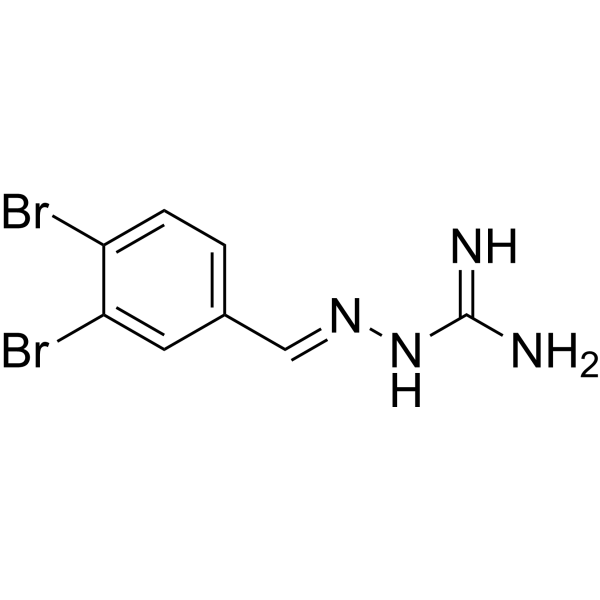
AC-263093 free base

Based on 1 Customer Validation
AC-263093 free base (AC-093) is a NPFFR2 agonist and a NPFFR1 functional antagonist, with pKi values of 6.9 and 7.0, respectively. AC-263093 free base selectively activates NPFFR2 (and inhibits NPFFR1) coupled to Gai/o proteins, thereby inhibiting adenylyl cyclase to reduce cAMP production. AC-263093 free base can be used for research on depression and anxiety-like disorders, inflammatory and neuropathic pain, and opioid tolerance.
연구목적의 판매만을 진행합니다. 환자를 대상으로 한 판매는 하지 않습니다.
- Purity : 99.66%
- CAS No.: 849459-86-5
- 화학식: C8H8Br2N4
- 분자량:319.98
-
보관:Powder -20°C, 3 years , 4°C, 2 years ; In solvent -80°C, 6 months , -20°C, 1 month

To place orders, for customer services and technical support, please contact: MedChemExpress USA
Tel: 609-228-6898 E-mail: [email protected] [email protected]


-
 Biological Activity
-
Chemical Information
-
용액&용해도
- 순도&문서
- References
-
 Help & FAQs




Biological Activity
제품 설명
IC50 & Target
[3]|
NPFF1-R 3320 nM (Ki) |
NPFF2-R 1296 nM (Ki) |
Cellular Effect
|
Cell Line

|
Type | Value | Description | References |
|---|---|---|---|---|
| COS-1 | EC50 |
2195 nM
Compound: AC-093
|
Agonist activity at human NPFF2 receptor expressed in COS1 cells assessed as [3H]inositol phosphate accumulation after 2 hrs by liquid scintillation counting
Agonist activity at human NPFF2 receptor expressed in COS1 cells assessed as [3H]inositol phosphate accumulation after 2 hrs by liquid scintillation counting
|
[PMID: 22708927] |
| COS-1 | EC50 |
527 nM
Compound: AC-093
|
Agonist activity at human NPFF1 receptor expressed in COS1 cells assessed as [3H]inositol phosphate accumulation after 2 hrs by liquid scintillation counting
Agonist activity at human NPFF1 receptor expressed in COS1 cells assessed as [3H]inositol phosphate accumulation after 2 hrs by liquid scintillation counting
|
[PMID: 22708927] |
In Vitro
AC-263093 (AC-093 hydrochloride) (1 μM; 15 min) inhibits Forskolin (HY-15371)-stimulated cAMP production in mRPTCs (mouse renal proximal tubule cells)[1].
AC-263093 (0.1 μM; 30 min) attenuates the stimulation of intracellular cAMP concentration by Fenoldopam (HY-B0735A) in hRPTCs (human renal proximal tubule cells)[1].
AC-263093 binds to human NPFFR2 and NPFFR1 with Ki values of 1296 nM and 3320 nM, respectively, and in a cAMP functional assay, it has a pEC50 of 5.2 for NPFFR2 with an efficacy of 78%[3].
AC-263093 is a full agonist of the recombinant human FF2 receptor in NIH-3T3 cells with a pEC50 of 5.9, and shows very low intrinsic efficacy at the human FF1 receptor (12% at 6 μM)[3].
AC-263093 has full efficacy at recombinant human FF2 receptors in HEK-293T cells, with a pEC50 of 5.2, and shows only weak agonist activity at human FF1 receptors (23% at 30 μM)[3].
AC-263093 binds human NPFFR1 and NPFFR2 with approximately equal affinity in radioligand binding assays (pKi = 7.0 and 6.9, respectively)[5].
AC-263093 (5 µM) functionally inhibits NPFFR1 in NIH/3T3 cells transfected with NPFFR1, completely abolishing 1 µM NPAF-induced β-galactosidase activity[5].
MedChemExpress (MCE) has not independently confirmed the accuracy of these methods. They are for reference only. .
In Vivo
AC-263093 (20 mg/kg; i.p.; once daily; 20 days) increased immobility time in the tail suspension test, induced anhedonic responses to sucrose, elicited anxiety-like behavior in the elevated plus maze, and decreased hippocampal GR and MR protein levels in wild-type C57BL/6 mouse models[2].
AC-263093 (10 mg/kg; i.p.; single administration; 15 min before formalin injection) selectively reduces formalin-induced phase 2 flinching behavior in rats[3].
AC-263093 (1-10 mg/kg; i.p.; single administration) dose- and time-dependently attenuated thermal hyperalgesia in the Carrageenan (HY-125474)-induced inflammatory thermal hyperalgesia model in SD rats[3].
AC-263093 (1-30 mg/kg; i.p.; single administration) dose-dependently reversed SNL-induced mechanical hypersensitivity in rats[3].
MedChemExpress (MCE) has not independently confirmed the accuracy of these methods. They are for reference only.
-
Animal Model:C57BL/6 (male)[2]
-
Dosage:30 mg/kg
-
Administration:i.p.; single dose; 1 h before behavioral tests
-
Result:Prominently up-regulated blood CORT and ACTH levels.
-
Animal Model:C57BL/6 (male)[2]
-
Dosage:20 mg/kg
-
Administration:i.p.; once daily; for 20 consecutive days
-
Result:After 20 days of AC-263093 administration, TST immobility time was enhanced, whereas FST immobility time was not altered.
Chronic AC-263093-exposed mice showed an anhedonic response to sucrose solution, with lower sucrose consumption and lower sucrose/water consumption ratio than control.
In the EPM, chronic AC-263093-exposed mice displayed anxiety-like behavior, with changes in time spent in open arms, time spent in closed arms, and open-arm entries.
Persistently increased serum CORT and decreased hippocampal GR and MR protein levels compared with control.
-
Animal Model:Sprague-Dawley (male, 150-300 g)[3]
-
Dosage:10 mg/kg
-
Administration:i.p.; single dose; 15 min before formalin injection
-
Result:Intraperitoneal administration of 10 mg/kg AC-263093 selectively inhibited flinching behavior in phase 2 (11-60 min) of the formalin test.
The phase 2 value obtained was 213.3 flinches.


Chemical Information
-
CAS No. 849459-86-5
-
Appearance Solid
-
분자량 319.98
-
화학식 C8H8Br2N4
-
Color White to off-white
-
SMILES
BrC1=CC=C(/C=N/NC(N)=N)C=C1Br
-
Synonyms
AC-093
-
선적
Room temperature in continental US; may vary elsewhere.
-
보관
Powder -20°C 3 years 4°C 2 years In solvent -80°C 6 months -20°C 1 month


용액&용해도
In Vitro:
DMSO : 125 mg/mL (390.65 mM; Need ultrasonic; Hygroscopic DMSO has a significant impact on the solubility of product, please use newly opened DMSO)
Please refer to the solubility information to select the appropriate solvent. Once prepared, please aliquot and store the solution to prevent product inactivation from repeated freeze-thaw cycles.
Storage method and period of stock solution: -80°C, 6 months; -20°C, 1 month. When stored at -80°C, please use it within 6 months. When stored at -20°C, please use it within 1 month.
Please refer to the solubility information to select the appropriate solvent. Once prepared, please aliquot and store the solution to prevent product inactivation from repeated freeze-thaw cycles.
Storage method and period of stock solution: -80°C, 6 months; -20°C, 1 month. When stored at -80°C, please use it within 6 months. When stored at -20°C, please use it within 1 month.
Concentration (start) × Volume (start) = Concentration (final) × Volume (final)
In Vivo:
The following protocol is derived from the literature and is for reference only. It is recommended to first try a small sample.
In Vivo Dissolution Calculator
Please enter the basic information of animal experiments:
-
-
-
-
Recommended: Prepare an additional quantity of animals to account for potential losses during experiments.
Working solution concentration: 0.22 mg/mL


순도&문서
-
Data Sheet (284 KB)
-
SDS (251 KB)
- English - EN (251 KB)
- Français - FR (251 KB)
- Deutsch - DE (251 KB)
- Norwegian - NO (251 KB)
- Español - ES (251 KB)
- Swedish - SV (251 KB)
- Italian - IT (251 KB)
- Korean - KR (251 KB)
- Portuguese - PT (251 KB)
-
Handling Instructions (2659 KB)
References


Complete Stock Solution Preparation Table
Please refer to the solubility information to select the appropriate solvent. Once prepared, please aliquot and store the solution to prevent product inactivation from repeated freeze-thaw cycles.
Storage method and period of stock solution: -80°C, 6 months; -20°C, 1 month. When stored at -80°C, please use it within 6 months. When stored at -20°C, please use it within 1 month.
| Optional Solvent | Concentration Solvent Mass | 1 mg | 5 mg | 10 mg | 25 mg |
|---|---|---|---|---|---|
| DMSO | 1 mM | 3.1252 mL | 15.6260 mL | 31.2520 mL | 78.1299 mL |
| 5 mM | 0.6250 mL | 3.1252 mL | 6.2504 mL | 15.6260 mL | |
| 10 mM | 0.3125 mL | 1.5626 mL | 3.1252 mL | 7.8130 mL | |
| 15 mM | 0.2083 mL | 1.0417 mL | 2.0835 mL | 5.2087 mL | |
| 20 mM | 0.1563 mL | 0.7813 mL | 1.5626 mL | 3.9065 mL | |
| 25 mM | 0.1250 mL | 0.6250 mL | 1.2501 mL | 3.1252 mL | |
| 30 mM | 0.1042 mL | 0.5209 mL | 1.0417 mL | 2.6043 mL | |
| 40 mM | 0.0781 mL | 0.3906 mL | 0.7813 mL | 1.9532 mL | |
| 50 mM | 0.0625 mL | 0.3125 mL | 0.6250 mL | 1.5626 mL | |
| 60 mM | 0.0521 mL | 0.2604 mL | 0.5209 mL | 1.3022 mL | |
| 80 mM | 0.0391 mL | 0.1953 mL | 0.3906 mL | 0.9766 mL | |
| 100 mM | 0.0313 mL | 0.1563 mL | 0.3125 mL | 0.7813 mL |


AC-263093 free base Related Classifications
HY-124680 Related Classifications
 Powered by Bioz