



AChE-IN-29
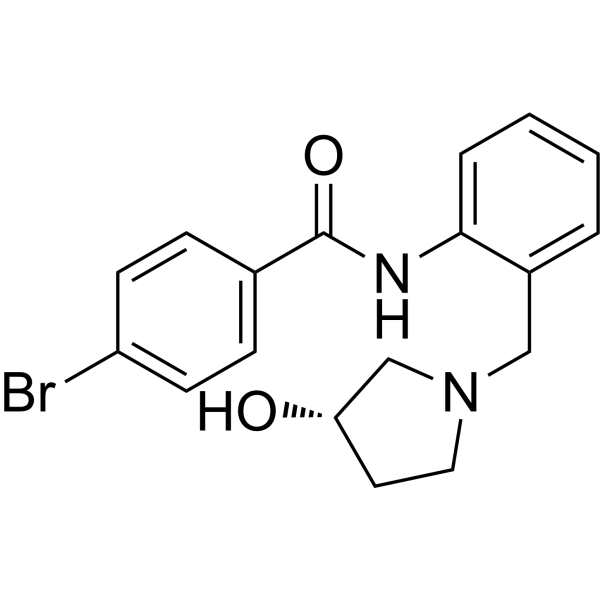
AChE-IN-29, 3-OH pyrrolidine derivative, is an cholinesterase (ChE) inhibitor. AChE-IN-29 has cholinesterase inhibitory activity for hAChE, eeAChE and eqBChE with IC50 values of 0.25 μM, 0.23 μM and 0.72 μM, respectively. AChE-IN-29 can be used for the research of Alzheimer's disease.
For research use only. We do not sell to patients.
- CAS No.: 3041113-91-8
- Formula: C18H19BrN2O2
- Molecular Weight:375.26
-
Storage:
Please store the product under the recommended conditions in the Certificate of Analysis.

To place orders, for customer services and technical support, please contact: MedChemExpress USA
Tel: 609-228-6898 E-mail: [email protected] [email protected]


-
 Biological Activity
-
Chemical Information
- Protocols
- Purity & Documentation
- References
-
 Help & FAQs




Biological Activity
Description
IC50 & Target
IC50: 0.25 μM (hAChE); 0.23 μM (eeAChE); eqBChE (0.72 μM); 24.12 μM (in DPPH assay)[1]
In Vitro
AChE-IN-29 (VA10) can effectively inhibit the AChE, BChE and Aβ1-42[1].
AChE-IN-29 has Cholinesterase inhibitory activity for hAChE, eeAChE and eqBChE with IC50 values of 0.25 μM, 0.23 μM and 0.72 μM, respectively[1].
AChE-IN-29 has significant antioxidant activity with IC50 value of 24.12 μM in DPPH assay[1].
AChE-IN-29 (5 μM, 10 μM, 20 μM) can inhibit self-induced Aβ1-42 aggregation as well as hAChE-induced Aβ1-42 aggregation[1].
MedChemExpress (MCE) has not independently confirmed the accuracy of these methods. They are for reference only. Further protocols information, click here.
-
Cell Line:SH-SY5Y cells
-
Concentration:5, 10, and 20 μM
-
Incubation Time:72 h
-
Result:Reduced the Aβ1-42 aggregation and showed no toxic effects on tested cell line (SH-SY5Y).
In Vivo
AChE-IN-29 (p.o.; 10 mg/kg) recovers cell density in hippocampus region[1].
MedChemExpress (MCE) has not independently confirmed the accuracy of these methods. They are for reference only.
-
Animal Model:Male Wistar rats (200 ± 15 g)[1]
-
Dosage:2.5, 5, and 10 mg/kg
-
Administration:p.o.; once a day for seven days
-
Result:Improved cognition and memory in the scopolamine-induced cholinergic deficit.
Restoresd the neuronal cells and can inhibit neuronal toxicity in AD conditions.


Chemical Information
-
CAS No. 3041113-91-8
-
Molecular Weight 375.26
-
Formula C18H19BrN2O2
-
SMILES
O=C(C1=CC=C(C=C1)Br)NC2=CC=CC=C2CN3CC[C@@H](C3)O
-
Shipping
Room temperature in continental US; may vary elsewhere.
-
Storage
Please store the product under the recommended conditions in the Certificate of Analysis.

Protocols
-
Cell Cytotoxicity Assay
Cytotoxicity assays are usually based on the assessment of cell membrane damage, which can also be indirectly detected by measuring cell viability. Detection methods include MTT assay, CKK-8 assay, LDH assay and ATP assay, etc.
-
Alzheimer’s Disease Modeling
Alzheimer’s Disease (AD) is a neurodegenerative disorder characterized by a progressive decline in cognitive functions and loss of specific types of neurons and synapses. Alzheimer's symptoms can be simulated in mice by injecting drugs (such as Aβ) or genetically modified.


Purity & Documentation
References

Calculators
Concentration (start) × Volume (start) = Concentration (final) × Volume (final)


AChE-IN-29 Related Classifications
HY-149817 Related Classifications
 Powered by Bioz