



Acotiamide hydrochloride

Based on 1 Customer Validation
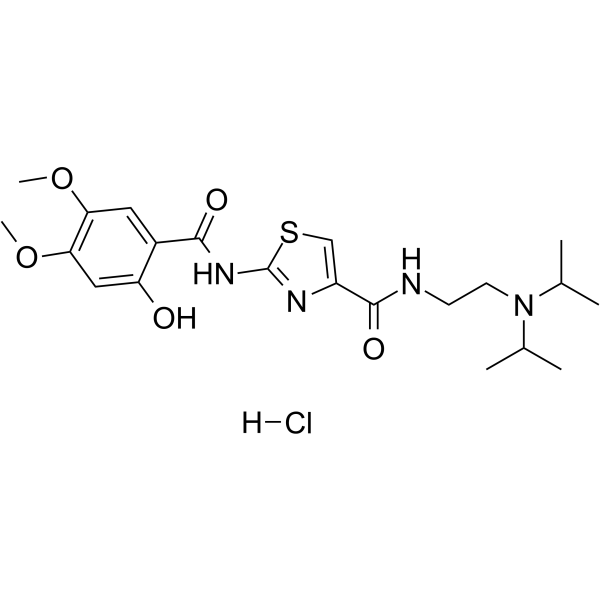
Acotiamide hydrochloride is an orally active, selective and reversible acetylcholinesterase (AChE) inhibitor, with an IC50 of 1.79 μM. Acotiamide hydrochloride can enhance gastric contractility and accelerate delayed gastric emptying. Acotiamide hydrochloride has the potential for the research of functional dyspepsia involving gastric motility dysfunction and intestinal inflammatory.
Nur für Forschungszwecke. Wir verkaufen nicht an Patienten.
- Reinheit : 99.62%
- CAS. Nr.: 185104-11-4
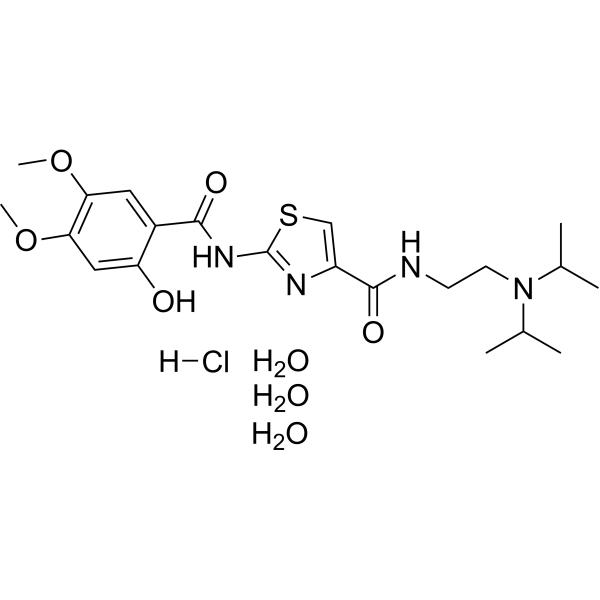
- Formel: C21H31ClN4O5S
- Molecular Weight:487.01
-
Speicherung:
4°C, sealed storage, away from moisture
* In solvent : -80°C, 6 months; -20°C, 1 month (sealed storage, away from moisture)

To place orders, for customer services and technical support, please contact: MedChemExpress USA
Tel: 609-228-6898 E-mail: [email protected] [email protected]


-
 Biologische Aktivität
-
Chemical Information
- Reinheit & Dokumentation
- Verweise
-
 Help & FAQs




Biologische Aktivität
Beschreibung
IC50 & Target
IC50: 1.79 μM (AChE)[3].
In Vitro
Acotiamide hydrochloride (10, 30, 100 μM; 1 hour) reduces expression levels of IκB-α phosphorylation in LPS- and MCP-1-stimulated macrophage cell lines[1].
MedChemExpress (MCE) has not independently confirmed the accuracy of these methods. They are for reference only. .
-
Cell Line:NR8383, macrophage
-
Concentration:10, 30, 100 μM
-
Incubation Time:1 hour
-
Result:Significantly reduced both TNF-α and IL-6 productions in LPS/MCP-1-stimulated NR8383 cells.
In Vivo
Acotiamide hydrochloride (0.83 mg/kg; i.v.; once) inhibits AChE in rat stomach with an IC50 value of 1.79 μM[3].
MedChemExpress (MCE) has not independently confirmed the accuracy of these methods. They are for reference only.
-
Animal Model:Male mongrel dogs (9-11 kg), Male beagle dogs (9.6-12.9 kg)[2]
-
Dosage:0.3, 1, 3, 10, 30 mg/kg
-
Administration:Intravenous injection; once.
-
Result:Increased the postprandial gastric motility.
-
Animal Model:Male Sprague-Dawley rats (aged 6-7 weeks)[3].
-
Dosage:0.83 mg/kg
-
Administration:Intravenous injection; once.
-
Result:Effectively improved functional dyspepsia by inhibiting AChE in rat stomach.


Chemical Information
-
CAS. Nr. 185104-11-4
-
Appearance Solid
-
Molecular Weight 487.01
-
Formel C21H31ClN4O5S
-
Color White to off-white
-
SMILES
O=C(C1=CSC(NC(C2=CC(OC)=C(OC)C=C2O)=O)=N1)NCCN(C(C)C)C(C)C.[H]Cl
-
Synonyms
Z-338; YM443
-
Versand
Room temperature in continental US; may vary elsewhere.
-
Speicherung
4°C, sealed storage, away from moisture
* In solvent : -80°C, 6 months; -20°C, 1 month (sealed storage, away from moisture)


Reinheit & Dokumentation
-
Data Sheet (273 KB)
-
SDS (393 KB)
- English - EN (393 KB)
- Français - FR (393 KB)
- Deutsch - DE (393 KB)
- Norwegian - NO (393 KB)
- Español - ES (393 KB)
- Swedish - SV (393 KB)
- Italian - IT (393 KB)
- Korean - KR (393 KB)
- Portuguese - PT (393 KB)
-
Handling Instructions (2659 KB)
Verweise
[1]. Kazuyoshi Y oshii, et al. Physiologically-Based Pharmacokinetic and Pharmacodynamic Modeling for the Inhibition of Acetylcholinesterase by Acotiamide, A Novel Gastroprokinetic Agent for the Treatment of Functional Dyspepsia, in Rat Stomach. Pharmaceutical [Content Brief]
[2]. Hiroshi Yamawaki, et al. Acotiamide attenuates central urocortin 2-induced intestinal inflammatory responses, and urocortin 2 treatment reduces TNF-α productions in LPS-stimulated macrophage cell lines. Neurogastroenterol Motil. 2020 Aug;32(8):e13813. [Content Brief]
[3]. Matsunaga Y, Acotiamide hydrochloride (Z-338), a new selective acetylcholinesterase inhibitor, enhances gastric motility without prolonging QT interval in dogs: comparison with cisapride, itopride, and mosapride. J Pharmacol Exp Ther. 2011 Mar;336(3):791- [Content Brief]

Calculators
Konzentration (Stammlösung) × Volumen (Stammlösung) = Konzentration (Ziellösung) × Volumen (Ziellösung)


Acotiamide hydrochloride Related Classifications
HY-121467A Related Classifications
 Powered by Bioz