



AhR modulator-1
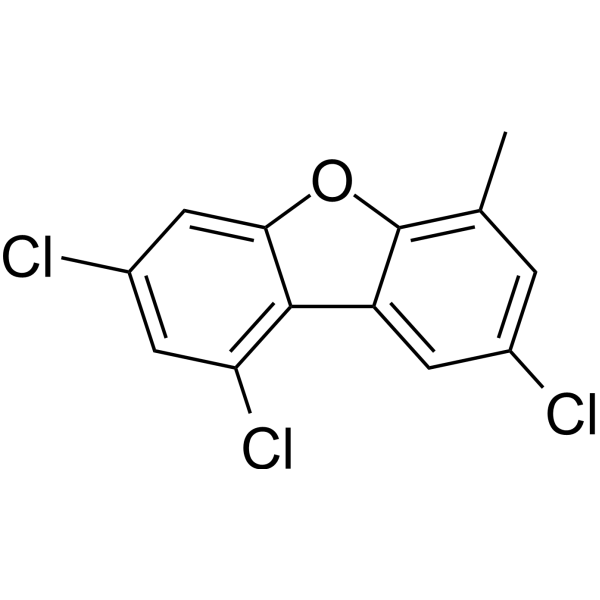
AhR modulator-1 (compound 6-MCDF) is a selective and orally active aryl hydrocarbon receptor (AhR) modulator. AhR modulator-1 inhibits metastasis, in part, by inhibiting prostatic VEGF production prior to tumor formation. AhR modulator-1 also possess anti-estrogenic properties in rat uterus.
Nur für Forschungszwecke. Wir verkaufen nicht an Patienten.
- CAS. Nr.: 118174-38-2
- Formel: C13H7Cl3O
- Molecular Weight:285.55
-
Speicherung:
Please store the product under the recommended conditions in the Certificate of Analysis.

To place orders, for customer services and technical support, please contact: MedChemExpress USA
Tel: 609-228-6898 E-mail: [email protected] [email protected]


-
 Biologische Aktivität
-
Chemical Information
- Protokoll
- Reinheit & Dokumentation
- Verweise
-
 Help & FAQs


Alle VEGFR Isoform-spezifische Produkte anzeigen
More

Biologische Aktivität
Beschreibung
IC50 & Target
Aryl hydrocarbon receptor (AhR) [1][2]
Prostatic VEGF[1]
Estrogenic[1]
In Vitro
AhR modulator-1 (6-MCDF; 0.1-10 μM; 48-96 hours; ASPC-1 cells) treatment exhibits dose-dependent growth inhibitory effects with growth inhibitory effects of 26, 43 and 99% at concentrations of 0.1, 1 and 10 μM, respectively[2].
MedChemExpress (MCE) has not independently confirmed the accuracy of these methods. They are for reference only.
-
Cell Line:ASPC-1 cells
-
Concentration:0.1 μM, 1 μM and 10 μM
-
Incubation Time:48 hours, 72 hours, 96 hours
-
Result:Exhibited dose-dependent growth inhibitory effects.
In Vivo
MedChemExpress (MCE) has not independently confirmed the accuracy of these methods. They are for reference only.
-
Animal Model:C57BL/6-Tg(TRAMP)8247Ng/J (TRAMP) mice (8-week-old)[1]
-
Dosage:0 mg/kg, 10 mg/kg, 40 mg/kg
-
Administration:Oral administration; daily; for 12 weeks
-
Result:The frequency of pelvic lymph node metastasis was reduced 5-fold in mice fed the 40 mg /kg diet.S erum VEGF concentrations were also reduced.


Chemical Information
-
CAS. Nr. 118174-38-2
-
Molecular Weight 285.55
-
Formel C13H7Cl3O
-
SMILES
CC1=C(OC2=CC(Cl)=CC(Cl)=C23)C3=CC(Cl)=C1
-
Versand
Room temperature in continental US; may vary elsewhere.
-
Speicherung
Please store the product under the recommended conditions in the Certificate of Analysis.


Reinheit & Dokumentation
Verweise
[1]. Fritz WA, et al. The selective aryl hydrocarbon receptor modulator 6-methyl-1,3,8-trichlorodibenzofuran inhibits prostate tumor metastasis in TRAMP mice. Biochem Pharmacol. 2009 Apr 1;77(7):1151-60. [Content Brief]
[2]. Koliopanos A, et al. Increased arylhydrocarbon receptor expression offers a potential therapeutic target for pancreatic cancer. Oncogene. 2002 Sep 5;21(39):6059-70. [Content Brief]

Calculators
Konzentration (Stammlösung) × Volumen (Stammlösung) = Konzentration (Ziellösung) × Volumen (Ziellösung)


AhR modulator-1 Related Classifications
HY-135671 Related Classifications
 Powered by Bioz