



CD36 Antibody (YA6150)
(Synonyms: CD36; GP3B; GP4; Platelet glycoprotein 4; Fatty acid translocase; FAT; Glycoprotein IIIb; GPIIIB; Leukocyte differentiation antigen CD36; PAS IV; PAS-4; Platelet collagen receptor; Platelet glycoprotein IV; GPIV; Thrombospondin receptor; CD36)
Based on 1 Customer Validation
CD36 Antibody (YA6150) is a Rabbit-derived and non-conjugated IgG monoclonal antibody, targeting to CD36.
-
Host:
Rabbit
-
Isotype:
IgG
-
Application:
WB, IHC-P, ICC/IF, FC, mIHC
-
Reactivity :
Human, Mouse, Rat
-
Formulation:
1.Supplied in PBS (pH7.4), 0.1% BSA, 40% Glycerol. Preservative: 0.05% Sodium Azide.
2.Supplied in PBS (pH7.4), 0.1% BSA, 40% Glycerol, 0.2% Proclin950.
Please refer to the lot-specific COA for specific buffer information.
-
Conjugation:
Non-conjugated


To place orders, for customer services and technical support, please contact: MedChemExpress USA
Tel: 609-228-6898 E-mail: [email protected] [email protected]





Applications
| Application |
WB

WB: Western Blot
|
ICC/IF
ICC/IF: Immunocytochemistry/
Immunofluorescence |
IHC-P
IHC-P: Immunohistochemistry-Paraffin
|
FC
FC: Flow Cytometry
|
mIHC
mIHC: Multiplex Immunohistochemical
|
|---|---|---|---|---|---|
| Dilution Ratio | 1:2000 | 1:1000 | 1:1000 | 1:1000 | 1:1000-4000 |


Product Details
CD36 Antibody (YA6150) is a Rabbit-derived and non-conjugated IgG monoclonal antibody, targeting to CD36.
-
Host Rabbit

-
Clonality Monoclonal

-
Species ReactivityHuman, Mouse, Rat
-
Observed Molecular WeightObserved band size: 75-90 kDa
Note: Due to possible protein modifications or aggregation, the molecular weight should be confirmed by actual measurement, and the predicted value is for reference only.

-
Calculated Molecular Weight Predicted band size: 53 kDa

Recombinant protein within Human CD36 aa 30-439.
Protein A
Non-conjugated
Unmodified
IgG


Product Properties
-
Appearance
Solution
-
Formulation
1.Supplied in PBS (pH7.4), 0.1% BSA, 40% Glycerol. Preservative: 0.05% Sodium Azide.
2.Supplied in PBS (pH7.4), 0.1% BSA, 40% Glycerol, 0.2% Proclin950.
Please refer to the lot-specific COA for specific buffer information. -
Concentration
Batch-dependent, Please check the COA for the concentration of each lot. Check Lot Concentration
-
Storage & Stability
Stored at -20°C for 1 year. Avoid repeated freeze / thaw cycles.
-
Shipping
Shipping with blue ice.


Verification Images
-
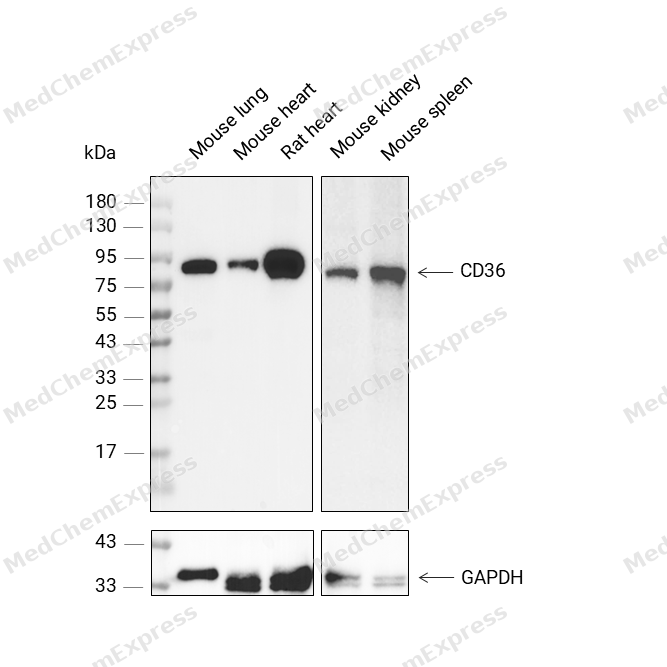 Western blot analysis was performed on protein extracts (30 μg) from Mouse lung (lane 2), Mouse heart (lane 3), Rat heart (lane 4), Mouse kidney (lane 5) , and Mouse spleen (lane 6) using CD36 antibody. Proteins were transferred onto a 0.45 μm PVDF membrane using the Trans-Blot® Turbo™ system for 13 min. The membrane was then blocked with 5% nonfat milk in TBST (HY-K1025) for 1 h at room temperature. Thhe primary antibody (1:2000) and loading control antibody GAPDH Antibody (HRP) (HY-P80954A) (1:2500) were diluted in 5% nonfat milk in TBST and incubated with the membrane overnight at 4°C. After washing, the membrane of primary antibody was incubated with HRP-conjugated goat anti-rabbit/mouse IgG secondary antibody (HY-P8001/HY-P8004) (1:5000) diluted in 5% nonfat milk in TBST for 1 h at room temperature. Protein bands were visualized using an Ultra High Sensitivity ECL detection kit (HY-K1005).
 -
 Flow cytometric analysis of 1X10⁶ THP-1 cells labeling CD36 Antibody (HY-P86458, red). Cells were fixed with 4% paraformaldehyde and permeabilised with 90% methanol. Then stained with the primary antibody at 1/1000 dilution for an hour at 4℃. AF488-conjugated Goat Anti-Rabbit IgG H&L (HY-P8002) was used as the secondary antibody at 1/1,000 dilution for 30 minutes at 4℃. Rabbit IgG Isotype Control (HY-P80879, blue) was used as the isotype control, cells without incubation with primary antibody were used as the unlabeled control (black).
 -
 Flow cytometric analysis of 1X10⁶ THP-1 cells labeling CD36 Antibody (HY-P86458, red). Cells were fixed with 4% paraformaldehyde and permeabilised with 90% methanol. Then stained with the primary antibody at 1/1000 dilution for an hour at 4℃. AF488-conjugated Goat Anti-Rabbit IgG H&L (HY-P8002) was used as the secondary antibody at 1/1,000 dilution for 30 minutes at 4℃. Rabbit IgG Isotype Control (HY-P80879, blue) was used as the isotype control, cells without incubation with primary antibody were used as the unlabeled control (black).


Background
-
Function
CD36 multifunctional glycoprotein that acts as a receptor for a broad range of ligands. Ligands can be of proteinaceous nature like thrombospondin, fibronectin, collagen or amyloid-beta as well as of lipidic nature such as oxidized low-density lipoprotein (oxLDL), anionic phospholipids, long-chain fatty acids and bacterial diacylated lipopeptides. They are generally multivalent and can therefore engage multiple receptors simultaneously, the resulting formation of CD36 clusters initiates signal transduction and internalization of receptor-ligand complexes. The dependency on coreceptor signaling is strongly ligand specific. Cellular responses to these ligands are involved in angiogenesis, inflammatory response, fatty acid metabolism, taste and dietary fat processing in the intestine (Probable). Binds long-chain fatty acids and facilitates their transport into cells, thus participating in muscle lipid utilization, adipose energy storage, and gut fat absorption. Mechanistically, binding of fatty acids activates downstream kinase LYN, which phosphorylates the palmitoyltransferase ZDHHC5 and inactivates it, resulting in the subsequent depalmitoylation of CD36 and caveolar endocytosis. In the small intestine, plays a role in proximal absorption of dietary fatty acid and cholesterol for optimal chylomicron formation, possibly through the activation of MAPK1/3 (ERK1/2) signaling pathway. Involved in oral fat perception and preferences. Detection into the tongue of long-chain fatty acids leads to a rapid and sustained rise in flux and protein content of pancreatobiliary secretions. In taste receptor cells, mediates the induction of an increase in intracellular calcium levels by long-chain fatty acids, leading to the activation of the gustatory neurons in the nucleus of the solitary tract. Important factor in both ventromedial hypothalamus neuronal sensing of long-chain fatty acid and the regulation of energy and glucose homeostasis. Receptor for thrombospondins, THBS1 and THBS2, mediating their antiangiogenic effects. Involved in inducing apoptosis in podocytes in response to elevated free fatty acids, acting together with THBS1. As a coreceptor for TLR4:TLR6 heterodimer, promotes inflammation in monocytes/macrophages. Upon ligand binding, such as oxLDL or amyloid-beta 42, interacts with the heterodimer TLR4:TLR6, the complex is internalized and triggers inflammatory response, leading to NF-kappa-B-dependent production of CXCL1, CXCL2 and CCL9 cytokines, via MYD88 signaling pathway, and CCL5 cytokine, via TICAM1 signaling pathway, as well as IL1B secretion, through the priming and activation of the NLRP3 inflammasome. Selective and nonredundant sensor of microbial diacylated lipopeptide that signal via TLR2:TLR6 heterodimer, this cluster triggers signaling from the cell surface, leading to the NF-kappa-B-dependent production of TNF, via MYD88 signaling pathway and subsequently is targeted to the Golgi in a lipid-raft dependent pathway; (Microbial infection) Directly mediates cytoadherence of Plasmodium falciparum parasitized erythrocytes and the internalization of particles independently of TLR signaling[1][2][3][4][5][6][7][8].
-
Subcellular Localization
Cell membrane; Multi-pass membrane protein; Membrane raft; Golgi apparatus; Apical cell membrane
-
Isoforms & Post-Translational Modification
P16671 has 4 isomers: P16671-1: 53053 Da (predicted); P16671-2: 32265 Da (predicted); P16671-3: 48600 Da (predicted); P16671-4: 46090 Da (predicted).
N-glycosylated and O-glycosylated with a ratio of 2:1;Palmitoylated by ZDHHC5 (PubMed:32958780). Palmitoylation is required for proper localization at the plasma membrane (PubMed:32958780, PubMed:37461827);Ubiquitinated at Lys-469 and Lys-472. Ubiquitination is induced by fatty acids such as oleic acid and leads to degradation by the proteasome (PubMed:18353783, PubMed:21610069). Ubiquitination and degradation are inhibited by insulin which blocks the effect of fatty acids (PubMed:18353783) -
Subunit
Interacts with THBS1 and THBS2; the interactions mediate the THBS antiangiogenic activity (PubMed:10613822, PubMed:1371676). Upon interaction with a ligand, such as oxidized low-density lipoprotein (oxLDL) or amyloid-beta 42, rapidly forms a complex with TLR4 and TLR6; the complex is internalized and triggers an inflammatory signal. Through its C-terminus, interacts with PTK2, PXN and LYN, but not with SRC. LYN kinase activity is required for facilitating TLR4:TLR6 heterodimerization and signal initiation (PubMed:1371676, PubMed:20037584). Upon interaction with ligands such as diacylated lipopeptides, interacts with the TLR2:TLR6 heterodimer (PubMed:16880211). Interacts with CD9, CD81, FCER1G, ITGB2 and/or ITGB2; forming a membrane heteromeric complex required for the internalization of CD36 and its ligands (By similarity). Interacts (when palmitoylated) with ARF6; this interaction mediates CD36 transport to the plasma membrane (PubMed:37461827)
-
SwissProt ID
-
Synonyms
CD36; GP3B; GP4; Platelet glycoprotein 4; Fatty acid translocase; FAT; Glycoprotein IIIb; GPIIIB; Leukocyte differentiation antigen CD36; PAS IV; PAS-4; Platelet collagen receptor; Platelet glycoprotein IV; GPIV; Thrombospondin receptor; CD36


Documentation
-
Data Sheet (262 KB)
-
SDS (252 KB)
- English - EN (252 KB)
- Français - FR (252 KB)
- Deutsch - DE (252 KB)
- Norwegian - NO (252 KB)
- Español - ES (252 KB)
- Swedish - SV (252 KB)
- Italian - IT (252 KB)
- Korean - KR (252 KB)
- Portuguese - PT (252 KB)
-
User Guide for Antibodies (1077 KB)
References
[1]. Smith J, et al. Opposite regulation of CD36 ubiquitination by fatty acids and insulin: effects on fatty acid uptake. J Biol Chem. 2008 May 16;283(20):13578-85. [Content Brief]
[2]. Tran TT, et al. Luminal lipid regulates CD36 levels and downstream signaling to stimulate chylomicron synthesis. J Biol Chem. 2011 Jul 15;286(28):25201-10. [Content Brief]
[3]. Hao JW, et al. CD36 facilitates fatty acid uptake by dynamic palmitoylation-regulated endocytosis. Nat Commun. 2020 Sep 21;11(1):4765. [Content Brief]
[4]. Masuda D, et al. Chylomicron remnants are increased in the postprandial state in CD36 deficiency. J Lipid Res. 2009 May;50(5):999-1011. [Content Brief]
[5]. Keller KL, et al. Common variants in the CD36 gene are associated with oral fat perception, fat preferences, and obesity in African Americans. Obesity (Silver Spring). 2012 May;20(5):1066-73. [Content Brief]
[6]. Mrizak I, et al. The A allele of cluster of differentiation 36 (CD36) SNP 1761667 associates with decreased lipid taste perception in obese Tunisian women. Br J Nutr. 2015 Apr 28;113(8):1330-7. [Content Brief]
[7]. Stewart CR, et al. CD36 ligands promote sterile inflammation through assembly of a Toll-like receptor 4 and 6 heterodimer. Nat Immunol. 2010 Feb;11(2):155-61. [Content Brief]
[8]. Triantafilou M, et al. Membrane sorting of toll-like receptor (TLR)-2/6 and TLR2/1 heterodimers at the cell surface determines heterotypic associations with CD36 and intracellular targeting. J Biol Chem. 2006 Oct 13;281(41):31002-11. [Content Brief]

 Powered by Bioz
