



Cytochrome P450 17A1 Antibody (YA478)
(Synonyms: CYP17, S17AH, CYP17A1, 17-alpha-hydroxyprogesterone aldolase, CYPXVII, Cytochrome P450 17A1, Cytochrome P450-C17, Steroid 17-alpha-monooxygenase, Cytochrome P450c17)
Based on 1 Customer Validation
Cytochrome P450 17A1 Antibody (YA478) is a Rabbit-derived and non-conjugated IgG monoclonal antibody, targeting to Cytochrome P450 17A1.
-
Host:
Rabbit
-
Isotype:
IgG
-
Application:
WB, ICC/IF, IHC-P, FC
-
Reactivity :
Human, Mouse, Rat
-
Formulation:
Supplied in 1*TBS (pH7.4), 0.05% BSA and 40% Glycerol. Preservative: 0.05% Sodium Azide.
-
Conjugation:
Non-conjugated


To place orders, for customer services and technical support, please contact: MedChemExpress USA
Tel: 609-228-6898 E-mail: [email protected] [email protected]





Applications
| Application |
WB

WB: Western Blot
|
ICC/IF
ICC/IF: Immunocytochemistry/
Immunofluorescence |
IHC-P
IHC-P: Immunohistochemistry-Paraffin
|
FC
FC: Flow Cytometry
|
|---|---|---|---|---|
| Dilution Ratio | 1:500 | 1:50-1:200 | 1:50-1:200 | 1:50-1:100 |


Product Details
Cytochrome P450 17A1 Antibody (YA478) is a Rabbit-derived and non-conjugated IgG monoclonal antibody, targeting to Cytochrome P450 17A1.
-
Host Rabbit

-
Clonality Recombinant,Monoclonal

-
Species ReactivityHuman, Mouse, Rat
-
Observed Molecular WeightObserved band size: 57 kDa
Note: Due to possible protein modifications or aggregation, the molecular weight should be confirmed by actual measurement, and the predicted value is for reference only.

-
Calculated Molecular Weight Predicted band size: 57 kDa

Entrez Gene: 1586 Human ; 13074 Mouse ; 25146 Rat
SwissProt: P05093 Human ; P27786 Mouse ; P11715 Rat
OMIM: 202110 Human
Synthetic peptide corresponding to Human Cytochrome P450 17A1.AA range:81-240.
Endogenous
Protein A affinity purified.
Non-conjugated
Unmodified
IgG


Product Properties
-
Appearance
Solution
-
Formulation
Supplied in 1*TBS (pH7.4), 0.05% BSA and 40% Glycerol. Preservative: 0.05% Sodium Azide.
-
Concentration
Batch-dependent, Please check the COA for the concentration of each lot. Check Lot Concentration
-
Storage & Stability
Stored at -20°C for 1 year. Avoid repeated freeze / thaw cycles.
-
Shipping
Shipping with blue ice.


Verification Images
-
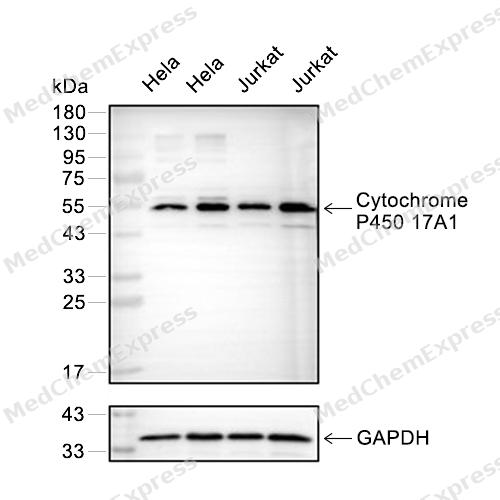 Western blot analysis of extracts from Hela(lane 2(15μg) or lane 3(30μg) ) and Jurkat(lane 4(15μg) or lane 5(30μg) ) using Cytochrome P450 17A1(HY-P80449) Rabbit mAb. Proteins were transferred to a PVDF membrane and blocked with 5% BSA in TBST for 2 hour at room temperature. The primary antibody (HY-P80449, 1/1000) and Loading control antibody (GAPDH, HY-P80954, 1/3000) was used in 5% BSA in TBST at 4°C overnight. Goat Anti-Rabbit/Mouse IgG-HRP Secondary Antibody (HY-P8001/HY-P8004, 1/10,000) was used for 1 hour at room temperature.
 -
 Western blot analysis was performed on protein extracts (25 μg) from HepG2 (lane 1), Mouse brain (lane 2) and Rat brain (lane 3) using Cytochrome P450 17A1 antibody. Proteins were transferred onto a 0.45 μm PVDF membrane using the Trans-Blot® Turbo™ system for 13 min. The membrane was then blocked with 5% nonfat milk in TBST (HY-K1025) for 1 h at room temperature. The primary antibody (1:1000) and loading control antibody GAPDH Antibody (HRP) (HY-P80954A) (1:5000) were diluted in 5% nonfat milk in TBST and incubated with the membrane overnight at 4°C. After washing, the membrane of primary antibody was incubated with HRP-conjugated goat anti-rabbit/mouse IgG secondary antibody (HY-P8001/HY-P8004) (1:5000) diluted in 5% nonfat milk in TBST for 1 h at room temperature. Protein bands were visualized using an Ultra High Sensitivity ECL detection kit (HY-K1005).


Background
-
Function
Cytochrome P450 17A1 is an A cytochrome P450 monooxygenase involved in corticoid and androgen biosynthesis. Catalyzes 17-alpha hydroxylation of C21 steroids, which is common for both pathways. A second oxidative step, required only for androgen synthesis, involves an acyl-carbon cleavage. The 17-alpha hydroxy intermediates, as part of adrenal glucocorticoids biosynthesis pathway, are precursors of cortisol (Probable). Hydroxylates steroid hormones, pregnenolone and progesterone to form 17-alpha hydroxy metabolites, followed by the cleavage of the C17-C20 bond to form C19 steroids, dehydroepiandrosterone (DHEA) and androstenedione. Has 16-alpha hydroxylase activity. Catalyzes 16-alpha hydroxylation of 17-alpha hydroxy pregnenolone, followed by the cleavage of the C17-C20 bond to form 16-alpha-hydroxy DHEA. Also 16-alpha hydroxylates androgens, relevant for estriol synthesis. Mechanistically, uses molecular oxygen inserting one oxygen atom into a substrate, and reducing the second into a water molecule, with two electrons provided by NADPH via cytochrome P450 reductase (CPR; NADPH-ferrihemoprotein reductase)[1][2][3][4][5].
-
Subcellular Localization
Endoplasmic reticulum membrane; Microsome membrane
-
SwissProt ID
-
Synonyms
CYP17, S17AH, CYP17A1, 17-alpha-hydroxyprogesterone aldolase, CYPXVII, Cytochrome P450 17A1, Cytochrome P450-C17, Steroid 17-alpha-monooxygenase, Cytochrome P450c17
-
Research Field
Cardiovascular


Documentation
-
Data Sheet (262 KB)
-
SDS (251 KB)
- English - EN (251 KB)
- Français - FR (251 KB)
- Deutsch - DE (251 KB)
- Norwegian - NO (251 KB)
- Español - ES (251 KB)
- Swedish - SV (251 KB)
- Italian - IT (251 KB)
- Korean - KR (251 KB)
- Portuguese - PT (251 KB)
-
User Guide for Antibodies (1077 KB)
References
[1]. DeVore NM, et al. Structures of cytochrome P450 17A1 with prostate cancer drugs abiraterone and TOK-001. Nature. 2012 Jan 22;482(7383):116-9. [Content Brief]
[2]. Petrunak EM, et al. Structures of human steroidogenic cytochrome P450 17A1 with substrates. J Biol Chem. 2014 Nov 21;289(47):32952-64. [Content Brief]
[3]. Yoshimoto FK, et al. Mechanism of 17α,20-Lyase and New Hydroxylation Reactions of Human Cytochrome P450 17A1: 18O LABELING AND OXYGEN SURROGATE EVIDENCE FOR A ROLE OF A PERFERRYL OXYGEN. J Biol Chem. 2016 Aug 12;291(33):17143-64. [Content Brief]
[4]. Auchus RJ, et al. Cytochrome b5 augments the 17,20-lyase activity of human P450c17 without direct electron transfer. J Biol Chem. 1998 Feb 6;273(6):3158-65. [Content Brief]
[5]. Lee SG, et al. Hydroxylation and lyase reactions of steroids catalyzed by mouse cytochrome P450 17A1 (Cyp17a1). J Inorg Biochem. 2023 Mar;240:112085. [Content Brief]

 Powered by Bioz
