



Dnmt3a Antibody (YA475)
(Synonyms: DNA (cytosine-5)-methyltransferase 3A, Dnmt3a, Cysteine methyltransferase DNMT3A, DNA methyltransferase HsaIIIA, DNA MTase HsaIIIA, M.HsaIIIA, DNMT3A)Based on 1 publication(s) in Google Scholar
Dnmt3a Antibody (YA475) is a Rabbit-derived and non-conjugated IgG monoclonal antibody, targeting to Dnmt3a.
-
Host:
Rabbit
-
Isotype:
IgG
-
Application:
WB, ICC/IF
-
Reactivity :
Human, Mouse
-
Formulation:
Supplied in 1*TBS (pH7.4), 0.05% BSA and 40% Glycerol. Preservative: 0.05% Sodium Azide.
-
Conjugation:
Non-conjugated


To place orders, for customer services and technical support, please contact: MedChemExpress USA
Tel: 609-228-6898 E-mail: [email protected] [email protected]



Publications Citing Use of MedChemExpress (MCE) Dnmt3a Antibody (YA475)
More

Applications
| Application |
WB

WB: Western Blot
|
ICC/IF
ICC/IF: Immunocytochemistry/
Immunofluorescence |
|---|---|---|
| Dilution Ratio | 1:1000-1:5000 | 1:50-1:200 |


Product Details
Dnmt3a Antibody (YA475) is a Rabbit-derived and non-conjugated IgG monoclonal antibody, targeting to Dnmt3a.
-
Host Rabbit

-
Clonality Recombinant,Monoclonal

-
Species ReactivityHuman, Mouse
-
Observed Molecular WeightObserved band size: 130 kDa
Note: Due to possible protein modifications or aggregation, the molecular weight should be confirmed by actual measurement, and the predicted value is for reference only.

-
Calculated Molecular Weight Predicted band size: 102 kDa

Entrez Gene: 1788 Human ; 13435 Mouse ; 444984 Rat
SwissProt: Q9Y6K1 Human ; O88508 Mouse ; Q1LZ53 Rat
OMIM: 615879 Human
Synthetic peptide corresponding to Human Dnmt3a.AA range:600-640.
Endogenous
Protein A affinity purified.
Non-conjugated
Unmodified
IgG


Product Properties
-
Appearance
Solution
-
Formulation
Supplied in 1*TBS (pH7.4), 0.05% BSA and 40% Glycerol. Preservative: 0.05% Sodium Azide.
-
Concentration
Batch-dependent, Please check the COA for the concentration of each lot. Check Lot Concentration
-
Storage & Stability
Stored at -20°C for 1 year. Avoid repeated freeze / thaw cycles.
-
Versand
Shipping with blue ice.


Publications (1)
-
Journal Impact Factor
-
Most Recent
-
J Transl Med
Tumor-derived exosomal lncRNA-MIR193BHG promotes bone metastasis of breast cancer by targeting the miR-489-3p/DNMT3A signaling axis in osteoclasts. [Abstract]2025 Jan 31;23(1):142. PMID: 39891171


Verification Images
-
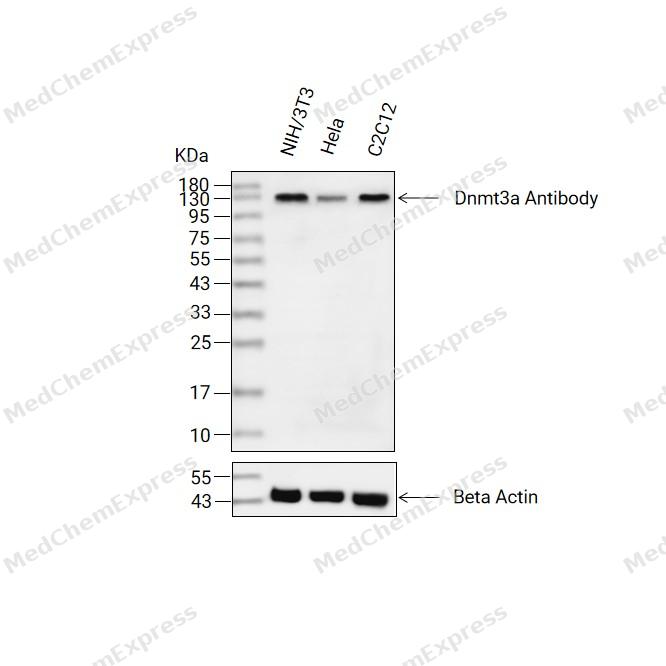 Western blot analysis of extracts from NIH/3T3(lane 2(20ug) ,Hela(lane 3(20ug) and C2C12(lane 4(20ug) using Dnmt3a Antibody (HY-P80107) Rabbit mAb. Proteins were transferred to a PVDF membrane and blocked with 5% non-fat milk in TBST for 2 hour at room temperature. The primary antibody (1/1000) and Loading control antibody (Beta Actin, HY-P83730, 1/10000) was used in 5% non-fat milk in TBST at 4°C overnight. Goat Anti-Mouse/Rabbit IgG-HRP Secondary Antibody (1/10000) was used for 1 hour at room temperature.
 -
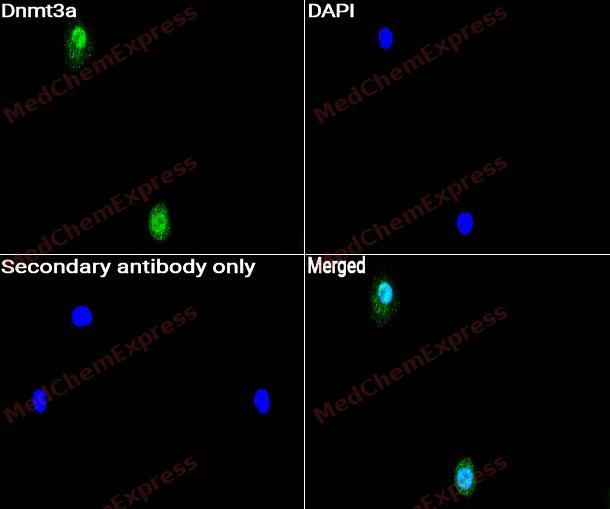 Immunocytochemistry analysis of Hela cells labeling Dnmt3a with Dnmt3a Antibody (HY-P80107) at 1/50 dilution. Cells were fixed in 4% paraformaldehyde for 15 minutes at room temperature, permeabilized with 0.1% Triton X-100 for 10 minutes at room temperature, then blocked with QuickBlock™ Blocking Buffer for Immunol Staining for 10 min at room temperature. Cells were then incubated with Dnmt3a Antibody (HY-P80107) at 1/50 dilution in QuickBlock™ Blocking Buffer for Immunol Staining at 4 ℃. Alexa Fluor® 488-conjugated AffiniPure Goat Anti-Rabbit IgG H&L(HY-P8002, Green) was used as the secondary antibody at 1/1,000 dilution. PBS instead of the primary antibody was used as the secondary antibody only control. The Nuclear counterstain was DAPI (Blue).
 -
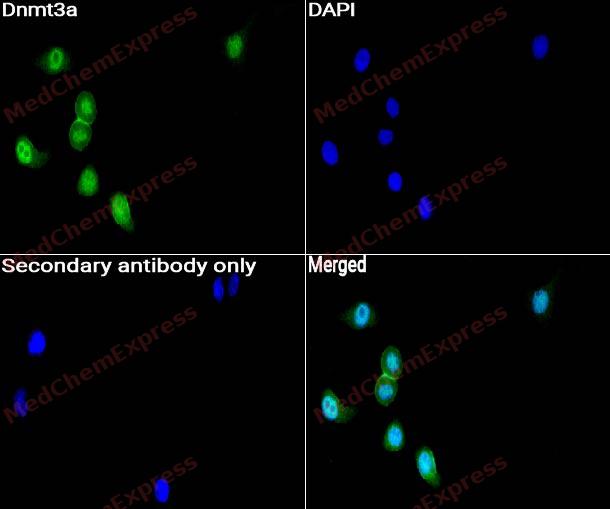 Immunocytochemistry analysis of A549 cells labeling Dnmt3a with Dnmt3a Antibody (HY-P80107) at 1/50 dilution. Cells were fixed in 4% paraformaldehyde for 15 minutes at room temperature, permeabilized with 0.1% Triton X-100 for 10 minutes at room temperature, then blocked with QuickBlock™ Blocking Buffer for Immunol Staining for 10 min at room temperature. Cells were then incubated with Dnmt3a Antibody (HY-P80107)at 1/50 dilution in QuickBlock™ Blocking Buffer for Immunol Staining at 4 ℃. Alexa Fluor® 488-conjugated AffiniPure Goat Anti-Rabbit IgG H&L(HY-P8002,Green) was used as the secondary antibody at 1/1,000 dilution. PBS instead of the primary antibody was used as the secondary antibody only control. The Nuclear counterstain was DAPI (Blue).


Background
-
Function
Dnmt3a is required for genome-wide de novo methylation and is essential for the establishment of DNA methylation patterns during development. DNA methylation is coordinated with methylation of histones. It modifies DNA in a non-processive manner and also methylates non-CpG sites. May preferentially methylate DNA linker between 2 nucleosomal cores and is inhibited by histone H1. Plays a role in paternal and maternal imprinting. Required for methylation of most imprinted loci in germ cells. Acts as a transcriptional corepressor for ZBTB18. Recruited to trimethylated 'Lys-36' of histone H3 (H3K36me3) sites. Can actively repress transcription through the recruitment of HDAC activity. Also has weak auto-methylation activity on Cys-710 in absence of DNA[1][2][3].
-
Subcellular Localization
Nucleus; Chromosome; Cytoplasm
-
Expression
Tissue_specificity:It is highly expressed in fetal tissues, skeletal muscle, heart, peripheral blood mononuclear cells, and kidneys, and at lower levels in the placenta, brain, liver, colon, spleen, small intestine, and lungs. -
Subunit
Heterotetramer composed of 1 DNMT3A homodimer and 2 DNMT3L subunits (DNMT3L-DNMT3A-DNMT3A-DNMT3L) (PubMed:17713477, PubMed:19834512). Interacts with UBC9, PIAS1 and PIAS2 (By similarity). Binds the ZBTB18 transcriptional repressor (By similarity). Interacts with SETDB1 (PubMed:16682412). Associates with HDAC1 through its ADD domain (By similarity). Interacts with UHRF1 (By similarity). Interacts with DNMT1 and DNMT3B (PubMed:12145218). Interacts with the PRC2/EED-EZH2 complex (PubMed:16357870). Interacts with MPHOSPH8 (PubMed:20871592, PubMed:22086334). Interacts with histone H3 that is not methylated at 'Lys-4' (H3K4) (By similarity). Interacts with SPOCD1 (By similarity). Interacts with ZNF263; recruited to the SIX3 promoter along with other proteins involved in chromatin modification and transcriptional corepression where it contributes to transcriptional repression (PubMed:32051553)
-
SwissProt ID
-
Synonyms
DNA (cytosine-5)-methyltransferase 3A, Dnmt3a, Cysteine methyltransferase DNMT3A, DNA methyltransferase HsaIIIA, DNA MTase HsaIIIA, M.HsaIIIA, DNMT3A
-
Research Field
Epigenetics and Nuclear Signaling
Documentation
-
Data Sheet (261 KB)
-
SDS (252 KB)
- English - EN (252 KB)
- Français - FR (252 KB)
- Deutsch - DE (252 KB)
- Norwegian - NO (252 KB)
- Español - ES (252 KB)
- Swedish - SV (252 KB)
- Italian - IT (252 KB)
- Korean - KR (252 KB)
- Portuguese - PT (252 KB)
-
User Guide for Antibodies (1077 KB)
References
[1]. Chen T, et al. A novel Dnmt3a isoform produced from an alternative promoter localizes to euchromatin and its expression correlates with active de novo methylation. J Biol Chem. 2002 Oct 11;277(41):38746-54. [Content Brief]
[2]. Viré E, et al. The Polycomb group protein EZH2 directly controls DNA methylation. Nature. 2006 Feb 16;439(7078):871-4. [Content Brief]
[3]. Heyn P, et al. Gain-of-function DNMT3A mutations cause microcephalic dwarfism and hypermethylation of Polycomb-regulated regions. Nat Genet. 2019 Jan;51(1):96-105. [Content Brief]

 Powered by Bioz
