



FKBP51 Antibody (YA433)
(Synonyms: AIG6, FKBP51, FKBP5, Peptidyl-prolyl cis-trans isomerase FKBP5, PPIase FKBP5, 51 kDa FK506-binding protein, 54 kDa progesterone receptor-associated immunophilin, Androgen-regulated protein 6, FF1 antigen, FK506-binding protein 5, FKBP54, HSP90-binding immunophilin, Rotamase, 51 kDa FKBP, FKBP-51, FKBP-5, p54)
Based on 1 Customer Validation
FKBP51 Antibody (YA433) is a Rabbit-derived and non-conjugated IgG monoclonal antibody, targeting to FKBP51.
-
Host:
Rabbit
-
Isotype:
IgG
-
Application:
WB, IHC-P, IP, FC
-
Reactivity :
Human, Rat
-
Formulation:
Supplied in 1*TBS (pH7.4), 0.05% BSA and 40% Glycerol. Preservative: 0.05% Sodium Azide.
-
Conjugation:
Non-conjugated


To place orders, for customer services and technical support, please contact: MedChemExpress USA
Tel: 609-228-6898 E-mail: [email protected] [email protected]





Applications
| Application |
WB

WB: Western Blot
|
IHC-P
IHC-P: Immunohistochemistry-Paraffin
|
FC
FC: Flow Cytometry
|
IP
IP: Immunoprecipitation
|
|---|---|---|---|---|
| Dilution Ratio | 1:500-1:1000 | 1:50-1:200 | 1:50-1:100 | Use at an assay dependent concentration. |


Product Details
FKBP51 Antibody (YA433) is a Rabbit-derived and non-conjugated IgG monoclonal antibody, targeting to FKBP51.
-
Host Rabbit

-
Clonality Recombinant,Monoclonal

-
Species ReactivityHuman, Rat
-
Observed Molecular WeightObserved band size: 55 kDa
Note: Due to possible protein modifications or aggregation, the molecular weight should be confirmed by actual measurement, and the predicted value is for reference only.

-
Calculated Molecular Weight Predicted band size: 51 kDa

Synthetic peptide corresponding to Human FKBP51.AA range:400-440.
Endogenous
Protein A affinity purified.
Non-conjugated
Unmodified
IgG


Product Properties
-
Appearance
Solution
-
Formulation
Supplied in 1*TBS (pH7.4), 0.05% BSA and 40% Glycerol. Preservative: 0.05% Sodium Azide.
-
Concentration
Batch-dependent, Please check the COA for the concentration of each lot. Check Lot Concentration
-
Storage & Stability
Stored at -20°C for 1 year. Avoid repeated freeze / thaw cycles.
-
Shipping
Shipping with blue ice.


Verification Images
-
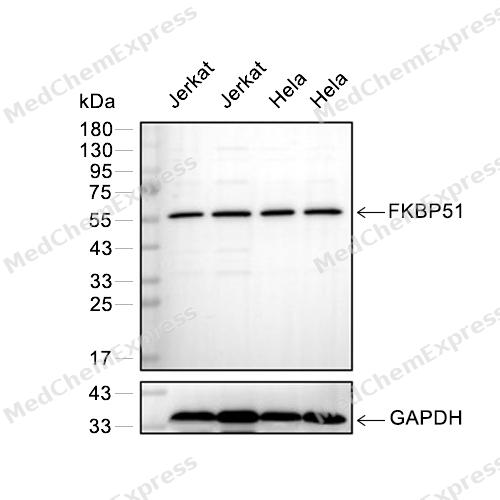 Western blot analysis of extracts from Jurkat(lane 2(15μg) or lane 3(30μg)) and Hela(lane 4(15μg) or lane 5(30μg)) using FKBP51(HY-P80401) Rabbit mAb. Proteins were transferred to a PVDF membrane and blocked with 5% BSA in TBST for 2 hour at room temperature. The primary antibody (HY-P80401, 1/1000) and Loading control antibody (GAPDH, HY-P80954, 1/3000) was used in 5% BSA in TBST at 4°C overnight. Goat Anti-Mouse/Rabbit IgG-HRP Secondary Antibody (HY-P8004/HY-P8001, 1/10,000) was used for 1 hour at room temperature.
 -
 Western blot analysis was performed on protein extracts (25 μg) from HeLa (lane 2), Jurkat (lane 3), HepG2 (lane 4), 293T (lane 5), and THP-1 (lane 6) using FKBP51 antibody. Proteins were transferred onto a 0.45 μm PVDF membrane using the Trans-Blot® Turbo™ system for 13 min. The membrane was then blocked with 5% nonfat milk in TBST (HY-K1025) for 1 h at room temperature. The primary antibody (1:1000) and loading control antibody GAPDH Antibody (HRP) (HY-P80954A) (1:5000) were diluted in 5% nonfat milk in TBST and incubated with the membrane overnight at 4°C. After washing, the membrane of primary antibody was incubated with HRP-conjugated goat anti-rabbit/mouse IgG secondary antibody (HY-P8001/HY-P8004) (1:5000) diluted in 5% nonfat milk in TBST for 1 h at room temperature. Protein bands were visualized using an Ultra High Sensitivity ECL detection kit (HY-K1005).
 -
 Flow cytometric analysis of 1X10⁶ HeLa cells labeling FKBP51 Antibody (HY-P80401, red). Cells were fixed with 4% paraformaldehyde and permeabilised with 90% methanol. Then stained with the primary antibody at 1/100 dilution for an hour at 4℃. AF488-conjugated Goat Anti-Rabbit IgG H&L (HY-P8002) was used as the secondary antibody at 1/1,000 dilution for 30 minutes at 4℃. Rabbit IgG Isotype Control (HY-P80879, blue) was used as the isotype control, cells without incubation with primary antibody were used as the unlabeled control (black).


Background
-
Function
FKBP51, encoded by FKBP5, is an Hsp90-associated immunophilin co-chaperone that regulates glucocorticoid receptor sensitivity and steroid receptor signaling[1]. Mechanistically, FKBP51 integrates into GR:Hsp90 complexes and antagonizes FKBP52-dependent potentiation of glucocorticoid receptor activity[2]. In cancer signaling models, FKBP51 acts as an Akt-PHLPP scaffold and promotes Akt dephosphorylation, linking FKBP51 biology to chemotherapy response research[3]. In stress-related disease studies, FKBP5 polymorphisms associate with antidepressant response, depressive episode recurrence, and childhood-abuse-dependent PTSD symptom risk[4][5]. Compared with FKBP52, FKBP51 remains a key isoform because selective ligand design must overcome their conserved FK1 binding domains and opposing GR functions[2][6]. For experimental applications, SAFit1 and SAFit2 provide selective FKBP51 inhibition through induced fit, supporting isoform-focused studies of stress behavior, neuroendocrine feedback, and target engagement[6][7].- FKBP51 research should prioritize GR:Hsp90 regulation, FKBP52 contrast, and stress-related experimental models. - SAFit-class inhibitors enable isoform-selective FKBP51 perturbation but require careful probe validation.
-
Subcellular Localization
Cytoplasm; Nucleus
-
Expression
Tissue_specificity:Widely expressed, enriched in testis compared to other tissues
Induction:By androgen -
Subunit
Part of a heteromultimeric cytoplasmic complex with HSP90AA1, HSPA1A/HSPA1B and steroid receptors. Upon ligand binding dissociates from the complex and FKBP4 takes its place (By similarity). Interacts with functionally mature heterooligomeric progesterone receptor complexes along with HSP90 and TEBP (PubMed:7693698). Interacts with NR3C1 (By similarity). Interacts with Akt/AKT1 and PHLPP1; enhancing dephosphorylation and subsequent activation of Akt/AKT1 (PubMed:28147277). Interacts with IFI44L; this interaction modulates the kinase activity of IKBKB and IKBKE (PubMed:31434731). Interacts with IKBKB and IKBKE (PubMed:26101251, PubMed:31434731)
-
SwissProt ID
-
Synonyms
AIG6, FKBP51, FKBP5, Peptidyl-prolyl cis-trans isomerase FKBP5, PPIase FKBP5, 51 kDa FK506-binding protein, 54 kDa progesterone receptor-associated immunophilin, Androgen-regulated protein 6, FF1 antigen, FK506-binding protein 5, FKBP54, HSP90-binding immunophilin, Rotamase, 51 kDa FKBP, FKBP-51, FKBP-5, p54
-
Research Field
Immunology


Documentation
-
Data Sheet (262 KB)
-
SDS (251 KB)
- English - EN (251 KB)
- Français - FR (251 KB)
- Deutsch - DE (251 KB)
- Norwegian - NO (251 KB)
- Español - ES (251 KB)
- Swedish - SV (251 KB)
- Italian - IT (251 KB)
- Korean - KR (251 KB)
- Portuguese - PT (251 KB)
-
User Guide for Antibodies (1077 KB)
References
[1]. Storer CL, et al. FKBP51 and FKBP52 in signaling and disease. Trends Endocrinol Metab. 2011 Dec;22(12):481-90. [Content Brief]
[2]. Noddings CM, et al. Cryo-EM reveals how Hsp90 and FKBP immunophilins co-regulate the glucocorticoid receptor. Nat Struct Mol Biol. 2023 Dec;30(12):1867-1877. [Content Brief]
[3]. Pei H, et al. FKBP51 affects cancer cell response to chemotherapy by negatively regulating Akt. Cancer Cell. 2009 Sep 8;16(3):259-66. [Content Brief]
[4]. Binder EB, et al. Polymorphisms in FKBP5 are associated with increased recurrence of depressive episodes and rapid response to antidepressant treatment. Nat Genet. 2004 Dec;36(12):1319-25. [Content Brief]
[5]. Binder EB, et al. Association of FKBP5 polymorphisms and childhood abuse with risk of posttraumatic stress disorder symptoms in adults. JAMA. 2008 Mar 19;299(11):1291-305. [Content Brief]
[6]. Gaali S, et al. Selective inhibitors of the FK506-binding protein 51 by induced fit. Nat Chem Biol. 2015 Jan;11(1):33-7. [Content Brief]
[7]. Buffa V, et al. Analysis of the Selective Antagonist SAFit2 as a Chemical Probe for the FK506-Binding Protein 51. ACS Pharmacol Transl Sci. 2023 Feb 14;6(3):361-371. [Content Brief]

 Powered by Bioz
