



SIRT2 Antibody (YA081)
(Synonyms: SIR2L, SIR2L2, SIRT2, NAD-dependent protein deacetylase sirtuin-2, NAD-dependent protein defatty-acylase sirtuin-2, Regulatory protein SIR2 homolog 2, SIR2-like protein 2)
Based on 1 Customer Validation
SIRT2 Antibody (YA081) is a Rabbit-derived and non-conjugated IgG monoclonal antibody, targeting to SIRT2.
-
Host:
Rabbit
-
Isotype:
IgG
-
Application:
WB, ICC/IF, IP, FC
-
Reactivity :
Human, Rat
-
Formulation:
Supplied in 1*TBS (pH7.4), 0.05% BSA and 40% Glycerol. Preservative: 0.05% Sodium Azide.
-
Conjugation:
Non-conjugated


To place orders, for customer services and technical support, please contact: MedChemExpress USA
Tel: 609-228-6898 E-mail: [email protected] [email protected]





Applications
| Application |
WB

WB: Western Blot
|
ICC/IF
ICC/IF: Immunocytochemistry/
Immunofluorescence |
FC
FC: Flow Cytometry
|
IP
IP: Immunoprecipitation
|
|---|---|---|---|---|
| Dilution Ratio | 1:500-1:2000 | 1:50-1:200 | 1:50-1:100 | Use at an assay dependent concentration. |


Product Details
SIRT2 Antibody (YA081) is a Rabbit-derived and non-conjugated IgG monoclonal antibody, targeting to SIRT2.
-
Host Rabbit

-
Clonality Recombinant,Monoclonal

-
Species ReactivityHuman, Rat
-
Observed Molecular WeightObserved band size: 40/35 kDa
Note: Due to possible protein modifications or aggregation, the molecular weight should be confirmed by actual measurement, and the predicted value is for reference only.

-
Calculated Molecular Weight Predicted band size: 43 kDa

Entrez Gene: 22933 Human ; 64383 Mouse ;
SwissProt: Q8IXJ6 Human ; Q8VDQ8 Mouse ; Q5RJQ4 Rat
OMIM: 604480 Human
Synthetic peptide corresponding to Human SIRT2.AA range:335-389.
Endogenous
Protein A affinity purified.
Non-conjugated
Unmodified
IgG


Product Properties
-
Appearance
Solution
-
Formulation
Supplied in 1*TBS (pH7.4), 0.05% BSA and 40% Glycerol. Preservative: 0.05% Sodium Azide.
-
Concentration
Batch-dependent, Please check the COA for the concentration of each lot. Check Lot Concentration
-
Storage & Stability
Stored at -20°C for 1 year. Avoid repeated freeze / thaw cycles.
-
Shipping
Shipping with blue ice.


Verification Images
-
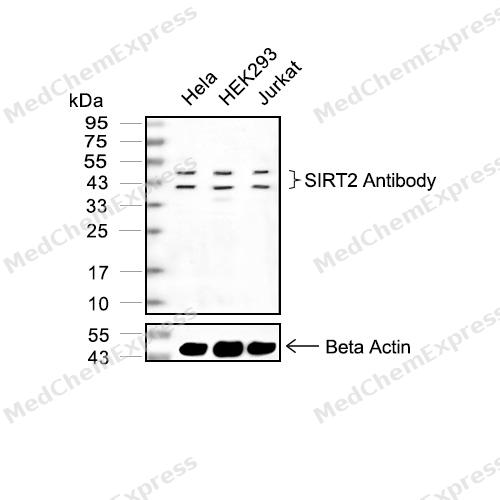 Western blot analysis of extracts from Hela(lane 2(20μg) , HEK293(lane 3(20μg) and Jurkat(lane 4(20ug) using SIRT2(HY-P80320 Rabbit mAb. Proteins were transferred to a PVDF membrane and blocked with 5% non-fat milk in TBST for 2 hour at room temperature. The primary antibody (1/1000) and Loading control antibody (Beta Actin, HY-P80438, 1/10000) was used in 5% non-fat milk in TBST at 4°C overnight. Goat Anti-Mouse/Rabbit IgG-HRP Secondary Antibody (1/10000) was used for 1 hour at room temperature.
 -
 Immunocytochemistry analysis of A431 cells labeling SIRT2 with SIRT2 Antibody (HY-P80320) at 1/100 dilution. Cells were fixed in 4% paraformaldehyde for 15 minutes at room temperature, permeabilized with 0.1% Triton X-100 in PBS for 15 minutes at room temperature, then blocked with quick block buffer for 10 minutes at room temperature. Cells were then incubated with SIRT2 Antibody (HY-P80320) at 1/100 dilution in quick block buffer overnight at 4 ℃. AF488-conjugated Goat Anti-Rabbit IgG H&L(HY-P8002, Green) was used as the secondary antibody at 1/1,000 dilution. PBS instead of the primary antibody was used as the secondary antibody only control. The Nuclear counterstain was DAPI (Blue).
 -
 Immunocytochemistry analysis of U2OS cells labeling SIRT2 with SIRT2 Antibody (HY-P80320) at 1/100 dilution. Cells were fixed in 4% paraformaldehyde for 15 minutes at room temperature, permeabilized with 0.1% Triton X-100 in PBS for 15 minutes at room temperature, then blocked with quick block buffer for 10 minutes at room temperature. Cells were then incubated with SIRT2 Antibody (HY-P80320) at 1/100 dilution in quick block buffer overnight at 4 ℃. AF488-conjugated Goat Anti-Rabbit IgG H&L(HY-P8002, Green) was used as the secondary antibody at 1/1,000 dilution. PBS instead of the primary antibody was used as the secondary antibody only control. The Nuclear counterstain was DAPI (Blue).


Background
-
Function
SIRT2 is an NAD+-dependent sirtuin deacetylase with a catalytic core containing a Rossmann-fold NAD-binding domain and a zinc-binding module[1]. It functions as a cytoplasmic microtubule regulator by deacetylating α-tubulin Lys40 in vitro and in vivo, while SIRT2 knockdown causes tubulin hyperacetylation[2]. Mechanistically, SIRT2 also enters chromatin-linked cell-cycle control, because it deacetylates histone H4K16 during G2/M and supports mitotic chromatin regulation[3]. In cancer-relevant models, SIRT2 maintains genome integrity by deacetylating APC/C coactivators CDH1 and CDC20, and Sirt2 deficiency causes centrosome amplification, aneuploidy, and tumorigenesis in mice[4]. In neurodegeneration models, SIRT2 inhibition rescues α-synuclein toxicity and modifies inclusion morphology in cellular Parkinson’s disease models[5]. Compared with related sirtuin isoforms, SIRT2 shows distinctive cytoplasmic localization but undergoes active nuclear import controlled by its C-terminus and importins[6]. Isoform-level analysis is important because catalytically inactive nuclear SIRT2.5 antagonizes SIRT2.1 and SIRT2.2 effects on HBV replication from cccDNA[7]. For experimental applications, SIRT2 inhibitors support studies of microtubule acetylation, mitotic regulation, α-synuclein toxicity, viral chromatin control, and Myc-driven cancer signaling[2][4][5][7][8].
-
Subcellular Localization
Nucleus; Cytoplasm, perinuclear region; Cytoplasm; Cytoplasm, cytoskeleton; Cytoplasm, cytoskeleton, microtubule organizing center, centrosome; Cytoplasm, cytoskeleton, microtubule organizing center, centrosome, centriole; Cytoplasm, cytoskeleton, spindle; Midbody; Chromosome; Perikaryon; Cell projection; Cell projection, growth cone; Myelin membrane; Cytoplasm; Nucleus; Cytoplasm; Nucleus; Cytoplasm; Nucleus
-
Expression
Tissue_specificity:Isomer 1 is expressed in the heart, liver, and skeletal muscle, and weakly in the cerebral cortex. Isomer 2 is expressed strongly in the cerebral cortex, and weakly in the heart and liver. Compared to normal tissues, it is expressed weakly in various malignancies, including breast cancer, liver cancer, brain cancer, kidney cancer, and prostate cancer. Compared to normal brain tissue, it is expressed weakly in glioma cell lines (protein level) . It is widely expressed. It is highly expressed in the heart, brain, and skeletal muscle, but weakly expressed in the placenta and lungs. Its expression is downregulated in many gliomas, suggesting that it may act as a tumor suppressor gene in human gliomas by regulating microtubule networks.
Induction:Up-regulated in response to low levels of glucose and anoxia-reoxygenation stress. Up-regulated by trichostatin A. Down-regulated in response to high levels of glucose. Down-regulated by histone deacetylation in several tumors -
Subunit
Interacts with CDC20, FOXO3 and FZR1.
-
SwissProt ID
-
Synonyms
SIR2L, SIR2L2, SIRT2, NAD-dependent protein deacetylase sirtuin-2, NAD-dependent protein defatty-acylase sirtuin-2, Regulatory protein SIR2 homolog 2, SIR2-like protein 2
-
Research Field
Epigenetics and Nuclear Signaling


Documentation
-
Data Sheet (263 KB)
-
SDS (252 KB)
- English - EN (252 KB)
- Français - FR (252 KB)
- Deutsch - DE (252 KB)
- Norwegian - NO (252 KB)
- Español - ES (252 KB)
- Swedish - SV (252 KB)
- Italian - IT (252 KB)
- Korean - KR (252 KB)
- Portuguese - PT (252 KB)
-
User Guide for Antibodies (1077 KB)
References
[1]. Finnin MS, et al. Structure of the histone deacetylase SIRT2. Nat Struct Biol. 2001 Jul;8(7):621-5. [Content Brief]
[2]. North BJ, et al. The human Sir2 ortholog, SIRT2, is an NAD+-dependent tubulin deacetylase. Mol Cell. 2003 Feb;11(2):437-44. [Content Brief]
[3]. Vaquero A, et al. SirT2 is a histone deacetylase with preference for histone H4 Lys 16 during mitosis. Genes Dev. 2006 May 15;20(10):1256-61. [Content Brief]
[4]. Kim HS, et al. SIRT2 maintains genome integrity and suppresses tumorigenesis through regulating APC/C activity. Cancer Cell. 2011 Oct 18;20(4):487-99. [Content Brief]
[5]. Outeiro TF, et al. Sirtuin 2 inhibitors rescue alpha-synuclein-mediated toxicity in models of Parkinson's disease. Science. 2007 Jul 27;317(5837):516-9. [Content Brief]
[6]. Eldridge MJG, et al. Active nuclear import of the deacetylase Sirtuin-2 is controlled by its C-terminus and importins. Sci Rep. 2020 Feb 10;10(1):2034. [Content Brief]
[7]. Piracha ZZ, et al. An Alternatively Spliced Sirtuin 2 Isoform 5 Inhibits Hepatitis B Virus Replication from cccDNA by Repressing Epigenetic Modifications Made by Histone Lysine Methyltransferases. J Virol. 2020 Jul 30;94(16):e00926-20. [Content Brief]
[8]. Brady JJ, et al. An Arntl2-Driven Secretome Enables Lung Adenocarcinoma Metastatic Self-Sufficiency. Cancer Cell. 2016 May 9;29(5):697-710. [Content Brief]

 Powered by Bioz
