



TLR2 Antibody (YA3547)
(Synonyms: Toll-like receptor 2; Toll like receptor 2; Toll like receptor 2 precursor; Toll-like receptor 2; TLR 2; TLR-2; Toll/interleukin-1 receptor-like protein 4; CD282 antigen; CD282; TIL 4; TIL4; TLR2_HUMAN; Toll/interleukin 1 receptor like 4; Toll/interleukin 1 receptor like protein 4; Toll/interleukin receptor like protein 4.)Based on 1 publication(s) in Google Scholar
TLR2 Antibody (YA3547) is a Rabbit-derived and non-conjugated IgG monoclonal antibody, targeting to TLR2.
-
Host:
Rabbit
-
Isotype:
IgG
-
Application:
WB, ICC/IF, FC
-
Reactivity :
Human, Mouse, Rat
-
Formulation:
1.Supplied in TBS (pH7.4), 0.05% BSA, 40% Glycerol. Preservative: 0.05% Sodium Azide.
2.Supplied in PBS (pH7.4), 0.1% BSA, 40% Glycerol, 0.2% Proclin950.
Please refer to the lot-specific COA for specific buffer information.
-
Conjugation:
Non-conjugated


To place orders, for customer services and technical support, please contact: MedChemExpress USA
Tel: 609-228-6898 E-mail: [email protected] [email protected]



Publications Citing Use of MedChemExpress (MCE) TLR2 Antibody (YA3547)
More

Applications
| Application |
WB

WB: Western Blot
|
FC
FC: Flow Cytometry
|
ICC/IF
ICC/IF: Immunocytochemistry/
Immunofluorescence |
|---|---|---|---|
| Dilution Ratio | 1:1000 | 1:50-100 | 1:50-100 |


Product Details
TLR2 Antibody (YA3547) is a Rabbit-derived and non-conjugated IgG monoclonal antibody, targeting to TLR2.
-
Host Rabbit

-
Clonality Monoclonal,Recombinant

-
Species ReactivityHuman, Mouse, Rat
-
Observed Molecular WeightObserved band size: 80-90 kDa
Note: Due to possible protein modifications or aggregation, the molecular weight should be confirmed by actual measurement, and the predicted value is for reference only.

-
Calculated Molecular Weight Predicted band size: 90 kDa

Entrez Gene: 7097 Human ; 24088 Mouse ; 310553 Rat
SwissProt: O60603 Human ; Q9QUN7 Mouse ;
OMIM: 246300 Human
Recombinant protein within human TLR2 aa 21-588 (Extracellular).
Endogenous
affinity purified
Non-conjugated
Unmodified
IgG


Product Properties
-
Appearance
Solution
-
Formulation
1.Supplied in TBS (pH7.4), 0.05% BSA, 40% Glycerol. Preservative: 0.05% Sodium Azide.
2.Supplied in PBS (pH7.4), 0.1% BSA, 40% Glycerol, 0.2% Proclin950.
Please refer to the lot-specific COA for specific buffer information. -
Concentration
Batch-dependent, Please check the COA for the concentration of each lot. Check Lot Concentration
-
Storage & Stability
Stored at -20°C for 1 year. Avoid repeated freeze / thaw cycles.
-
Shipping
Shipping with blue ice.


Publications (1)
-
Journal Impact Factor
-
Most Recent
-
Vet Microbiol
Streptococcus suis employs the Ihk/Irr-PepO axis to subvert macrophage actin polymerization: A novel anti-phagocytic strategy enhancing bacterial virulence. [Abstract]2025 Sep 11:310:110726. PMID: 40946614


Verification Images
-
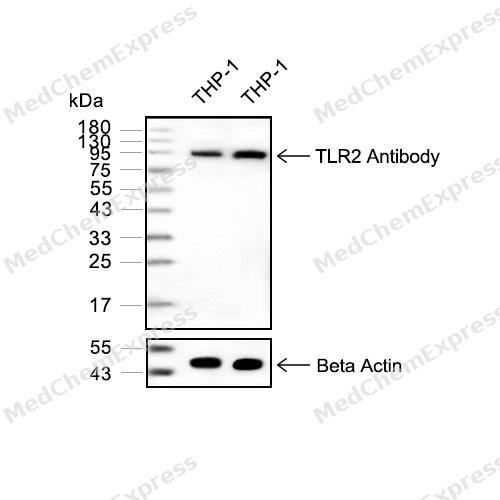 Western blot analysis of extracts from THP-1(lane 2(20μg) and THP-1(lane 3(40μg) using TLR2(HY-P81134 Rabbit mAb. Proteins were transferred to a PVDF membrane and blocked with 5% non-fat milk in TBST for 2 hour at room temperature. The primary antibody (1/1000) and Loading control antibody (Beta Actin, HY-P80438, 1/10000) was used in 5% non-fat milk in TBST at 4°C overnight. Goat Anti-Mouse/Rabbit IgG-HRP Secondary Antibody (1/10000) was used for 1 hour at room temperature.
 -
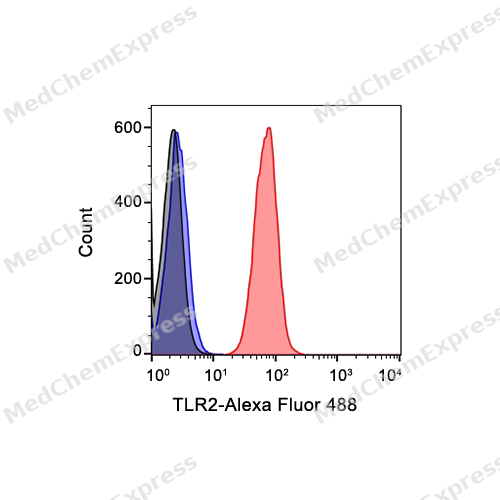 Flow cytometric analysis of 1X10^6 THP-1 cells labeling TLR2 Antibody (HY-P81134, red). Cells were fixed with 4% paraformaldehyde and permeabilised with 90% methanol. Then stained with the primary antibody at 1/50 dilution for an hour at 4℃. Alexa Fluor® 488-conjugated AffiniPure Goat Anti-Rabbit IgG H&L (HY-P8002) was used as the secondary antibody at 1/1,000 dilution for 30 minutes at 4℃. Rabbit IgG Isotype Control (HY-P80879, blue) was used as the isotype control, cells without incubation with primary antibody were used as the unlabeled control (black).
 -
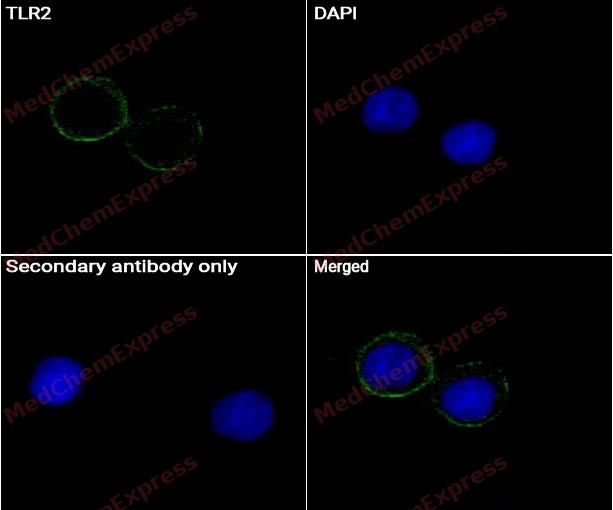 Immunocytochemistry analysis of RAW 264.7 cells labeling TLR2 Antibody (HY-P81134) at 1/50 dilution. Cells were fixed in 4% paraformaldehyde for 15 minutes at room temperature, permeabilized with 0.1% Triton X-100 for 10 minutes at room temperature, then blocked with BSA for Immunol Staining for 10 min at room temperature. Cells were then incubated with TLR2 Antibody (HY-P81134) at 1/50 dilution in BSA for Immunol Staining at 4 ℃ Overnight. AF488-conjugated AffiniPure Goat Anti-Rabbit IgG H&L(HY-P8002, Green) was used as the secondary antibody at 1/1,000 dilution. PBS instead of the primary antibody was used as the secondary antibody only control. The Nuclear counterstain was DAPI (Blue).
 -
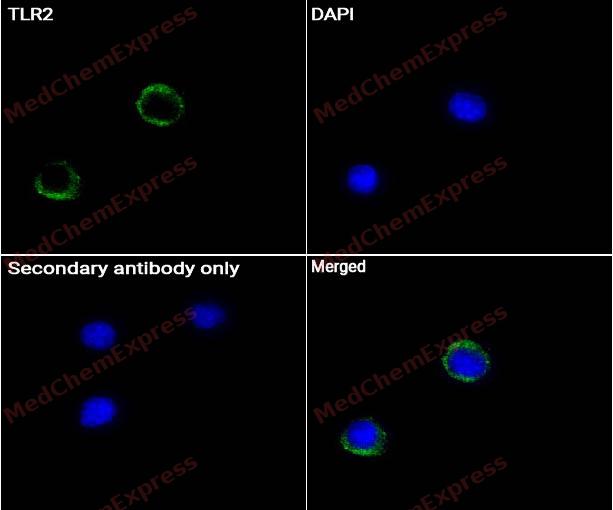 Immunocytochemistry analysis of THP-1 cells labeling TLR2 Antibody (HY-P81134) at 1/50 dilution. Cells were fixed in 4% paraformaldehyde for 15 minutes at room temperature, permeabilized with 0.1% Triton X-100 for 10 minutes at room temperature, then blocked with BSA for Immunol Staining for 10 min at room temperature. Cells were then incubated with TLR2 Antibody (HY-P81134) at 1/50 dilution in BSA for Immunol Staining at 4 ℃ Overnight. AF488-conjugated AffiniPure Goat Anti-Rabbit IgG H&L(HY-P8002, Green) was used as the secondary antibody at 1/1,000 dilution. PBS instead of the primary antibody was used as the secondary antibody only control. The Nuclear counterstain was DAPI (Blue).


Background
-
Function
TLR2 is a plasma-membrane Toll-like receptor that supports innate immune surveillance by sensing microbial patterns and initiating inflammatory cytokine signaling[1]. Mechanistically, TLR2 functions through heterodimerization with TLR1 or TLR6, and ligand-triggered TLR2/1 or TLR2/6 complexes initiate downstream immune signaling[2]. In dendritic cells, TLR2-mediated uptake promotes clathrin-mediated endocytosis, Rab7 upregulation, and TAP-independent antigen cross-presentation, linking innate recognition to CTL priming[3]. In disease models, TLR2 activation participates in inflammatory bowel disease, traumatic deep venous thrombosis, hypoxic-ischemic brain damage, and splenic marginal zone lymphoma signaling[4][5][6][7]. Compared with nucleic-acid-sensing endosomal TLR3, TLR7, TLR8, and TLR9, TLR2 belongs to the non-endosomal receptor group and emphasizes cell-surface recognition with TLR1/TLR6 pairing[1][2]. For experimental applications, Pam3CSK4 is used as a TLR2 agonist, while C29, M2000, and phloretin have been reported to suppress TLR2-related inflammatory signaling in defined cell or animal models[4][5][8][9].
-
Subcellular Localization
Membrane; Single-pass type I membrane protein; Cytoplasmic vesicle, phagosome membrane; Single-pass type I membrane protein; Membrane raft
-
Expression
Tissue_specificity:Highly expressed in peripheral blood leukocytes, in particular in monocytes, in bone marrow, lymph node and in spleen. Also detected in lung and in fetal liver. Levels are low in other tissues
Induction: (Microbial infection) In macrophages, induced by SARS-CoV-2 infection -
Subunit
Interacts with LY96, TLR1 and TLR6 (via extracellular domain) (PubMed:17889651). TLR2 seems to exist in heterodimers with either TLR1 or TLR6 before stimulation by the ligand.
-
SwissProt ID
-
Synonyms
Toll-like receptor 2; Toll like receptor 2; Toll like receptor 2 precursor; Toll-like receptor 2; TLR 2; TLR-2; Toll/interleukin-1 receptor-like protein 4; CD282 antigen; CD282; TIL 4; TIL4; TLR2_HUMAN; Toll/interleukin 1 receptor like 4; Toll/interleukin 1 receptor like protein 4; Toll/interleukin receptor like protein 4.
Documentation
-
Data Sheet (263 KB)
-
SDS (252 KB)
- English - EN (252 KB)
- Français - FR (252 KB)
- Deutsch - DE (252 KB)
- Norwegian - NO (252 KB)
- Español - ES (252 KB)
- Swedish - SV (252 KB)
- Italian - IT (252 KB)
- Korean - KR (252 KB)
- Portuguese - PT (252 KB)
-
User Guide for Antibodies (1077 KB)
References
[1]. Lim KH, et al. Toll-like receptor signaling. Cold Spring Harb Perspect Biol. 2013 Jan 1;5(1):a011247. [Content Brief]
[2]. Mansouri A, et al. Homology Modeling, Molecular Dynamics Simulation, and Prediction of Bovine TLR2 Heterodimerization. Int J Mol Sci. 2024 Jan 25;25(3):1496. [Content Brief]
[3]. Shen KY, et al. Molecular mechanisms of TLR2-mediated antigen cross-presentation in dendritic cells. J Immunol. 2014 May 1;192(9):4233-41. [Content Brief]
[4]. Wu W, et al. Endoplasmic reticulum stress is upregulated in inflammatory bowel disease and contributed TLR2 pathway-mediated inflammatory response. Immunopharmacol Immunotoxicol. 2024 Apr;46(2):192-198. [Content Brief]
[5]. Guo T, et al. TLR2 promotes traumatic deep venous thrombosis of the lower extremity following femoral fracture by activating the NF‑κB/COX‑2 signaling pathway in rats. Exp Ther Med. 2024 Sep 20;28(6):436. [Content Brief]
[6]. Gu Y, et al. Mesenchymal stem cells suppress neuronal apoptosis and decrease IL-10 release via the TLR2/NFκB pathway in rats with hypoxic-ischemic brain damage. Mol Brain. 2015 Oct 17;8(1):65. [Content Brief]
[7]. Fonte E, et al. Toll-like receptor stimulation in splenic marginal zone lymphoma can modulate cell signaling, activation and proliferation. Haematologica. 2015 Nov;100(11):1460-8. [Content Brief]
[8]. Aletaha S, et al. M2000 (β-D-Mannuronic Acid) as a Novel Antagonist for Blocking the TLR2 and TLR4 Downstream Signalling Pathway. Scand J Immunol. 2017 Feb;85(2):122-129. [Content Brief]
[9]. Kim J, et al. Phloretin as a Potent Natural TLR2/1 Inhibitor Suppresses TLR2-Induced Inflammation. Nutrients. 2018 Jul 5;10(7):868. [Content Brief]

 Powered by Bioz
