



Antofloxacin
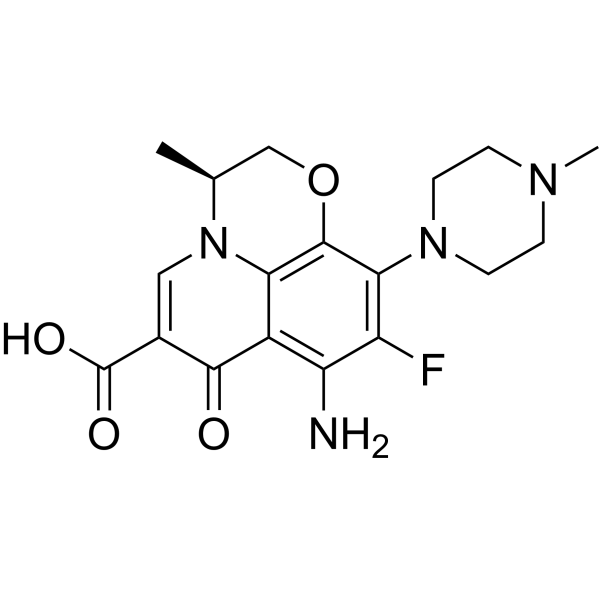
Antofloxacin is a well tolerate, orally active and broad-spectrum 8-amino-fluoroquinolone with potent antibacterial activities. Antofloxacin shows superior antibacterial activity against gyrA mutation-positive H. pylori strains, especially in Asn87- mutated strains, compared to levofloxacin. Antofloxacin is a weak, reversible inhibitor of CYP1A2 for the research of infections caused by a diverse group of bacterial species.
Para uso exclusivo en investigación. No vendemos a pacientes.
- No. CAS: 119354-43-7
- Fòrmula: C18H21FN4O4
- Peso molecular:376.38
-
Almacenamiento:
Please store the product under the recommended conditions in the Certificate of Analysis.

To place orders, for customer services and technical support, please contact: MedChemExpress USA
Tel: 609-228-6898 E-mail: [email protected] [email protected]


-
 Actividad biológica
-
Chemical Information
- Protocolo
- Pureza y Documentación
- Referencias
-
 Help & FAQs


Ver todos los productos específicos de isoformas Antibiotic
More

Actividad biológica
Descripciòn
IC50 & Target
|
Quinolone |
In Vivo
MedChemExpress (MCE) has not independently confirmed the accuracy of these methods. They are for reference only.
-
Animal Model:Mice[3]
-
Dosage:2.5~160 mg/kg (Pharmacokinetic Analysis)
-
Administration:S.c.; 24 hours
-
Result:Penetration ratio ranged from 1.22 to 1.54 for the total drug concentrations and was independent of the dose levels.


Chemical Information
-
No. CAS 119354-43-7
-
Peso molecular 376.38
-
Fòrmula C18H21FN4O4
-
SMILES
O=C1C2=C(N)C(F)=C(N3CCN(CC3)C)C4=C2N(C=C1C(O)=O)[C@@H](C)CO4
-
Envío
Room temperature in continental US; may vary elsewhere.
-
Almacenamiento
Please store the product under the recommended conditions in the Certificate of Analysis.


Pureza y Documentación
Referencias
[1]. He XJ, et al. Efficacy and Safety of Antofloxacin-Based Triple Therapy for Helicobacter pylori Eradication Failure in China [published online ahead of print, 2021 Feb 8]. Dig Dis Sci. 2021;10.1007/s10620-021-06856-z. [Content Brief]
[2]. Liu L, et al. Modulation of pharmacokinetics of theophylline by antofloxacin, a novel 8-amino-fluoroquinolone, in humans. Acta Pharmacol Sin. 2011;32(10):1285-1293. [Content Brief]
[3]. Zhou YF, et al. In Vivo Pharmacokinetic and Pharmacodynamic Profiles of Antofloxacin against Klebsiella pneumoniae in a Neutropenic Murine Lung Infection Model. Antimicrob Agents Chemother. 2017;61(5):e02691-16. Published 2017 Apr 24. [Content Brief]

Calculators
Concentration (start) × Volume (start) = Concentration (final) × Volume (final)


Antofloxacin Related Classifications
HY-123319A Related Classifications
 Powered by Bioz