



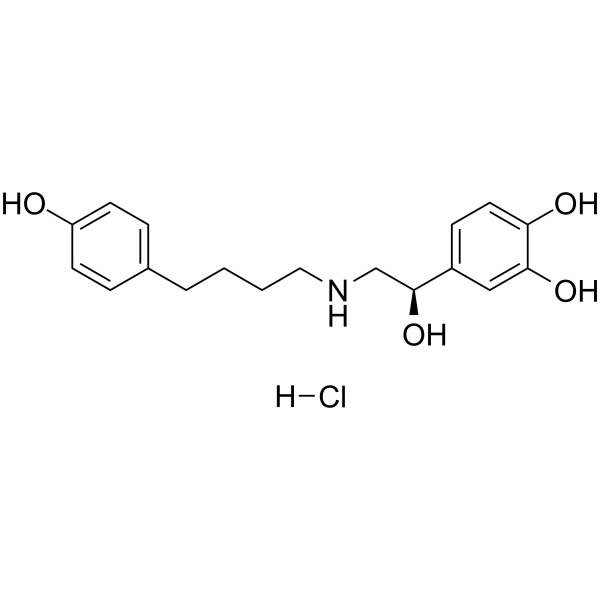
Arbutamine hydrochloride
Arbutamine hydrochloride is a short-acting, potent and nonselective β-adrenoceptor agonist. Arbutamine hydrochloride stimulates cardiac β1-, tracheal β2-, and adiopocyte β3- adrenergic receptors. Arbutamine hydrochloride provides cardiac stress increases heart rate, cardiac contractility, and systolic blood pressure. Arbutamine hydrochloride can be used for cardiac stress agent .
For research use only. We do not sell to patients.
- CAS No.: 125251-66-3
- Formula: C18H24ClNO4
- Molecular Weight:353.84
-
Storage:
Please store the product under the recommended conditions in the Certificate of Analysis.

To place orders, for customer services and technical support, please contact: MedChemExpress USA
Tel: 609-228-6898 E-mail: [email protected] [email protected]


-
 Biological Activity
-
Chemical Information
- Purity & Documentation
- References
-
 Help & FAQs


All Adrenergic Receptor Isoforms
More

Biological Activity
Description
In Vitro
Arbutamine hydrochloride (0.1-100 nM) increases heart contractile force and pD2 value of 8.45. Arbutamine has the affinity constants (KA) value of 7.32 for cardiac β1-adrenergic receptors[3].
MedChemExpress (MCE) has not independently confirmed the accuracy of these methods. They are for reference only. .
In Vivo
MedChemExpress (MCE) has not independently confirmed the accuracy of these methods. They are for reference only.


Chemical Information
-
CAS No. 125251-66-3
-
Molecular Weight 353.84
-
Formula C18H24ClNO4
-
SMILES
OC1=CC=C([C@@H](O)CNCCCCC2=CC=C(O)C=C2)C=C1O.[H]Cl
-
Shipping
Room temperature in continental US; may vary elsewhere.
-
Storage
Please store the product under the recommended conditions in the Certificate of Analysis.


Purity & Documentation
References
[1]. Ruiz M, et al. Arbutamine stress perfusion imaging in dogs with critical coronary artery stenoses: (99m)Tc-sestamibi versus (201)Tl. J Nucl Med. 2002 May;43(5):664-70. [Content Brief]
[2]. Nagarajan R, et al. A novel catecholamine, arbutamine, for a pharmacological cardiac stress agent. Cardiovasc Drugs Ther. 1996 Mar;10(1):31-8. [Content Brief]
[3]. Abou-Mohamed G, et, al. Characterization of the adrenergic activity of arbutamine, a novel agent for pharmacological stress testing. Cardiovasc Drugs Ther. 1996 Mar;10(1):39-47. [Content Brief]

Calculators
Concentration (start) × Volume (start) = Concentration (final) × Volume (final)


Arbutamine hydrochloride Related Classifications
HY-16056A Related Classifications
 Powered by Bioz