



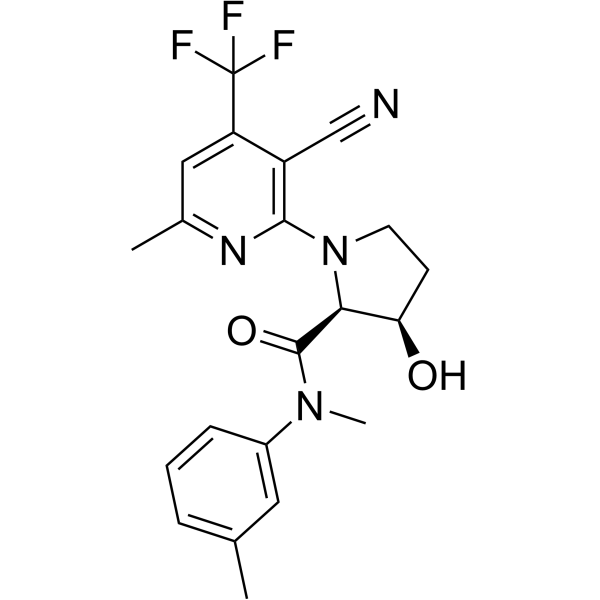
ART558 (GMP) is ART558 (HY-141520) produced by using GMP guidelines. GMP small molecules works appropriately as an auxiliary reagent for cell therapy manufacture. ART558 is a potent, selective and allosteric DNA polymerase theta (Polθ) inhibitor (IC50=7.9 nM). ART558 elicits BRCA-gene synthetic lethality and DNA damage. ART558 can be used for the research of cancer, such as breast cancer.
Nos produits utilisent uniquement pour la recherche. Nous ne vendons pas aux patients.
- CAS No.: 2603528-97-6
- Formule: C21H21F3N4O2
- Masse moléculaire:418.41
-
Stockage:
Please store the product under the recommended conditions in the Certificate of Analysis.


To place orders, for customer services and technical support, please contact: MedChemExpress USA
Tel: 609-228-6898 E-mail: [email protected] [email protected]


-
 Activité biologique
-
Chemical Information
- Protocole
- Pureté et documentation
- Références
-
 Help & FAQs


Voir tous les produits spécifiques à Isoform DNA/RNA Synthesis
More

Activité biologique
Description
IC50 & Target
|
DNA Polymerase |
Cellular Effect
|
Cell Line

|
Type | Value | Description | References |
|---|---|---|---|---|
| DLD-1 | EC50 |
>12 μM
Compound: 22; ART558
|
Antiproliferative activity against human DLD-1 cells
Antiproliferative activity against human DLD-1 cells
|
[PMID: 36200480] |
| DLD-1 | EC50 |
0.8 nM
Compound: 22; ART558
|
Antiproliferative activity against human BRCA-2 deficient DLD-1 cells
Antiproliferative activity against human BRCA-2 deficient DLD-1 cells
|
[PMID: 36200480] |
| HEK293 | EC50 |
180 nM
Compound: 22; ART558
|
Inhibition of microhomology-mediated end joining in HEK293 cells
Inhibition of microhomology-mediated end joining in HEK293 cells
|
[PMID: 36200480] |
In Vitro
ART558 (GMP) (0-10 μM; 7 days; BRCA2wild-type or BRCA2-/- cells) shows synthetic lethality and a combinatorial effect with the PARPi olaparib in previously described isogenic models of BRCA1-deficiency[1].
ART558 (GMP) (5 μM; 0-72 hours; BRCA2wild-type or BRCA2-/- cells) shows γH2AX accumulation in cells[1].
ART558 (GMP) inhibits the major Polθ mediated DNA repair process, Theta-Mediated End Joining, without targeting NonHomologous End Joining. ART558 (GMP) elicits DNA damage and synthetic lethality in BRCA1- or BRCA2-mutant tumour cells and enhances the effects of a PARP inhibitor[1].
ART558 (GMP) increases biomarkers of single-stranded DNA and synthetic lethality in 53BP1-defective cells whilst the inhibition of DNA nucleases that promote end-resection reversed these effects, implicating these in the synthetic lethal mechanism-of-action. ART558 (GMP) increases the residence time of YFP-tagged full-length Polθ at sites of laserinduced DNA damage[1].
MedChemExpress (MCE) has not independently confirmed the accuracy of these methods. They are for reference only.


Chemical Information
-
CAS No. 2603528-97-6
-
Masse moléculaire 418.41
-
Formule C21H21F3N4O2
-
SMILES
CN(C1=CC(C)=CC=C1)C([C@H]2N(C3=C(C(C(F)(F)F)=CC(C)=N3)C#N)CC[C@H]2O)=O
-
Livraison
Room temperature in continental US; may vary elsewhere.
-
Stockage
Please store the product under the recommended conditions in the Certificate of Analysis.


Pureté et documentation
Références

Calculators
Concentration (start) × Volume (start) = Concentration (final) × Volume (final)


ART558 (GMP) Related Classifications
HY-141520G Related Classifications
 Powered by Bioz