



ASN04421891

Based on 1 Customer Validation
ASN04421891 is a GPR17 agonist with nanomolar EC50 and high specificity. ASN04421891 promotes oligodendrocyte precursor cell maturation to mature myelinating oligodendrocytes. ASN04421891 can be used for the research of cerebral ischaemia, cardiac ischaemia, renal ischaemia, cerebral trauma, multiple sclerosis, schizophrenia, depression, alzheimer's disease, alzheimer-like dementia, parkinson's disease, huntington's chorea, amyotrophic lateral sclerosis (ALS), neuroinflammatory disorders.
Nur für Forschungszwecke. Wir verkaufen nicht an Patienten.
- Reinheit : 99.00%
- CAS. Nr.: 570365-12-7
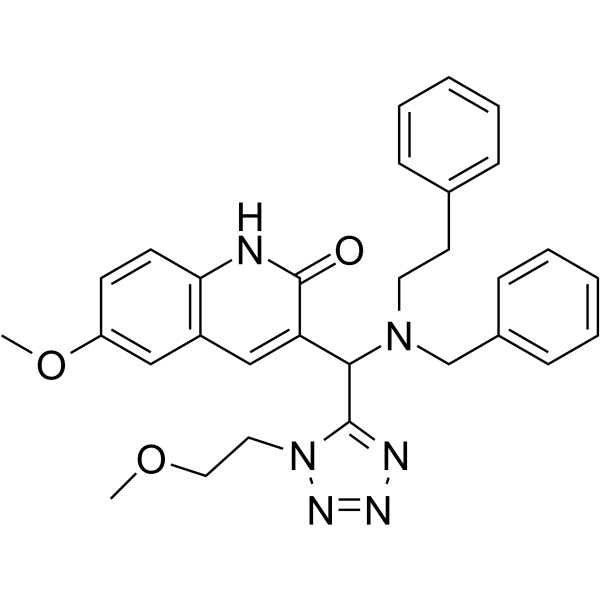
- Formel: C30H32N6O3
- Molecular Weight:524.61
-
Speicherung:Powder -20°C, 3 years ; In solvent -80°C, 6 months , -20°C, 1 month

To place orders, for customer services and technical support, please contact: MedChemExpress USA
Tel: 609-228-6898 E-mail: [email protected] [email protected]


-
 Biologische Aktivität
-
Chemical Information
- Protokoll
- Reinheit & Dokumentation
- Verweise
-
 Help & FAQs




Biologische Aktivität
Beschreibung
In Vitro
ASN04421891 exhibits an EC50 of 3.67 nM as an agonist in GPR17-transfected human 1321N1 cells, with a potency reaching 142.8% of that of the reference agonist LTC4[1].
ASN04421891 (10 nM; 48 h) promotes the differentiation of primary rat oligodendrocyte precursor cells into mature, myelin basic protein-positive oligodendrocytes, with an activity of 140%-170% of that in the vehicle control group[1].
MedChemExpress (MCE) has not independently confirmed the accuracy of these methods. They are for reference only.


Chemical Information
-
CAS. Nr. 570365-12-7
-
Appearance Solid
-
Molecular Weight 524.61
-
Formel C30H32N6O3
-
Color White to off-white
-
SMILES
O=C1NC2=C(C=C(OC)C=C2)C=C1C(C3=NN=NN3CCOC)N(CCC4=CC=CC=C4)CC5=CC=CC=C5
-
Versand
Room temperature in continental US; may vary elsewhere.
-
Speicherung
Powder -20°C 3 years In solvent -80°C 6 months -20°C 1 month


Reinheit & Dokumentation
-
Data Sheet (271 KB)
-
SDS (251 KB)
- English - EN (251 KB)
- Français - FR (251 KB)
- Deutsch - DE (251 KB)
- Norwegian - NO (251 KB)
- Español - ES (251 KB)
- Swedish - SV (251 KB)
- Italian - IT (251 KB)
- Korean - KR (251 KB)
- Portuguese - PT (251 KB)
-
Handling Instructions (2659 KB)
Verweise

Calculators
Konzentration (Stammlösung) × Volumen (Stammlösung) = Konzentration (Ziellösung) × Volumen (Ziellösung)


ASN04421891 Related Classifications
HY-128128 Related Classifications
 Powered by Bioz