



Diphenyl disulfide (Standard)
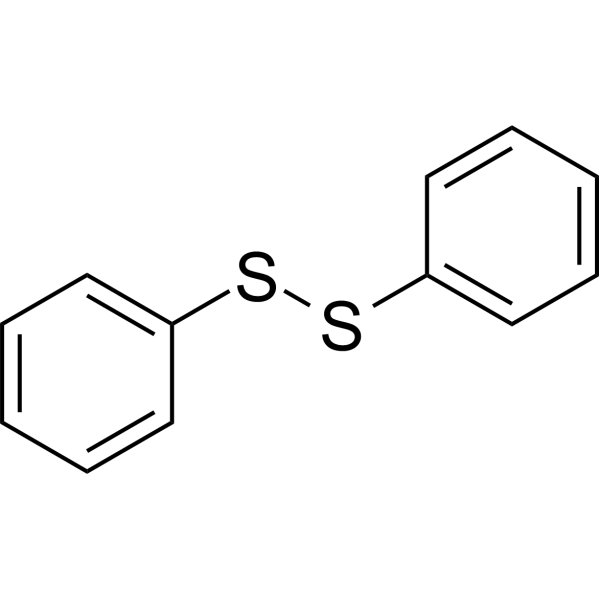
Diphenyl disulfide (Standard) is an analytical standard for diphenyl disulfide (HY-Y1177). This product is intended for research and analytical applications. Diphenyl disulfide (Phenyl disulfide) is an organic disulfide compound. Diphenyl disulfide inhibits the PI3K/AKT/mTOR pathway, and induces ferroptosis (ferroptosis), apoptosis (apoptosis) and autophagy (autophagy) in cancer cells. Diphenyl disulfide downregulates GPX4 expression, inhibits NRF2 phosphorylation, induces lipid peroxidation, promotes xCT ubiquitination, induces proteolytic cleavage of p21 Bax into p18 Bax, and suppresses cell proliferation and viability. Diphenyl disulfide can be used in research related to melanoma and breast cancer.
Nur für Forschungszwecke. Wir verkaufen nicht an Patienten.
- Reinheit : 0%
- CAS. Nr.: 882-33-7
- Formel: C12H10S2
- Molecular Weight:218.35
-
Speicherung:
Please store the product under the recommended conditions in the Certificate of Analysis.


To place orders, for customer services and technical support, please contact: MedChemExpress USA
Tel: 609-228-6898 E-mail: [email protected] [email protected]


-
 Product Information
-
Chemical Information
- Reinheit & Dokumentation
-
 Help & FAQs





Product Information
Information
Anwendung
The compound is the grade of analytical standard, which is the reference standard supplied assay. It is commonly used in qualitative, quantitative and methodological research experiments in HPLC, GC and MS.


Chemical Information
-
CAS. Nr. 882-33-7
-
Molecular Weight 218.35
-
Formel C12H10S2
-
SMILES
C1(SSC2=CC=CC=C2)=CC=CC=C1
-
Synonyms
Phenyl disulfide (Standard)
-
Structure Classification
-
Initial Source
-
Versand
Room temperature in continental US; may vary elsewhere.
-
Speicherung
Please store the product under the recommended conditions in the Certificate of Analysis.


Reinheit & Dokumentation
Verweise
[1]. Demaison J, et al. The S-S Bridge: A Mixed Experimental-Computational Estimation of the Equilibrium Structure of Diphenyl Disulfide. Chemphyschem. 2019 Feb 4;20(3):366-373. [Content Brief]
[2]. Taniguchi N. Alkyl- or arylthiolation of aryl iodide via cleavage of the S-S bond of disulfide compound by nickel catalyst and zinc. J Org Chem. 2004 Oct 1;69(20):6904-6. [Content Brief]

Calculators
Konzentration (Stammlösung) × Volumen (Stammlösung) = Konzentration (Ziellösung) × Volumen (Ziellösung)


Diphenyl disulfide (Standard) Related Classifications
HY-Y1177R Related Classifications
 Powered by Bioz