



Aureothin
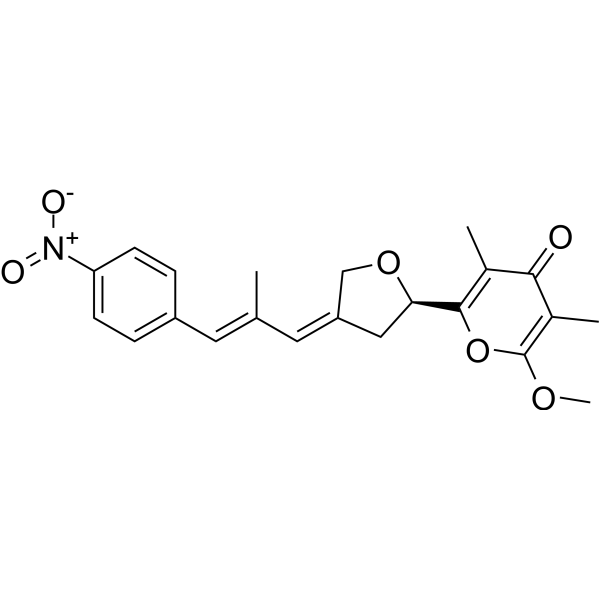
Aureothin, is a natural polyketide, is a HIV inhibitor with an IC50 of 5.3 nM. Aureothin is a microbial biolarvicide.
For research use only. We do not sell to patients.
- CAS No.: 2825-00-5
- Formula: C22H23NO6
- Molecular Weight:397.42
-
Storage:
Please store the product under the recommended conditions in the Certificate of Analysis.

To place orders, for customer services and technical support, please contact: MedChemExpress USA
Tel: 609-228-6898 E-mail: [email protected] [email protected]


-
 Biological Activity
-
Chemical Information
- Protocols
- Purity & Documentation
- References
-
 Help & FAQs




Biological Activity
Description
IC50 & Target
[2]|
HIV 5.3 nM (IC50) |
In Vitro
Aureothin shows larvicidal activity against A. aegypti with a LC50 value of 1.5 ppm for 24 h post-treatment, and 3.8 ppm for 48 h post-treatment[1].
MedChemExpress (MCE) has not independently confirmed the accuracy of these methods. They are for reference only. Further protocols information, click here.


Chemical Information
-
CAS No. 2825-00-5
-
Molecular Weight 397.42
-
Formula C22H23NO6
-
SMILES
CC1=C([C@H]2C/C(CO2)=C/C(C)=C/C3=CC=C(C=C3)[N+]([O-])=O)OC(OC)=C(C1=O)C
-
Initial Source
Streptomyces thioluteus
-
Shipping
Room temperature in continental US; may vary elsewhere.
-
Storage
Please store the product under the recommended conditions in the Certificate of Analysis.

Protocols
-
Cell Cytotoxicity Assay
Cytotoxicity assays are usually based on the assessment of cell membrane damage, which can also be indirectly detected by measuring cell viability. Detection methods include MTT assay, CKK-8 assay, LDH assay and ATP assay, etc.


Purity & Documentation
-
Data Sheet (269 KB)
-
SDS (252 KB)
- Français - FR (252 KB)
- Deutsch - DE (252 KB)
- Norwegian - NO (252 KB)
- Español - ES (252 KB)
- Swedish - SV (252 KB)
- Italian - IT (252 KB)
- Korean - KR (252 KB)
- Portuguese - PT (252 KB)
-
Handling Instructions (2659 KB)
References
[1]. Seong Jong Kim, et al. Streptomyces distallicus, a Potential Microbial Biolarvicide. J Agric Food Chem. 2022 Sep 14;70(36):11274-11280. [Content Brief]
[2]. Alexander Herrmann, et al. Potent inhibition of HIV replication in primary human cells by novel synthetic polyketides inspired by Aureothin. Sci Rep. 2020 Jan 28;10(1):1326. [Content Brief]

Calculators
Concentration (start) × Volume (start) = Concentration (final) × Volume (final)


Aureothin Related Classifications
HY-121291 Related Classifications
 Powered by Bioz