



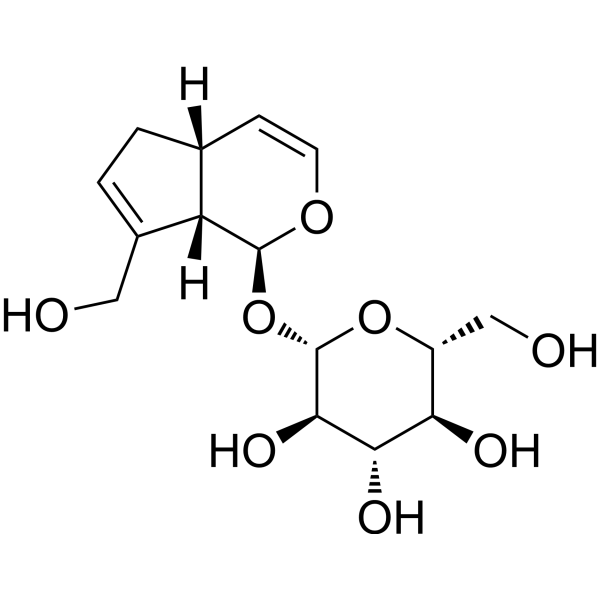
Bartsioside

Based on 1 Customer Validation
Bartsioside is an anti-inflammatory agent which can be extracted from C. deserticola. Bartsioside exerts no significant cytotoxicity under 40 μM to BV-2 cells.
For research use only. We do not sell to patients.
- Purity : 99.50%
- CAS No.: 62133-72-6
- Formula: C15H22O8
- Molecular Weight:330.33
-
Storage:Powder -20°C, 3 years , 4°C, 2 years ; In solvent -80°C, 6 months , -20°C, 1 month

To place orders, for customer services and technical support, please contact: MedChemExpress USA
Tel: 609-228-6898 E-mail: [email protected] [email protected]


-
 Biological Activity
-
Chemical Information
-
Solvent & Solubility
- Protocols
- Purity & Documentation
- References
-
 Help & FAQs




Biological Activity
Description


Chemical Information
-
CAS No. 62133-72-6
-
Appearance Solid
-
Molecular Weight 330.33
-
Formula C15H22O8
-
Color White to off-white
-
SMILES
OCC1=CC[C@@](C=CO2)([H])[C@]1([H])[C@@H]2O[C@@H]3O[C@@H]([C@H]([C@@H]([C@H]3O)O)O)CO
-
Structure Classification
-
Initial Source
-
Shipping
Room temperature in continental US; may vary elsewhere.
-
Storage
Powder -20°C 3 years 4°C 2 years In solvent -80°C 6 months -20°C 1 month


Solvent & Solubility
In Vitro:
H2O : 100 mg/mL (302.73 mM; Need ultrasonic)
Please refer to the solubility information to select the appropriate solvent. Once prepared, please aliquot and store the solution to prevent product inactivation from repeated freeze-thaw cycles.
Storage method and period of stock solution: -80°C, 6 months; -20°C, 1 month. When stored at -80°C, please use it within 6 months. When stored at -20°C, please use it within 1 month.
* Note: If you choose water as the stock solution, please dilute it to the working solution, then filter and sterilize it with a 0.22 μm filter before use.
Please refer to the solubility information to select the appropriate solvent. Once prepared, please aliquot and store the solution to prevent product inactivation from repeated freeze-thaw cycles.
Storage method and period of stock solution: -80°C, 6 months; -20°C, 1 month. When stored at -80°C, please use it within 6 months. When stored at -20°C, please use it within 1 month.
* Note: If you choose water as the stock solution, please dilute it to the working solution, then filter and sterilize it with a 0.22 μm filter before use.
Concentration (start) × Volume (start) = Concentration (final) × Volume (final)


Purity & Documentation
-
Data Sheet (271 KB)
-
SDS (251 KB)
- English - EN (251 KB)
- Français - FR (251 KB)
- Deutsch - DE (251 KB)
- Norwegian - NO (251 KB)
- Español - ES (251 KB)
- Swedish - SV (251 KB)
- Italian - IT (251 KB)
- Korean - KR (251 KB)
- Portuguese - PT (251 KB)
-
Handling Instructions (2659 KB)
References


Complete Stock Solution Preparation Table
Please refer to the solubility information to select the appropriate solvent. Once prepared, please aliquot and store the solution to prevent product inactivation from repeated freeze-thaw cycles.
Storage method and period of stock solution: -80°C, 6 months; -20°C, 1 month. When stored at -80°C, please use it within 6 months. When stored at -20°C, please use it within 1 month.
| Optional Solvent | Concentration Solvent Mass | 1 mg | 5 mg | 10 mg | 25 mg |
|---|---|---|---|---|---|
| H2O | 1 mM | 3.0273 mL | 15.1364 mL | 30.2728 mL | 75.6819 mL |
| 5 mM | 0.6055 mL | 3.0273 mL | 6.0546 mL | 15.1364 mL | |
| 10 mM | 0.3027 mL | 1.5136 mL | 3.0273 mL | 7.5682 mL | |
| 15 mM | 0.2018 mL | 1.0091 mL | 2.0182 mL | 5.0455 mL | |
| 20 mM | 0.1514 mL | 0.7568 mL | 1.5136 mL | 3.7841 mL | |
| 25 mM | 0.1211 mL | 0.6055 mL | 1.2109 mL | 3.0273 mL | |
| 30 mM | 0.1009 mL | 0.5045 mL | 1.0091 mL | 2.5227 mL | |
| 40 mM | 0.0757 mL | 0.3784 mL | 0.7568 mL | 1.8920 mL | |
| 50 mM | 0.0605 mL | 0.3027 mL | 0.6055 mL | 1.5136 mL | |
| 60 mM | 0.0505 mL | 0.2523 mL | 0.5045 mL | 1.2614 mL | |
| 80 mM | 0.0378 mL | 0.1892 mL | 0.3784 mL | 0.9460 mL | |
| 100 mM | 0.0303 mL | 0.1514 mL | 0.3027 mL | 0.7568 mL |
* Note: If you choose water as the stock solution, please dilute it to the working solution, then filter and sterilize it with a 0.22 μm filter before use.


Bartsioside Related Classifications
HY-N12525 Related Classifications
 Powered by Bioz