



Biliverdin hydrochloride
Based on 1 publication(s) in Google Scholar
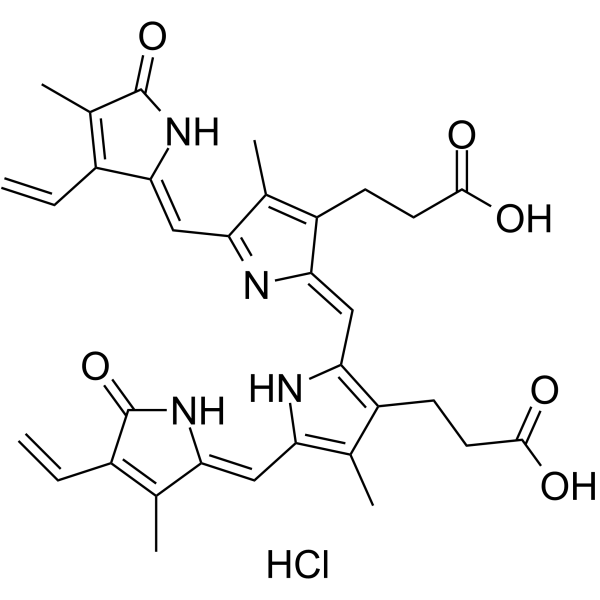
Biliverdin hydrochloride, a tetrapyrrolic pigment, is a product of heme catabolism. Heme is broken down into Biliverdin and carbon monoxide and iron by heme oxidase. Biliverdin hydrochloride is then quickly broken down to bilirubin by Biliverdin reductase. Biliverdin hydrochloride is anti-mutagenic, an antioxidant, anti-inflammatory, and immunosuppressant.
For research use only. We do not sell to patients.
- Purity : 99.3%
- CAS No.: 856699-18-8
- Formula: C33H35ClN4O6
- Molecular Weight:619.11
-
Storage:
-20°C, sealed storage, away from moisture
* In solvent : -80°C, 6 months; -20°C, 1 month (sealed storage, away from moisture)

To place orders, for customer services and technical support, please contact: MedChemExpress USA
Tel: 609-228-6898 E-mail: [email protected] [email protected]


-
 Biological Activity
-
Chemical Information
-
Solvent & Solubility
- Protocols
- Purity & Documentation
- References
-
 Help & FAQs


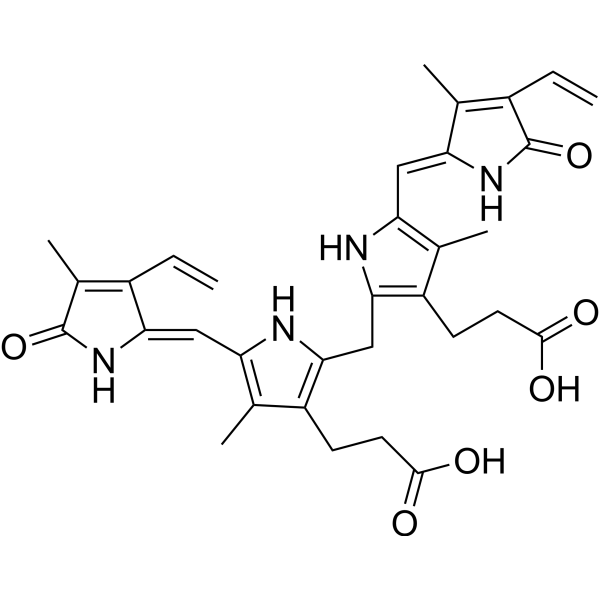
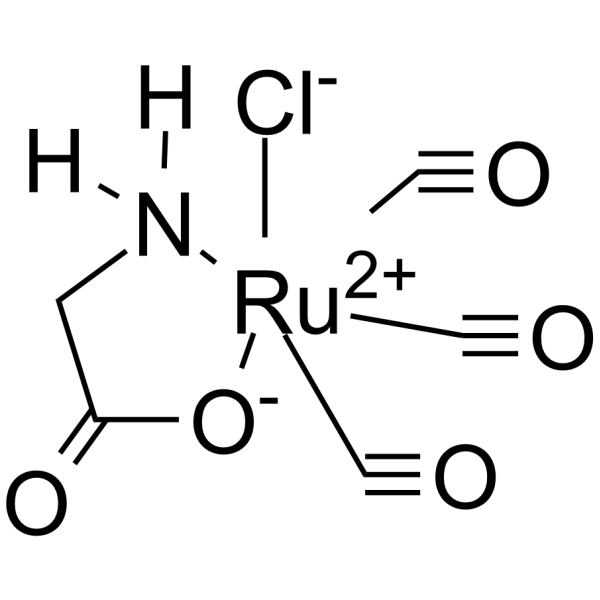
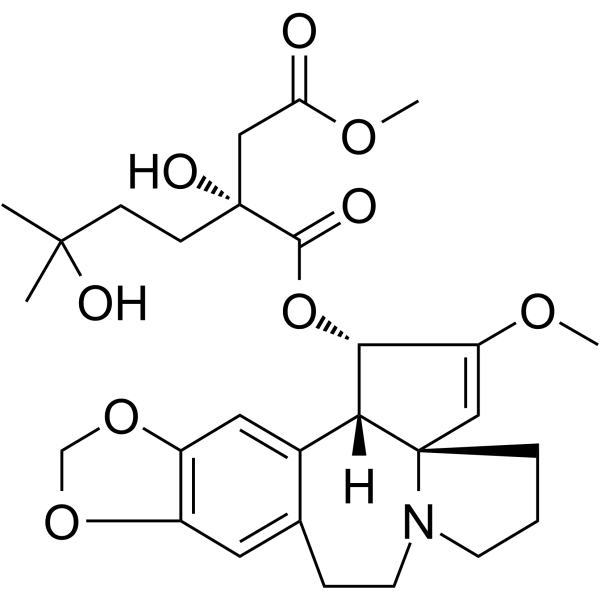
Publications Citing Use of MedChemExpress (MCE) Biliverdin hydrochloride
MoreAll Endogenous Metabolite Isoforms
More

Biological Activity
Description
IC50 & Target
|
Human Endogenous Metabolite |
In Vitro
Biliverdin hydrochloride is considered a waste product of heme degradation. When red blood cells lyse, either due to hemolytic diseases or by natural apoptosis, heme get released. The heme is metabolized by heme oxygenase using three molecules of oxygen and seven electrons and producing Biliverdin IX-alpha, carbon monoxide, and ferrous iron. The Biliverdin IX-alpha undergoes metabolism to bilirubin IX-alpha via NADPH-dependent Biliverdin reductase[1].
The buildup of Biliverdin hydrochloride has been shown to upregulate the activity of Biliverdin hydrochloride reductase, an enzyme that is a regulator of the innate immune system[1].
Biliverdin hydrochloride downregulates the proliferation of vascular smooth muscle cells and demonstrate an antioxidant effect in the damaged blood vessels. This decreases the formation of the tunica intima of blood vessels and blocks neovascularization and angiogenesis[1].
Biliverdin hydrochloride decreases inflammation by downregulating pro-inflammatory cytokines such as TLR-4 and by stimulating the production of anti-inflammatory cytokines such as IL-10[1].
Biliverdin hydrochloride is a scavenger of hydroxyl peroxide groups showing the antioxidant effects of Biliverdin[1].
MedChemExpress (MCE) has not independently confirmed the accuracy of these methods. They are for reference only. Further protocols information, click here.
In Vivo
MedChemExpress (MCE) has not independently confirmed the accuracy of these methods. They are for reference only.


Chemical Information
-
CAS No. 856699-18-8
-
Appearance Solid
-
Molecular Weight 619.11
-
Formula C33H35ClN4O6
-
Color Green to dark green
-
SMILES
OC(CCC1=C(C)C(/C=C(N2)/C(C=C)=C(C)C2=O)=N/C1=C\C3=C(C(C)=C(/C=C(N4)/C(C)=C(C=C)C4=O)N3)CCC(O)=O)=O.Cl
-
Structure Classification
-
Initial Source
-
Shipping
Room temperature in continental US; may vary elsewhere.
-
Storage
-20°C, sealed storage, away from moisture
* In solvent : -80°C, 6 months; -20°C, 1 month (sealed storage, away from moisture)


Publications (1)
-
Journal Impact Factor
-
Most Recent
-
J Virol
Seneca Valley virus 3C protease targets the Nrf2/HO-1 pathway to antagonize its antiviral activity. [Abstract]2026 Feb 17;100(2):e0165625. PMID: 41489372


Solvent & Solubility
In Vitro:
DMSO : 20 mg/mL (32.30 mM; Need ultrasonic and warming; Hygroscopic DMSO has a significant impact on the solubility of product, please use newly opened DMSO)
H2O : < 0.1 mg/mL (insoluble)
Please refer to the solubility information to select the appropriate solvent. Once prepared, please aliquot and store the solution to prevent product inactivation from repeated freeze-thaw cycles.
Storage method and period of stock solution: -80°C, 6 months; -20°C, 1 month (sealed storage, away from moisture). When stored at -80°C, please use it within 6 months. When stored at -20°C, please use it within 1 month.
Please refer to the solubility information to select the appropriate solvent. Once prepared, please aliquot and store the solution to prevent product inactivation from repeated freeze-thaw cycles.
Storage method and period of stock solution: -80°C, 6 months; -20°C, 1 month (sealed storage, away from moisture). When stored at -80°C, please use it within 6 months. When stored at -20°C, please use it within 1 month.
Concentration (start) × Volume (start) = Concentration (final) × Volume (final)

Protocols
-
Research Protocol for Inflammation-related Diseases
The NLRP3 inflammasome is a cytosolic innate immune signaling platform that integrates priming signals and danger-signal activation to promote caspase-1 activation, maturation of IL-1β and IL-18, and gasdermin D-mediated pyroptotic cell death. The core experimental logic is to determine whether inflammatory disease phenotypes are driven by increased NLRP3 expression, ASC-containing inflammasome assembly, caspase-1 cleavage, GSDMD cleavage, and extracellular release of IL-1β/IL-18 rather than by nonspecific cell injury alone. The pathway is strongly linked to inflammation-related disease phenotypes because monosodium urate crystals activate NALP3/NLRP3 inflammasome signaling in gout-like crystal inflammation, cholesterol crystals activate NLRP3 inflammasomes in atherogenesis models, and DSS-induced intestinal inflammation has been reported to involve NLRP3 inflammasome activity. However, experimental colitis studies also show context-dependent protective effects of NLRP3 inflammasome co
-
Genotoxicity/Mutagenicity Study
The bacterial reverse mutation assay detects point mutations that restore amino-acid prototrophy in auxotrophic Salmonella typhimurium or Escherichia coli tester strains; after exposure to a test article, mutagenic activity is read out as an increased number of revertant colonies on minimal agar compared with the vehicle control. The assay uses tester strains with different mutation targets so that base-substitution and frameshift mutagens can be detected, and testing is performed with and without exogenous mammalian metabolic activation because some chemicals require biotransformation to become mutagenic.


Purity & Documentation
-
Data Sheet (282 KB)
-
SDS (394 KB)
- English - EN (394 KB)
- Français - FR (394 KB)
- Deutsch - DE (394 KB)
- Norwegian - NO (394 KB)
- Español - ES (394 KB)
- Swedish - SV (394 KB)
- Italian - IT (394 KB)
- Korean - KR (394 KB)
- Portuguese - PT (394 KB)
-
Handling Instructions (2659 KB)
References


Complete Stock Solution Preparation Table
Please refer to the solubility information to select the appropriate solvent. Once prepared, please aliquot and store the solution to prevent product inactivation from repeated freeze-thaw cycles.
Storage method and period of stock solution: -80°C, 6 months; -20°C, 1 month (sealed storage, away from moisture). When stored at -80°C, please use it within 6 months. When stored at -20°C, please use it within 1 month.
| Optional Solvent | Concentration Solvent Mass | 1 mg | 5 mg | 10 mg | 25 mg |
|---|---|---|---|---|---|
| DMSO | 1 mM | 1.6152 mL | 8.0761 mL | 16.1522 mL | 40.3805 mL |
| 5 mM | 0.3230 mL | 1.6152 mL | 3.2304 mL | 8.0761 mL | |
| 10 mM | 0.1615 mL | 0.8076 mL | 1.6152 mL | 4.0381 mL | |
| 15 mM | 0.1077 mL | 0.5384 mL | 1.0768 mL | 2.6920 mL | |
| 20 mM | 0.0808 mL | 0.4038 mL | 0.8076 mL | 2.0190 mL | |
| 25 mM | 0.0646 mL | 0.3230 mL | 0.6461 mL | 1.6152 mL | |
| 30 mM | 0.0538 mL | 0.2692 mL | 0.5384 mL | 1.3460 mL |


Biliverdin hydrochloride Related Classifications
HY-135005 Related Classifications
 Powered by Bioz