



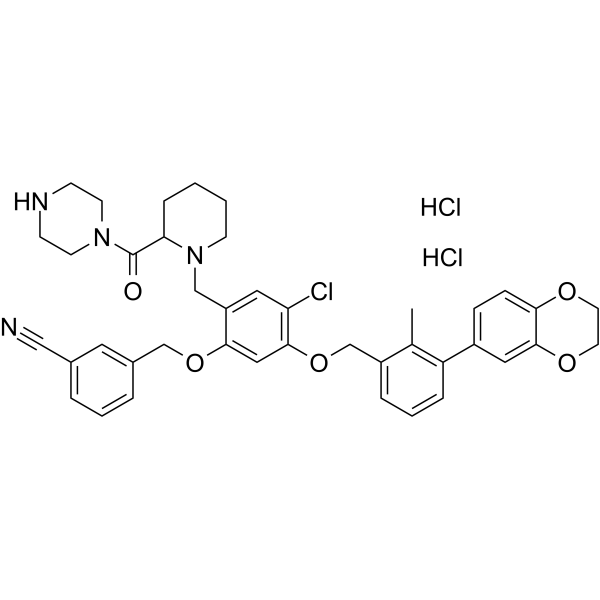
BMS-1166-N-piperidine-CO-N-piperazine dihydrochloride

Based on 1 Customer Validation
BMS-1166-N-piperidine-CO-N-piperazine dihydrochloride incorporates a ligand for PD-1/PD-L1 immune checkpoint, and a PROTAC linker. BMS-1166-N-piperidine-CO-N-piperazine dihydrochloride can be used in the synthesis of PROTAC PD-1/PD-L1 degrader-1?(HY-131183). PROTAC PD-1/PD-L1 degrader-1 inhibits PD-1/PD-L1 interaction with an IC50 of 39.2 nM.
For research use only. We do not sell to patients.
- Purity : 95.01%
- CAS No.: 2691796-83-3
- Formula: C41H45Cl3N4O5
- Molecular Weight:780.18
-
Storage:Powder -20°C, 3 years , 4°C, 2 years ; In solvent -80°C, 6 months , -20°C, 1 month

To place orders, for customer services and technical support, please contact: MedChemExpress USA
Tel: 609-228-6898 E-mail: [email protected] [email protected]


-
 Biological Activity
-
Chemical Information
-
Solvent & Solubility
- Protocols
- Purity & Documentation
- References
-
 Help & FAQs




Biological Activity
Description
Cellular Effect
|
Cell Line

|
Type | Value | Description | References |
|---|---|---|---|---|
| HeLa | IC50 |
2.8 μM
Compound: P7
|
Antiproliferative activity against human HeLa cells assessed as cell viability after 48 hrs by CCK-8 assay
Antiproliferative activity against human HeLa cells assessed as cell viability after 48 hrs by CCK-8 assay
|
[PMID: 33264007] |
| HepG2 | IC50 |
1.1 μM
Compound: P7
|
Antiproliferative activity against human HepG2 cells assessed as cell viability after 48 hrs by CCK-8 assay
Antiproliferative activity against human HepG2 cells assessed as cell viability after 48 hrs by CCK-8 assay
|
[PMID: 33264007] |
| Jurkat | IC50 |
8.1 μM
Compound: P7
|
Antiproliferative activity against human Jurkat cells assessed as cell viability after 48 hrs by CCK-8 assay
Antiproliferative activity against human Jurkat cells assessed as cell viability after 48 hrs by CCK-8 assay
|
[PMID: 33264007] |
| MCF7 | IC50 |
3.2 μM
Compound: P7
|
Antiproliferative activity against human MCF7 cells assessed as cell viability after 48 hrs by CCK-8 assay
Antiproliferative activity against human MCF7 cells assessed as cell viability after 48 hrs by CCK-8 assay
|
[PMID: 33264007] |
| NCI-H1299 | IC50 |
3.6 μM
Compound: P7
|
Antiproliferative activity against human H1299 cells assessed as cell viability after 48 hrs by CCK-8 assay
Antiproliferative activity against human H1299 cells assessed as cell viability after 48 hrs by CCK-8 assay
|
[PMID: 33264007] |
In Vitro
PROTACs contain two different ligands connected by a linker; one is a ligand for an E3 ubiquitin ligase and the other is for the target protein. PROTACs exploit the intracellular ubiquitin-proteasome system to selectively degrade target proteins[1].
MedChemExpress (MCE) has not independently confirmed the accuracy of these methods. They are for reference only. Further protocols information, click here.


Chemical Information
-
CAS No. 2691796-83-3
-
Appearance Solid
-
Molecular Weight 780.18
-
Formula C41H45Cl3N4O5
-
Color White to off-white
-
SMILES
N#CC1=CC=CC(COC2=CC(OCC3=CC=CC(C4=CC=C5OCCOC5=C4)=C3C)=C(C=C2CN6CCCCC6C(N7CCNCC7)=O)Cl)=C1.Cl.Cl
-
Shipping
Room temperature in continental US; may vary elsewhere.
-
Storage
Powder -20°C 3 years 4°C 2 years In solvent -80°C 6 months -20°C 1 month


Solvent & Solubility
In Vitro:
DMSO : 100 mg/mL (128.18 mM; Need ultrasonic; Hygroscopic DMSO has a significant impact on the solubility of product, please use newly opened DMSO)
Please refer to the solubility information to select the appropriate solvent. Once prepared, please aliquot and store the solution to prevent product inactivation from repeated freeze-thaw cycles.
Storage method and period of stock solution: -80°C, 6 months; -20°C, 1 month. When stored at -80°C, please use it within 6 months. When stored at -20°C, please use it within 1 month.
Please refer to the solubility information to select the appropriate solvent. Once prepared, please aliquot and store the solution to prevent product inactivation from repeated freeze-thaw cycles.
Storage method and period of stock solution: -80°C, 6 months; -20°C, 1 month. When stored at -80°C, please use it within 6 months. When stored at -20°C, please use it within 1 month.
Concentration (start) × Volume (start) = Concentration (final) × Volume (final)
In Vivo:
Select the appropriate dissolution method based on your experimental animal and administration route.
- For the following dissolution methods, please ensure to first prepare a clear stock solution using an In Vitro approach and then sequentially add co-solvents:
- To ensure reliable experimental results, the clarified stock solution can be appropriately stored based on storage conditions. As for the working solution for In Vivo experiments, it is recommended to prepare freshly and use it on the same day.
- The percentages shown for the solvents indicate their volumetric ratio in the final prepared solution. If precipitation or phase separation occurs during preparation, heat and/or sonication can be used to aid dissolution.
Add each solvent one by one: 10% DMSO 40% PEG300 5% Tween-80 45% Saline
Solubility: ≥ 2.5 mg/mL (3.20 mM); Clear solution
This protocol yields a clear solution of ≥ 2.5 mg/mL (saturation unknown).
Taking 1 mL working solution as an example, add 100 μL DMSO stock solution (25.0 mg/mL) to 400 μL PEG300, and mix evenly; then add 50 μL Tween-80 and mix evenly; then add 450 μL Saline to adjust the volume to 1 mL.
Preparation of Saline: Dissolve 0.9 g sodium chloride in ddH₂O and dilute to 100 mL to obtain a clear Saline solution.
Add each solvent one by one: 10% DMSO 90% (20% SBE-β-CD in Saline)
Solubility: 2.5 mg/mL (3.20 mM); Suspended solution; Need ultrasonic
This protocol yields a suspended solution of 2.5 mg/mL. Suspended solution can be used for oral and intraperitoneal injection.
Taking 1 mL working solution as an example, add 100 μL DMSO stock solution (25.0 mg/mL) to 900 μL 20% SBE-β-CD in Saline, and mix evenly.
Preparation of 20% SBE-β-CD in Saline (4°C, storage for one week): 2 g SBE-β-CD powder is dissolved in 10 mL Saline, completely dissolve until clear.
In Vivo Dissolution Calculator
Please enter the basic information of animal experiments:
-
-
-
-
Recommended: Prepare an additional quantity of animals to account for potential losses during experiments.
Please enter your animal formula composition:
-
%DMSO +
Recommended: Keep the proportion of DMSO in working solution below 2% if your animal is weak.
-
%+
-
+%Tween-80 + +
-
%Saline +
The co-solvents required include: DMSO, . All of co-solvents are available by MedChemExpress (MCE). , Tween 80. All of co-solvents are available by MedChemExpress (MCE).
Working solution concentration: 0.22 mg/mL
Method for preparing stock solution: mg drug dissolved in μL DMSO. Stock solution concentration: mg/mL.
1. Take μL DMSO stock solution;
2. Add μL .
μL , mix evenly;
3. Then add μL Tween 80, mix evenly;
4. Then add μL
Please ensure that the stock solution in the first step is dissolved to a clear state, and add co-solvents in sequence. You can use ultrasonic heating (ultrasonic cleaner, recommended frequency 20-40 kHz), vortexing, etc. to assist dissolution.

Protocols
-
Cell Cytotoxicity Assay
Cytotoxicity assays are usually based on the assessment of cell membrane damage, which can also be indirectly detected by measuring cell viability. Detection methods include MTT assay, CKK-8 assay, LDH assay and ATP assay, etc.
-
Research Protocol for Cancer Immunology
Cancer immunology studies how the immune system recognizes, suppresses, edits, or fails to eliminate malignant cells through tumor antigen release, antigen presentation, T-cell priming, immune trafficking, tumor-cell killing, and feedback inhibition in the tumor microenvironment. The cancer-immunity cycle links tumor antigenicity, dendritic-cell priming, CD8+ T-cell infiltration, cytotoxic function, and immune-checkpoint regulation to tumor rejection or immune escape. Immune-checkpoint pathways such as PD-1/PD-L1 and CTLA-4 suppress antitumor T-cell activity and can be therapeutically blocked, but many tumors remain resistant because of poor antigen presentation, weak T-cell infiltration, suppressive myeloid cells, regulatory T cells, and tumor-intrinsic immune-exclusion programs. Unresolved questions include which immune-cell states predict response, how tumor-intrinsic pathways exclude immune cells, how myeloid suppression limits checkpoint blockade, and which combination strategies


Purity & Documentation
-
Data Sheet (272 KB)
-
SDS (252 KB)
- English - EN (252 KB)
- Français - FR (252 KB)
- Deutsch - DE (252 KB)
- Norwegian - NO (252 KB)
- Español - ES (252 KB)
- Swedish - SV (252 KB)
- Italian - IT (252 KB)
- Korean - KR (252 KB)
- Portuguese - PT (252 KB)
-
Handling Instructions (2659 KB)
References


Complete Stock Solution Preparation Table
Please refer to the solubility information to select the appropriate solvent. Once prepared, please aliquot and store the solution to prevent product inactivation from repeated freeze-thaw cycles.
Storage method and period of stock solution: -80°C, 6 months; -20°C, 1 month. When stored at -80°C, please use it within 6 months. When stored at -20°C, please use it within 1 month.
| Optional Solvent | Concentration Solvent Mass | 1 mg | 5 mg | 10 mg | 25 mg |
|---|---|---|---|---|---|
| DMSO | 1 mM | 1.2818 mL | 6.4088 mL | 12.8176 mL | 32.0439 mL |
| 5 mM | 0.2564 mL | 1.2818 mL | 2.5635 mL | 6.4088 mL | |
| 10 mM | 0.1282 mL | 0.6409 mL | 1.2818 mL | 3.2044 mL | |
| 15 mM | 0.0855 mL | 0.4273 mL | 0.8545 mL | 2.1363 mL | |
| 20 mM | 0.0641 mL | 0.3204 mL | 0.6409 mL | 1.6022 mL | |
| 25 mM | 0.0513 mL | 0.2564 mL | 0.5127 mL | 1.2818 mL | |
| 30 mM | 0.0427 mL | 0.2136 mL | 0.4273 mL | 1.0681 mL | |
| 40 mM | 0.0320 mL | 0.1602 mL | 0.3204 mL | 0.8011 mL | |
| 50 mM | 0.0256 mL | 0.1282 mL | 0.2564 mL | 0.6409 mL | |
| 60 mM | 0.0214 mL | 0.1068 mL | 0.2136 mL | 0.5341 mL | |
| 80 mM | 0.0160 mL | 0.0801 mL | 0.1602 mL | 0.4005 mL | |
| 100 mM | 0.0128 mL | 0.0641 mL | 0.1282 mL | 0.3204 mL |


BMS-1166-N-piperidine-CO-N-piperazine dihydrochloride Related Classifications
HY-131386A Related Classifications
 Powered by Bioz