



Orange G

Based on 1 Customer Validation
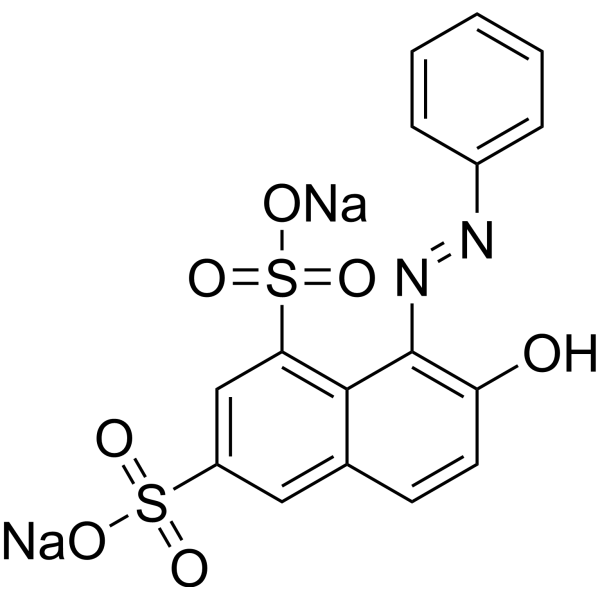
Orange G is an azo dye commonly found in textile wastewater and is mainly used for textile dyeing. Orange G has a coloring function and can give textiles a specific color. The stability and potential hazards of Orange G in the environment are often used to study the removal effects of various wastewater treatment technologies on difficult-to-degrade organic pollutants, especially the degradation of azo dyes. Related research focuses on how to destroy the azo bond of Orange G through chemical, physical or biological methods to achieve harmless treatment to solve the problem of textile wastewater pollution.
For research use only. We do not sell to patients.
- CAS No.: 1936-15-8
- Formula: C16H10N2Na2O7S2
- Molecular Weight:452.37
-
Storage:
4°C, sealed storage, away from moisture and light
* In solvent : -80°C, 6 months; -20°C, 1 month (sealed storage, away from moisture and light)

To place orders, for customer services and technical support, please contact: MedChemExpress USA
Tel: 609-228-6898 E-mail: [email protected] [email protected]


-
 Biological Activity
-
Chemical Information
-
Solvent & Solubility
- Purity & Documentation
- References
-
 Help & FAQs


-
HY-W040226
Indigo carmine -
HY-D0257
TartrazineAzo Dye -
HY-D0213
Sudan Black BFat-soluble Diazo Dye -
HY-D0914
Fast Green FCFSea Green Triarylmethane Food Dye -
HY-128382
Brilliant Black BNAntiviral Agent -
HY-D0003
Methyl BlueAntiseptic Dye -
HY-12489
Ponceau SProtein Staining Agent -
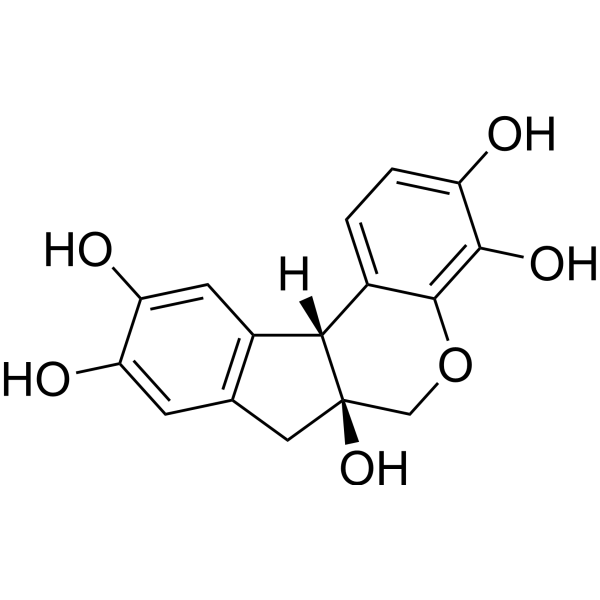
HY-N0116
HematoxylinHistologic Stain -
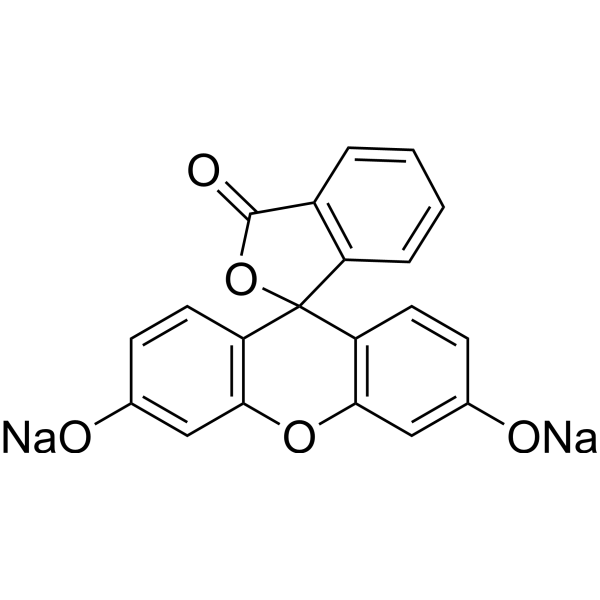
HY-D0208
Fluorescein sodiumFluorescent Tracer -
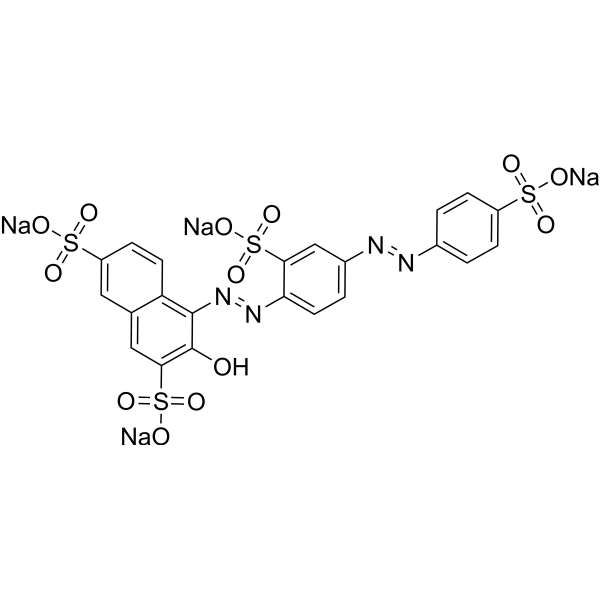
HY-12489A
Ponceau S, BSBiochemical Assay Reagent -

HY-145612
Sudan red 7BDye -
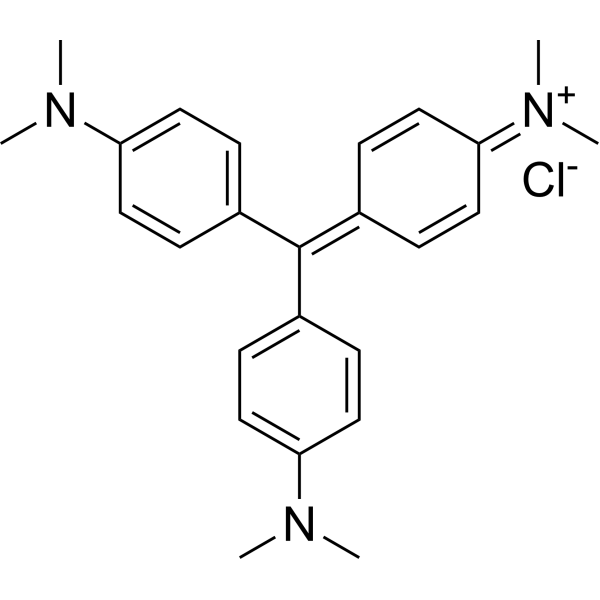
HY-B0324A
Crystal VioletFluorochrome


Biological Activity
Description
In Vitro
Orange G can be activated by persulfate. When Orange G (11.6 mM) was treated with 20 mM Fe (II) and 153 mM persulfate (PS), the main oxidation intermediates were phenol (PH) and benzoquinone (BQ). Orange G (0.1 mM) was reduced by 1 mM Fe (II), Fe (III), or zero-valent iron (ZVI) and 1 mM PS. Fe (II) and Fe (III) as activators completely removed the contaminant within 30 minutes, while ZVI as an activator had a lower oxidation rate. Increasing the concentration of oxidant and activator (0.2 mM Orange G, 2 mM Fe (III), and 6 mM PS) achieved mineralization close to 75% and complete removal of contaminants and ecotoxicity [1].
Orange G can be degraded by ultrasound (213 kHz), photocatalysis, and the combination of the two (sound-photocatalysis). The degradation rate of Orange G (0.09 mM, 75 min) was 43% in the ultrasound experiment alone, 59% in the photocatalysis experiment alone, and 85% in the sound-photocatalysis experiment. In addition, acidic pH (5.8) was conducive to ultrasound degradation, while alkaline pH (12) was conducive to photocatalytic degradation. The sound-photocatalysis process only showed an additive effect rather than a synergistic effect, and the total organic carbon (TOC) removal rate of sound-photocatalysis at pH 5.8 was higher, reaching 82%[2].
MedChemExpress (MCE) has not independently confirmed the accuracy of these methods. They are for reference only.


Chemical Information
-
CAS No. 1936-15-8
-
Appearance Solid
-
Molecular Weight 452.37
-
Formula C16H10N2Na2O7S2
-
Color Orange to red
-
SMILES
O=S(C1=C2C(/N=N/C3=CC=CC=C3)=C(O)C=CC2=CC(S(=O)(O[Na])=O)=C1)(O[Na])=O
-
Synonyms
Acid Orange GG
-
Shipping
Room temperature in continental US; may vary elsewhere.
-
Storage
4°C, sealed storage, away from moisture and light
* In solvent : -80°C, 6 months; -20°C, 1 month (sealed storage, away from moisture and light)


Solvent & Solubility
In Vitro:
DMSO : 25 mg/mL (55.26 mM; Need ultrasonic; Hygroscopic DMSO has a significant impact on the solubility of product, please use newly opened DMSO)
Please refer to the solubility information to select the appropriate solvent. Once prepared, please aliquot and store the solution to prevent product inactivation from repeated freeze-thaw cycles.
Storage method and period of stock solution: -80°C, 6 months; -20°C, 1 month (sealed storage, away from moisture and light). When stored at -80°C, please use it within 6 months. When stored at -20°C, please use it within 1 month.
Please refer to the solubility information to select the appropriate solvent. Once prepared, please aliquot and store the solution to prevent product inactivation from repeated freeze-thaw cycles.
Storage method and period of stock solution: -80°C, 6 months; -20°C, 1 month (sealed storage, away from moisture and light). When stored at -80°C, please use it within 6 months. When stored at -20°C, please use it within 1 month.
Concentration (start) × Volume (start) = Concentration (final) × Volume (final)


Purity & Documentation
-
Data Sheet (281 KB)
-
SDS (394 KB)
- English - EN (394 KB)
- Français - FR (394 KB)
- Deutsch - DE (394 KB)
- Norwegian - NO (394 KB)
- Español - ES (394 KB)
- Swedish - SV (394 KB)
- Italian - IT (394 KB)
- Korean - KR (394 KB)
- Portuguese - PT (394 KB)
-
Handling Instructions (2659 KB)
References
[1]. Rodriguez S, et al. Oxidation of Orange G by persulfate activated by Fe(II), Fe(III) and zero valent iron (ZVI). Chemosphere. 2014 Apr;101:86-92. [Content Brief]
[2]. Madhavan J, et al. Degradation of orange-G by advanced oxidation processes. Ultrason Sonochem. 2010 Feb;17(2):338-43. [Content Brief]


Complete Stock Solution Preparation Table
Please refer to the solubility information to select the appropriate solvent. Once prepared, please aliquot and store the solution to prevent product inactivation from repeated freeze-thaw cycles.
Storage method and period of stock solution: -80°C, 6 months; -20°C, 1 month (sealed storage, away from moisture and light). When stored at -80°C, please use it within 6 months. When stored at -20°C, please use it within 1 month.
| Optional Solvent | Concentration Solvent Mass | 1 mg | 5 mg | 10 mg | 25 mg |
|---|---|---|---|---|---|
| DMSO | 1 mM | 2.2106 mL | 11.0529 mL | 22.1058 mL | 55.2645 mL |
| 5 mM | 0.4421 mL | 2.2106 mL | 4.4212 mL | 11.0529 mL | |
| 10 mM | 0.2211 mL | 1.1053 mL | 2.2106 mL | 5.5264 mL | |
| 15 mM | 0.1474 mL | 0.7369 mL | 1.4737 mL | 3.6843 mL | |
| 20 mM | 0.1105 mL | 0.5526 mL | 1.1053 mL | 2.7632 mL | |
| 25 mM | 0.0884 mL | 0.4421 mL | 0.8842 mL | 2.2106 mL | |
| 30 mM | 0.0737 mL | 0.3684 mL | 0.7369 mL | 1.8421 mL | |
| 40 mM | 0.0553 mL | 0.2763 mL | 0.5526 mL | 1.3816 mL | |
| 50 mM | 0.0442 mL | 0.2211 mL | 0.4421 mL | 1.1053 mL |


Orange G Related Classifications
HY-135712 Related Classifications
 Powered by Bioz