



TRAP-7

Based on 1 Customer Validation
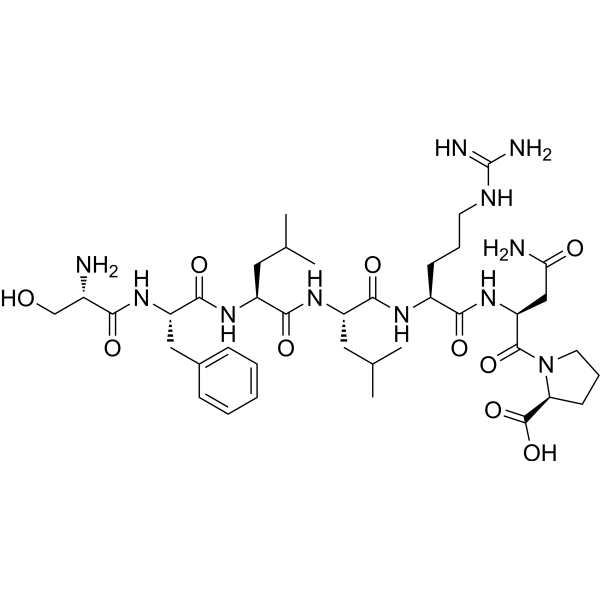
TRAP-7 is a thrombin receptor (PAR) activating peptide. TRAP-7 stimulates total inositol phosphate (IP) accumulation and phosphorylation of a specific endogenous substrate for activated PKC. TRAP-7 can be used in cardiovascular disease research.
For research use only. We do not sell to patients.
- Purity : 99.86%
- CAS No.: 145229-76-1
- Formula: C39H63N11O10
- Molecular Weight:845.99
-
Storage:
Sealed storage, away from moisture.
Powder -80°C, 2 years , -20°C, 1 year* In solvent : -80°C, 6 months; -20°C, 1 month (sealed storage, away from moisture)

To place orders, for customer services and technical support, please contact: MedChemExpress USA
Tel: 609-228-6898 E-mail: [email protected] [email protected]


-
 Biological Activity
-
Chemical Information
-
Solvent & Solubility
- Protocols
- Purity & Documentation
- References
-
 Help & FAQs




Biological Activity
Description


Chemical Information
-
CAS No. 145229-76-1
-
Appearance Solid
-
Molecular Weight 845.99
-
Formula C39H63N11O10
-
Color White to off-white
-
Sequence
Ser-Phe-Leu-Leu-Arg-Asn-Pro
-
Sequence Shortening
SFLLRNP
-
Shipping
Room temperature in continental US; may vary elsewhere.
-
Storage
Sealed storage, away from moisture
Powder -80°C 2 years -20°C 1 year * In solvent : -80°C, 6 months; -20°C, 1 month (sealed storage, away from moisture)


Solvent & Solubility
In Vitro:
H2O : ≥ 100 mg/mL (118.20 mM)
* "≥" means soluble, but saturation unknown.
Please refer to the solubility information to select the appropriate solvent. Once prepared, please aliquot and store the solution to prevent product inactivation from repeated freeze-thaw cycles.
Storage method and period of stock solution: -80°C, 6 months; -20°C, 1 month (sealed storage, away from moisture). When stored at -80°C, please use it within 6 months. When stored at -20°C, please use it within 1 month.
* Note: If you choose water as the stock solution, please dilute it to the working solution, then filter and sterilize it with a 0.22 μm filter before use.
Please refer to the solubility information to select the appropriate solvent. Once prepared, please aliquot and store the solution to prevent product inactivation from repeated freeze-thaw cycles.
Storage method and period of stock solution: -80°C, 6 months; -20°C, 1 month (sealed storage, away from moisture). When stored at -80°C, please use it within 6 months. When stored at -20°C, please use it within 1 month.
* Note: If you choose water as the stock solution, please dilute it to the working solution, then filter and sterilize it with a 0.22 μm filter before use.
Concentration (start) × Volume (start) = Concentration (final) × Volume (final)


Purity & Documentation
-
Data Sheet (273 KB)
-
SDS (394 KB)
- English - EN (394 KB)
- Français - FR (394 KB)
- Deutsch - DE (394 KB)
- Norwegian - NO (394 KB)
- Español - ES (394 KB)
- Swedish - SV (394 KB)
- Italian - IT (394 KB)
- Korean - KR (394 KB)
- Portuguese - PT (394 KB)
-
Handling Instructions (2659 KB)
References
[1]. Webb ML, et al. Effects of thrombin receptor activating peptide on phosphoinositide hydrolysis and protein kinase C activation in cultured rat aortic smooth muscle cells: evidence for "tethered-ligand" activation of smooth muscle cell thrombin receptors. Biochem Pharmacol. 1993 Apr 22;45(8):1577-82. [Content Brief]


Complete Stock Solution Preparation Table
Please refer to the solubility information to select the appropriate solvent. Once prepared, please aliquot and store the solution to prevent product inactivation from repeated freeze-thaw cycles.
Storage method and period of stock solution: -80°C, 6 months; -20°C, 1 month (sealed storage, away from moisture). When stored at -80°C, please use it within 6 months. When stored at -20°C, please use it within 1 month.
| Optional Solvent | Concentration Solvent Mass | 1 mg | 5 mg | 10 mg | 25 mg |
|---|---|---|---|---|---|
| H2O | 1 mM | 1.1820 mL | 5.9102 mL | 11.8205 mL | 29.5512 mL |
| 5 mM | 0.2364 mL | 1.1820 mL | 2.3641 mL | 5.9102 mL | |
| 10 mM | 0.1182 mL | 0.5910 mL | 1.1820 mL | 2.9551 mL | |
| 15 mM | 0.0788 mL | 0.3940 mL | 0.7880 mL | 1.9701 mL | |
| 20 mM | 0.0591 mL | 0.2955 mL | 0.5910 mL | 1.4776 mL | |
| 25 mM | 0.0473 mL | 0.2364 mL | 0.4728 mL | 1.1820 mL | |
| 30 mM | 0.0394 mL | 0.1970 mL | 0.3940 mL | 0.9850 mL | |
| 40 mM | 0.0296 mL | 0.1478 mL | 0.2955 mL | 0.7388 mL | |
| 50 mM | 0.0236 mL | 0.1182 mL | 0.2364 mL | 0.5910 mL | |
| 60 mM | 0.0197 mL | 0.0985 mL | 0.1970 mL | 0.4925 mL | |
| 80 mM | 0.0148 mL | 0.0739 mL | 0.1478 mL | 0.3694 mL | |
| 100 mM | 0.0118 mL | 0.0591 mL | 0.1182 mL | 0.2955 mL |
* Note: If you choose water as the stock solution, please dilute it to the working solution, then filter and sterilize it with a 0.22 μm filter before use.


TRAP-7 Related Classifications
HY-P4987 Related Classifications
 Powered by Bioz