



FR194738
Based on 2 publication(s) in Google Scholar
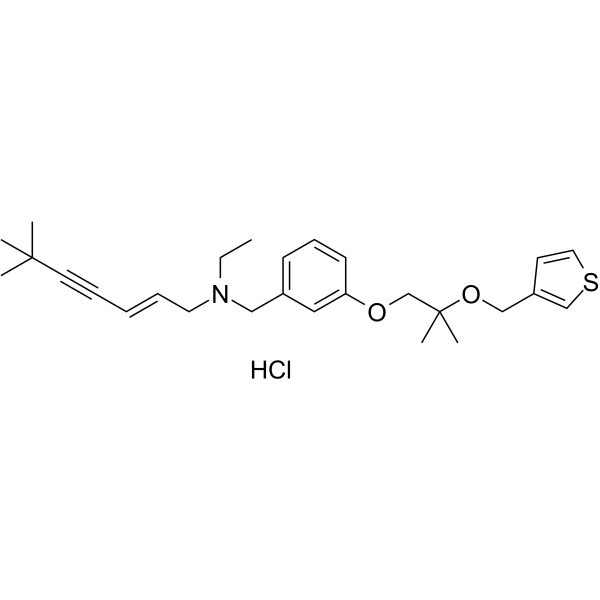
FR194738 is a squalene epoxidase inhibitor. FR194738 inhibits squalene epoxidase activity in HepG2 cell homogenates with an IC50 of 9.8 nM.
Nos produits utilisent uniquement pour la recherche. Nous ne vendons pas aux patients.
- Pureté : 98.76%
- CAS No.: 204067-52-7
- Formule: C27H38ClNO2S
- Masse moléculaire:476.11
-
Stockage:
4°C, sealed storage, away from moisture
* In solvent : -80°C, 6 months; -20°C, 1 month (sealed storage, away from moisture)

To place orders, for customer services and technical support, please contact: MedChemExpress USA
Tel: 609-228-6898 E-mail: [email protected] [email protected]


-
 Activité biologique
-
Chemical Information
-
Solvant et solubilité
- Pureté et documentation
- Références
-
 Help & FAQs


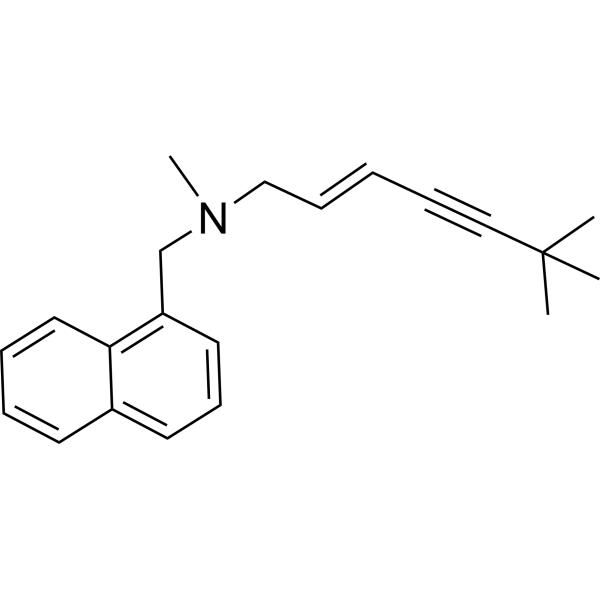
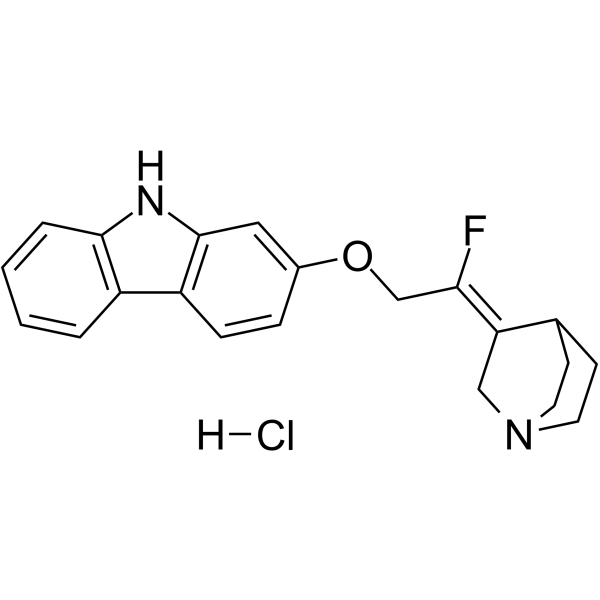
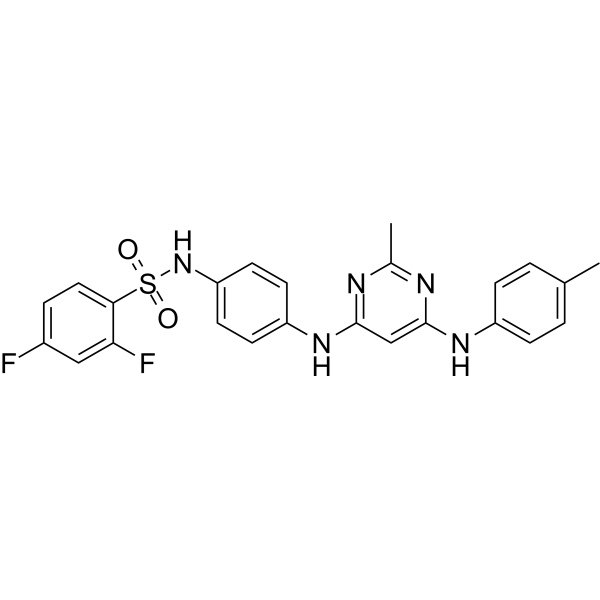
Publications Citing Use of MedChemExpress (MCE) FR194738
More

Activité biologique
Description
IC50 & Target
IC50: 9.8 nM (squalene epoxidase, in HepG2 cell homogenates)[1]
In Vitro
In intact HepG2 cells<, FR194738 concentration-dependently inhibits the incorporation of [14C]acetate into free cholesterol and cholesteryl ester, with IC50s of 4.9 and 8.0 nM, respectively. FR194738 induces intracellular [14C]squalene accumulation. FR194738 increases the incorporation of [14C]acetate into squalene, an intermediate of cholesterol synthesis[1]. FR194738 potently inhibits squalene epoxidase (SE) in HepG2 cell homogenate and liver microsomes in dogs and rats. The inhibitory effect of FR194738 in comparison to the HMG-CoA reductase inhibitors, Simvastatin, Fluvastatin and Pravastatin, on cholesterol biosynthesis in HepG2 cells is examined. Among these compounds, FR194738 is the most potent, with an IC50 of 2.1 nM. The IC50s of Simvastatin, Fluvastatin and Pravastatin are 40, 28 and 5100 nM, respectively[2]. FR194738 inhibits hamster liver microsomal squalene epoxidase activity in a concentration-dependent manner with an IC50 of 14 nM[3].
MedChemExpress (MCE) has not independently confirmed the accuracy of these methods. They are for reference only. .
In Vivo
MedChemExpress (MCE) has not independently confirmed the accuracy of these methods. They are for reference only.


Chemical Information
-
CAS No. 204067-52-7
-
Appearance Solid
-
Masse moléculaire 476.11
-
Formule C27H38ClNO2S
-
Color Off-white to light yellow
-
SMILES
CC(OCC1=CSC=C1)(C)COC2=CC(CN(C/C=C/C#CC(C)(C)C)CC)=CC=C2.Cl
-
Livraison
Room temperature in continental US; may vary elsewhere.
-
Stockage
4°C, sealed storage, away from moisture
* In solvent : -80°C, 6 months; -20°C, 1 month (sealed storage, away from moisture)


Publications (2)
-
Journal Impact Factor
-
Most Recent
-
Cancer Res
Squalene Epoxidase Metabolic Dependency Is a Targetable Vulnerability in Castration-Resistant Prostate Cancer. [Abstract]2022 Sep 2;82(17):3032-3044. PMID: 35767703 -
Clin Transl Med
Identifying squalene epoxidase as a metabolic vulnerability in high-risk osteosarcoma using an artificial intelligence-derived prognostic index. [Abstract]2024 Feb;14(2):e1586. PMID: 38372422


Solvant et solubilité
In Vitro:
DMSO : 100 mg/mL (210.04 mM; Need ultrasonic; Hygroscopic DMSO has a significant impact on the solubility of product, please use newly opened DMSO)
Please refer to the solubility information to select the appropriate solvent. Once prepared, please aliquot and store the solution to prevent product inactivation from repeated freeze-thaw cycles.
Storage method and period of stock solution: -80°C, 6 months; -20°C, 1 month (sealed storage, away from moisture). When stored at -80°C, please use it within 6 months. When stored at -20°C, please use it within 1 month.
Please refer to the solubility information to select the appropriate solvent. Once prepared, please aliquot and store the solution to prevent product inactivation from repeated freeze-thaw cycles.
Storage method and period of stock solution: -80°C, 6 months; -20°C, 1 month (sealed storage, away from moisture). When stored at -80°C, please use it within 6 months. When stored at -20°C, please use it within 1 month.
Concentration (start) × Volume (start) = Concentration (final) × Volume (final)
In Vivo:
Select the appropriate dissolution method based on your experimental animal and administration route.
- For the following dissolution methods, please ensure to first prepare a clear stock solution using an In Vitro approach and then sequentially add co-solvents:
- To ensure reliable experimental results, the clarified stock solution can be appropriately stored based on storage conditions. As for the working solution for In Vivo experiments, it is recommended to prepare freshly and use it on the same day.
- The percentages shown for the solvents indicate their volumetric ratio in the final prepared solution. If precipitation or phase separation occurs during preparation, heat and/or sonication can be used to aid dissolution.
Add each solvent one by one: 10% DMSO 90% (20% SBE-β-CD in Saline)
Solubility: ≥ 2.08 mg/mL (4.37 mM); Clear solution
This protocol yields a clear solution of ≥ 2.08 mg/mL (saturation unknown).
Taking 1 mL working solution as an example, add 100 μL DMSO stock solution (20.8 mg/mL) to 900 μL 20% SBE-β-CD in Saline, and mix evenly.
Preparation of 20% SBE-β-CD in Saline (4°C, storage for one week): 2 g SBE-β-CD powder is dissolved in 10 mL Saline, completely dissolve until clear.
In Vivo Dissolution Calculator
Please enter the basic information of animal experiments:
-
-
-
-
Recommended: Prepare an additional quantity of animals to account for potential losses during experiments.
Please enter your animal formula composition:
-
%DMSO +
Recommended: Keep the proportion of DMSO in working solution below 2% if your animal is weak.
-
%+
-
+%Tween-80 + +
-
%Saline +
The co-solvents required include: DMSO, . All of co-solvents are available by MedChemExpress (MCE). , Tween 80. All of co-solvents are available by MedChemExpress (MCE).
Working solution concentration: 0.22 mg/mL
Method for preparing stock solution: mg drug dissolved in μL DMSO. Stock solution concentration: mg/mL. * In solvent : -80°C, 6 months; -20°C, 1 month (sealed storage, away from moisture)
1. Take μL DMSO stock solution;
2. Add μL .
μL , mix evenly;
3. Then add μL Tween 80, mix evenly;
4. Then add μL
Please ensure that the stock solution in the first step is dissolved to a clear state, and add co-solvents in sequence. You can use ultrasonic heating (ultrasonic cleaner, recommended frequency 20-40 kHz), vortexing, etc. to assist dissolution.


Pureté et documentation
-
Fiche technique (276 KB)
-
SDS (252 KB)
- English - EN (252 KB)
- Français - FR (252 KB)
- Deutsch - DE (252 KB)
- Norwegian - NO (252 KB)
- Español - ES (252 KB)
- Swedish - SV (252 KB)
- Italian - IT (252 KB)
- Korean - KR (252 KB)
- Portuguese - PT (252 KB)
-
Instruction de manipulation (2659 KB)
Références
[1]. Sawada M, et al. Effect of FR194738, a potent inhibitor of squalene epoxidase, on cholesterol metabolism in HepG2 cells. Eur J Pharmacol. 2001 Nov 9;431(1):11-6. [Content Brief]
[2]. Sawada M, et al. Synthesis and biological activity of a novel squalene epoxidase inhibitor, FR194738. Bioorg Med Chem Lett. 2004 Feb 9;14(3):633-7. [Content Brief]
[3]. Sawada M, et al. Inhibition of cholesterol synthesis causes both hypercholesterolemia and hypocholesterolemia in hamsters. Biol Pharm Bull. 2002 Dec;25(12):1577-82. [Content Brief]


Complete Stock Solution Preparation Table
Please refer to the solubility information to select the appropriate solvent. Once prepared, please aliquot and store the solution to prevent product inactivation from repeated freeze-thaw cycles.
Storage method and period of stock solution: -80°C, 6 months; -20°C, 1 month (sealed storage, away from moisture). When stored at -80°C, please use it within 6 months. When stored at -20°C, please use it within 1 month.
| Optional Solvent | Concentration Solvent Mass | 1 mg | 5 mg | 10 mg | 25 mg |
|---|---|---|---|---|---|
| DMSO | 1 mM | 2.1004 mL | 10.5018 mL | 21.0036 mL | 52.5089 mL |
| 5 mM | 0.4201 mL | 2.1004 mL | 4.2007 mL | 10.5018 mL | |
| 10 mM | 0.2100 mL | 1.0502 mL | 2.1004 mL | 5.2509 mL | |
| 15 mM | 0.1400 mL | 0.7001 mL | 1.4002 mL | 3.5006 mL | |
| 20 mM | 0.1050 mL | 0.5251 mL | 1.0502 mL | 2.6254 mL | |
| 25 mM | 0.0840 mL | 0.4201 mL | 0.8401 mL | 2.1004 mL | |
| 30 mM | 0.0700 mL | 0.3501 mL | 0.7001 mL | 1.7503 mL | |
| 40 mM | 0.0525 mL | 0.2625 mL | 0.5251 mL | 1.3127 mL | |
| 50 mM | 0.0420 mL | 0.2100 mL | 0.4201 mL | 1.0502 mL | |
| 60 mM | 0.0350 mL | 0.1750 mL | 0.3501 mL | 0.8751 mL | |
| 80 mM | 0.0263 mL | 0.1313 mL | 0.2625 mL | 0.6564 mL | |
| 100 mM | 0.0210 mL | 0.1050 mL | 0.2100 mL | 0.5251 mL |


FR194738 Related Classifications
HY-100303A Related Classifications
 Powered by Bioz