



Nepafenac

Based on 1 Customer Validation
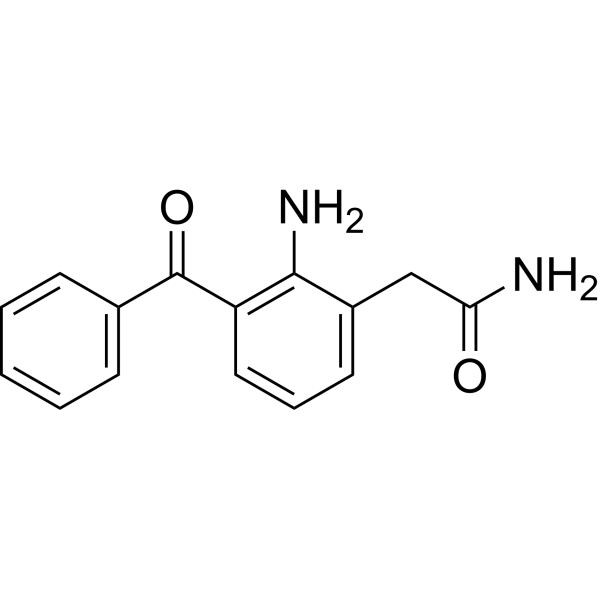
Nepafenac (AHR 9434; AL 6515), a nonsteroidal anti-inflammatory agent, is a topically administered COX-2 inhibitor with an IC50 of 0.12 μM. Nepafenac exhibits only weak COX-1 inhibitory activity (IC50 = 64.3 μM). Nepafenac possesses unique prodrug properties, which enable it to rapidly convert into the active metabolite Amfenac (HY-17479) in the ocular tissues, thereby achieving high concentrations in the retina and choroid. Nepafenac reduces inflammation and pain by inhibiting the activity of cyclooxygenase (COX) enzymes and thereby decreasing the production of prostaglandin PGE₂. Nepafenac can delay the metastasis of uveal melanoma (UM) in rabbit eyes. Nepafenac is mainly used for pain management and inflammation control after ophthalmic surgeries.
Nos produits utilisent uniquement pour la recherche. Nous ne vendons pas aux patients.
- Pureté : 99.56%
- CAS No.: 78281-72-8
- Formule: C15H14N2O2
- Masse moléculaire:254.28
-
Stockage:Powder -20°C, 3 years , 4°C, 2 years ; In solvent -80°C, 2 years , -20°C, 1 year

To place orders, for customer services and technical support, please contact: MedChemExpress USA
Tel: 609-228-6898 E-mail: [email protected] [email protected]


-
 Activité biologique
-
Chemical Information
-
Solvant et solubilité
- Protocole
- Pureté et documentation
- Références
-
 Help & FAQs


-
HY-B0577
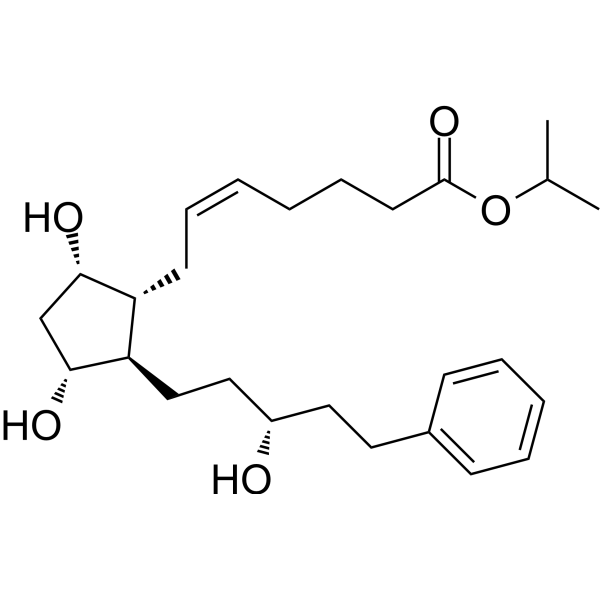
LatanoprostProstaglandin Receptor Agonist -
HY-B0440
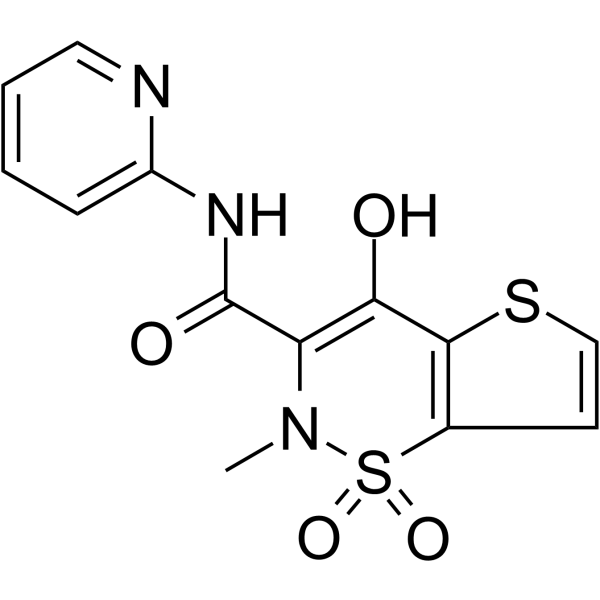
TenoxicamCOX Inhibitor -

HY-17357R
Nepafenac (Standard)Stanard of Nepafenac -
HY-B0336
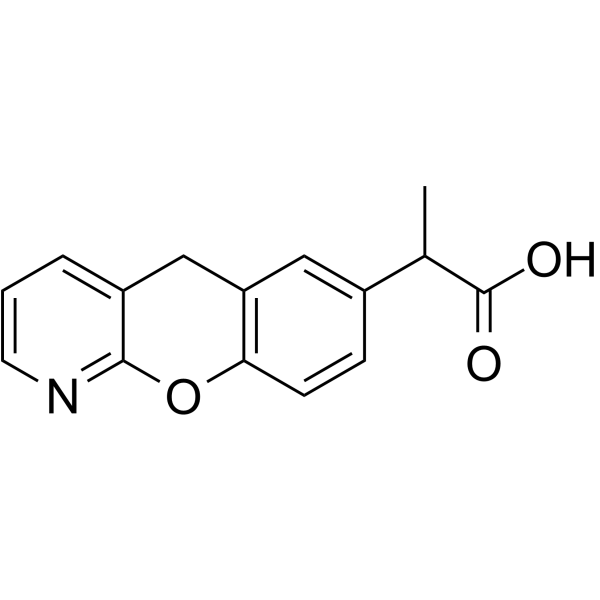
PranoprofenAnti-Inflammatory Agent -
HY-B0559
NabumetoneCOX-2 Inhibitor -
HY-14670
FirocoxibCOX-2 Inhibitor -

HY-B0336R
Pranoprofen (Standard)Anti-Inflammatory Agent -

HY-B0440R
Tenoxicam (Standard)COX Inhibitor -

HY-B0559R
Nabumetone (Standard)COX Inhibitor -

HY-W251708
AHR 10240Bromfenac Metabolite -
HY-14670R
Firocoxib (Standard)COX-2 Inhibitor -
HY-B0577R
Latanoprost (Standard)


Activité biologique
Description
IC50 & Target
[1]|
COX-1 64.3 μM (IC50) |
COX-2 0.12 μM (IC50) |
In Vitro
Nepafenac (0.05%-0.1% eye drops, 0-500 min) inhibits PGE₂ by 90-95% in the isolated rabbit iris/ciliary body and by 55% in the retina/choroid, for a duration of 6 hours and 4 hours, respectively at 1%[1].
Nepafenac (7-117 μM, 0-400 min) has a stronger isolated rabbit corneal and conjunctiva/sclera permeability than Diclofenac (HY-15036) with permeation coefficients (kps) of 727 × 10-6 min-1 and 128 × 10-6 min-1, respectively[2].
Nepafenac (0.05%-0.1% eye drops, 5 min) results in sustained flux of drug across the cornea for 6 h with short term perfusion of the isolated rabbit corneal surface and accumulates at 16.7 μM on the corneal endothelial side[2].
Nepafenac (8.9-140 μM, 0-6 h) can effectively hydrolyze into Amfenac in the cornea, iris/ciliary body, and retina/choroid of both rabbit and human eyes, moreover, the hydrolysis in rabbit cornea shows time and dose dependence[2].
MedChemExpress (MCE) has not independently confirmed the accuracy of these methods. They are for reference only.
In Vivo
Nepafenac (0.3% eye drops, topical ocular administration, twice daily for 12 weeks) delays the progression of uveal melanoma (UM) in rabbits[3].
MedChemExpress (MCE) has not independently confirmed the accuracy of these methods. They are for reference only.
-
Animal Model:Trauma-induced model of acute ocular inflammation established in New Zealand Albino rabbits (2-2.5 kg)[1]
-
Dosage:0.1% eye drops
-
Administration:Topical ocular administration, single dose
-
Result:Reduced protein exudation by 61% and inhibited PGE₂ by 98%. Exhibited the anti-inflammatory effect lasts for 8 hours after a single administration.
-
Animal Model:Human UM cell line induced xenograft tumor model established in male New Zealand albino rabbits[3]
-
Dosage:0.3% eye drops
-
Administration:Topical ocular administration, twice daily for 12 weeks
-
Result:Reduced the incidence of tumors.
Alleviated the tumor morphology, mainly presenting as flat lesions (in the control group, large tumors accompanied by vitreous hemorrhage were more common).
Significantly reduced the staining intensity of COX-2 in tumors. Delayed the appearance time of circulating tumor cells (CMCs), and reduced the lung and liver metastasis of the tumor.
Essai clinique
| NCT Number | Sponsor | Condition | Start Date |
Phase

|
|---|---|---|---|---|
| NCT01329991 | 2011-05 | PHASE1 |


Chemical Information
-
CAS No. 78281-72-8
-
Appearance Solid
-
Masse moléculaire 254.28
-
Formule C15H14N2O2
-
Color Light yellow to yellow
-
SMILES
O=C(N)CC1=CC=CC(C(C2=CC=CC=C2)=O)=C1N
-
Synonyms
AHR 9434; AL 6515
-
Livraison
Room temperature in continental US; may vary elsewhere.
-
Stockage
Powder -20°C 3 years 4°C 2 years In solvent -80°C 2 years -20°C 1 year


Solvant et solubilité
In Vitro:
DMSO : 100 mg/mL (393.27 mM; Need ultrasonic; Hygroscopic DMSO has a significant impact on the solubility of product, please use newly opened DMSO)
Please refer to the solubility information to select the appropriate solvent. Once prepared, please aliquot and store the solution to prevent product inactivation from repeated freeze-thaw cycles.
Storage method and period of stock solution: -80°C, 2 years; -20°C, 1 year. When stored at -80°C, please use it within 2 years. When stored at -20°C, please use it within 1 year.
Please refer to the solubility information to select the appropriate solvent. Once prepared, please aliquot and store the solution to prevent product inactivation from repeated freeze-thaw cycles.
Storage method and period of stock solution: -80°C, 2 years; -20°C, 1 year. When stored at -80°C, please use it within 2 years. When stored at -20°C, please use it within 1 year.
Concentration (start) × Volume (start) = Concentration (final) × Volume (final)


Pureté et documentation
-
Fiche technique (275 KB)
-
SDS (398 KB)
- English - EN (398 KB)
- Français - FR (398 KB)
- Deutsch - DE (398 KB)
- Norwegian - NO (398 KB)
- Español - ES (398 KB)
- Swedish - SV (398 KB)
- Italian - IT (398 KB)
- Korean - KR (398 KB)
- Portuguese - PT (398 KB)
-
Instruction de manipulation (2659 KB)
Références
[1]. Gamache DA, Graff G, Brady MT et al. Nepafenac, a unique nonsteroidal prodrug with potential utility in the treatment of trauma-induced ocular inflammation: I. Assessment of anti-inflammatory efficacy. Inflammation. 2000 Aug;24(4):357-70. [Content Brief]
[2]. Ke TL, Graff G, Spellman JM, Yanni JM. Nepafenac, a unique nonsteroidal prodrug with potential utility in the treatment of trauma-induced ocular inflammation: II. In vitro bioactivation and permeation of external ocular barriers. Inflammation. 2000 Aug;24(4):371-84. [Content Brief]
[3]. Marshall JC, Fernandes BF, Di Cesare S et al. The use of a cyclooxygenase-2 inhibitor (Nepafenac) in an ocular and metastatic animal model of uveal melanoma. Carcinogenesis. 2007 Sep;28(9):2053-8. [Content Brief]


Complete Stock Solution Preparation Table
Please refer to the solubility information to select the appropriate solvent. Once prepared, please aliquot and store the solution to prevent product inactivation from repeated freeze-thaw cycles.
Storage method and period of stock solution: -80°C, 2 years; -20°C, 1 year. When stored at -80°C, please use it within 2 years. When stored at -20°C, please use it within 1 year.
| Optional Solvent | Concentration Solvent Mass | 1 mg | 5 mg | 10 mg | 25 mg |
|---|---|---|---|---|---|
| DMSO | 1 mM | 3.9327 mL | 19.6634 mL | 39.3267 mL | 98.3168 mL |
| 5 mM | 0.7865 mL | 3.9327 mL | 7.8653 mL | 19.6634 mL | |
| 10 mM | 0.3933 mL | 1.9663 mL | 3.9327 mL | 9.8317 mL | |
| 15 mM | 0.2622 mL | 1.3109 mL | 2.6218 mL | 6.5545 mL | |
| 20 mM | 0.1966 mL | 0.9832 mL | 1.9663 mL | 4.9158 mL | |
| 25 mM | 0.1573 mL | 0.7865 mL | 1.5731 mL | 3.9327 mL | |
| 30 mM | 0.1311 mL | 0.6554 mL | 1.3109 mL | 3.2772 mL | |
| 40 mM | 0.0983 mL | 0.4916 mL | 0.9832 mL | 2.4579 mL | |
| 50 mM | 0.0787 mL | 0.3933 mL | 0.7865 mL | 1.9663 mL | |
| 60 mM | 0.0655 mL | 0.3277 mL | 0.6554 mL | 1.6386 mL | |
| 80 mM | 0.0492 mL | 0.2458 mL | 0.4916 mL | 1.2290 mL | |
| 100 mM | 0.0393 mL | 0.1966 mL | 0.3933 mL | 0.9832 mL |


Nepafenac Related Classifications
HY-17357 Related Classifications
 Powered by Bioz