



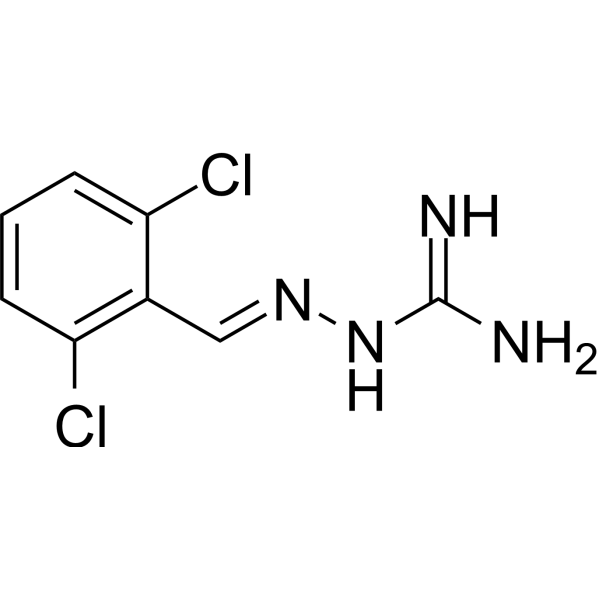
(E)-Guanabenz
(E)-Guanabenz ((E)-Wy-8678) is an orally active central α2-adrenoceptor agonist. (E)-Guanabenz has antihypertensive activity, acts via stimulating central α2-adrenoceptors, and reducing net sympathetic outflow into the periphery. (E)-Guanabenz also directly binds to and inhibits GADD34, and has neuroprotective activity. (E)-Guanabenz can be used for researching hypertension and Parkinson disease.
Nos produits utilisent uniquement pour la recherche. Nous ne vendons pas aux patients.
- CAS No.: 60329-03-5
- Formule: C8H8Cl2N4
- Masse moléculaire:231.08
-
Stockage:
Please store the product under the recommended conditions in the Certificate of Analysis.

To place orders, for customer services and technical support, please contact: MedChemExpress USA
Tel: 609-228-6898 E-mail: [email protected] [email protected]


-
 Activité biologique
-
Chemical Information
- Protocole
- Pureté et documentation
- Références
-
 Help & FAQs


Voir tous les produits spécifiques à Isoform Adrenergic Receptor
More

Activité biologique
Description
IC50 & Target
|
α adrenergic receptor |
Cellular Effect
|
Cell Line

|
Type | Value | Description | References |
|---|---|---|---|---|
| HEK293 | IC50 |
4.85 μM
Compound: Guanabenz
|
Inhibition of human OCT1 expressed in HEK293 cells assessed as decrease in uptake of ASP+ after 2 mins by fluorescence assay
Inhibition of human OCT1 expressed in HEK293 cells assessed as decrease in uptake of ASP+ after 2 mins by fluorescence assay
|
[PMID: 28230985] |
| HEK-293T | EC50 |
0.09 μM
Compound: 16a
|
Agonist activity at human TAAR1 receptor expressed in HEK293T cells cotransfected with beta-2 receptor assessed as cAMP production by BRET assay
Agonist activity at human TAAR1 receptor expressed in HEK293T cells cotransfected with beta-2 receptor assessed as cAMP production by BRET assay
|
10.1039/C5MD00400D |
Essai clinique
| NCT Number | Sponsor | Condition | Start Date |
Phase
|
|---|---|---|---|---|
| NCT01329991 | Plexxikon| | 2011-05 | PHASE1 |


Chemical Information
-
CAS No. 60329-03-5
-
Masse moléculaire 231.08
-
Formule C8H8Cl2N4
-
SMILES
ClC1=C(/C=N/NC(N)=N)C(Cl)=CC=C1
-
Synonyms
(E)-Wy-8678
-
Livraison
Room temperature in continental US; may vary elsewhere.
-
Stockage
Please store the product under the recommended conditions in the Certificate of Analysis.


Pureté et documentation
Références
[1]. Sun X, et al. Guanabenz promotes neuronal survival via enhancement of ATF4 and parkin expression in models of Parkinson disease. Exp Neurol. 2018 May;303:95-107. [Content Brief]
[2]. Xie J, et al. LC-MS/MS determination of guanabenz E/Z isomers and its application to in vitro and in vivo DMPK profiling studies. J Pharm Biomed Anal. 2021 Oct 25;205:114331. [Content Brief]

Calculators
Concentration (start) × Volume (start) = Concentration (final) × Volume (final)


(E)-Guanabenz Related Classifications
HY-W263279 Related Classifications
 Powered by Bioz