



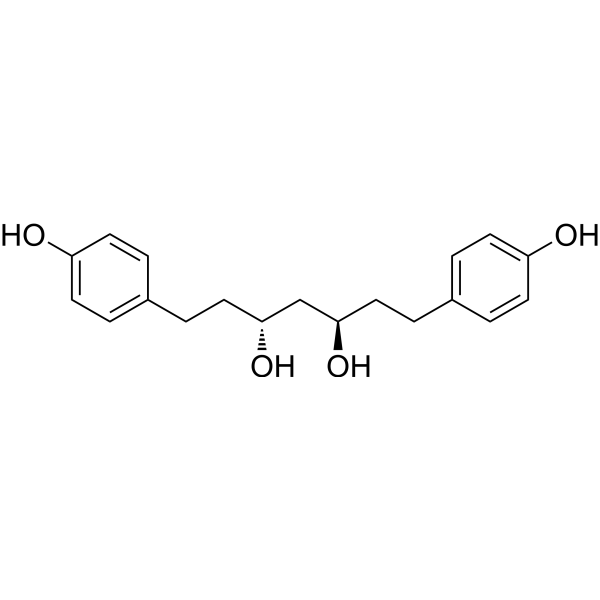
(+)-Hannokinol
(+)-Hannokinol can be isolated from AMOMUM TSAO-KO (ginger family) fruit. (+)-Hannokinol inhibits lipopolysaccharide-induced nitric oxide production in BV2 microglia.
Nos produits utilisent uniquement pour la recherche. Nous ne vendons pas aux patients.
- CAS No.: 408324-76-5
- Formule: C19H24O4
- Masse moléculaire:316.39
-
Stockage:
Please store the product under the recommended conditions in the Certificate of Analysis.

To place orders, for customer services and technical support, please contact: MedChemExpress USA
Tel: 609-228-6898 E-mail: [email protected] [email protected]


-
 Activité biologique
-
Chemical Information
- Protocole
- Pureté et documentation
- Références
-
 Help & FAQs




Activité biologique
Description
Cellular Effect
|
Cell Line

|
Type | Value | Description | References |
|---|---|---|---|---|
| B16-4A5 | IC50 |
>10 μM
Compound: 9
|
Antimelanogenic activity in mouse B16-4A5 cells assessed as inhibition of theophylline-induced melanin production after 72 hrs by spectrophotometry relative to control
Antimelanogenic activity in mouse B16-4A5 cells assessed as inhibition of theophylline-induced melanin production after 72 hrs by spectrophotometry relative to control
|
[PMID: 23910596] |
| HL-60 | IC50 |
>10 μg/mL
Compound: 9a
|
Cytotoxicity against human HL60 cells after 72 hrs by MTT assay
Cytotoxicity against human HL60 cells after 72 hrs by MTT assay
|
[PMID: 11908966] |
| HSC-2 | IC50 |
231 μg/mL
Compound: 9a
|
Cytotoxicity against human HSC2 cells by MTT assay
Cytotoxicity against human HSC2 cells by MTT assay
|
[PMID: 11908966] |
| RAW264.7 | IC50 |
>100 μM
Compound: 7a
|
Inhibition of LPS-induced nitric oxide production in mouse RAW264.7 cells after 24 hrs by Griess reaction based spectrophotometry
Inhibition of LPS-induced nitric oxide production in mouse RAW264.7 cells after 24 hrs by Griess reaction based spectrophotometry
|
[PMID: 21807513] |


Chemical Information
-
CAS No. 408324-76-5
-
Masse moléculaire 316.39
-
Formule C19H24O4
-
SMILES
OC(C=C1)=CC=C1CC[C@@H](O)C[C@H](O)CCC2=CC=C(C=C2)O
-
Structure Classification
-
Initial Source
-
Livraison
Room temperature in continental US; may vary elsewhere.
-
Stockage
Please store the product under the recommended conditions in the Certificate of Analysis.

Protocole
-
Phagocytosis Functional Assay
A phagocytosis functional assay measures the ability of phagocytic cells, such as neutrophils, macrophages, monocytes, or microglia/macrophages, to bind and internalize particulate targets including bacteria, yeast particles, beads, or myelin particles. Fluorescent flow-cytometry assays detect target uptake as fluorescence associated with gated phagocytes, while pH-sensitive dyes such as pHrodo increase signal in acidic phagosomal compartments and therefore preferentially report internalized particles rather than particles remaining outside the cell. Microscopy or high-content imaging can be used to confirm intracellular localization and, in some protocols, to follow uptake kinetics.


Pureté et documentation
Références

Calculators
Concentration (start) × Volume (start) = Concentration (final) × Volume (final)


(+)-Hannokinol Related Classifications
HY-N9675 Related Classifications
 Powered by Bioz