



TLR7 agonist 19
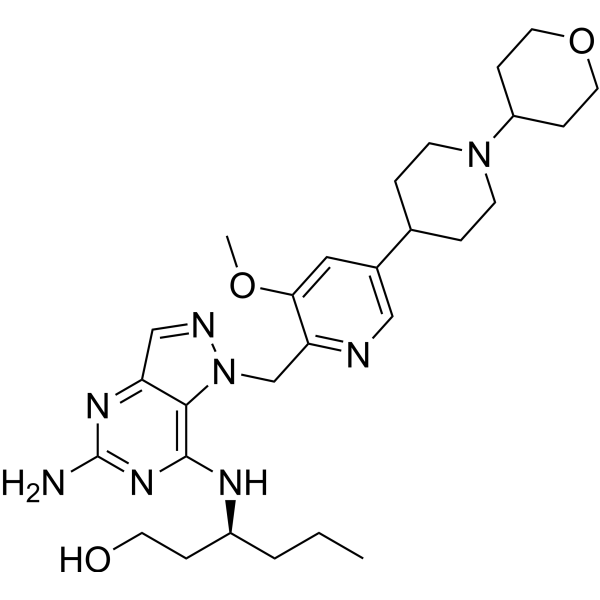
TLR7 agonist 19 (Compound 14) is a Toll-like receptor 7 (TLR7) agonist with excellent pharmacokinetic properties and synergistic antitumor activity.
Nos produits utilisent uniquement pour la recherche. Nous ne vendons pas aux patients.
- CAS No.: 2682008-42-8
- Formule: C28H42N8O3
- Masse moléculaire:538.68
-
Stockage:
Please store the product under the recommended conditions in the Certificate of Analysis.

To place orders, for customer services and technical support, please contact: MedChemExpress USA
Tel: 609-228-6898 E-mail: [email protected] [email protected]


-
 Activité biologique
-
Chemical Information
- Protocole
- Pureté et documentation
- Références
-
 Help & FAQs




Activité biologique
Description
Cellular Effect
|
Cell Line

|
Type | Value | Description | References |
|---|---|---|---|---|
| T-cell | IC50 |
>25 μM
Compound: 14
|
Cytotoxicity against PHA-activated T-cells (unknown origin) assessed as inhibition of IL-2 induced cell proliferation measured after 72 hrs by MTS assay
Cytotoxicity against PHA-activated T-cells (unknown origin) assessed as inhibition of IL-2 induced cell proliferation measured after 72 hrs by MTS assay
|
[PMID: 38352849] |


Chemical Information
-
CAS No. 2682008-42-8
-
Masse moléculaire 538.68
-
Formule C28H42N8O3
-
SMILES
CCC[C@H](NC1=C(N(CC2=NC=C(C3CCN(C4CCOCC4)CC3)C=C2OC)N=C5)C5=NC(N)=N1)CCO
-
Livraison
Room temperature in continental US; may vary elsewhere.
-
Stockage
Please store the product under the recommended conditions in the Certificate of Analysis.

Protocole
-
Subcutaneous Cell-Line-Derived Xenograft
Subcutaneous cell-line-derived xenograft (CDX) models are established by implanting cultured human cancer cell lines into immunodeficient mice, where the injected cells form localized tumors that can be monitored in vivo as a measure of tumorigenic potential, growth kinetics, and treatment response. These models are widely used in oncology research because they allow reproducible tumor formation and enable comparative assessment of tumor growth between different cell lines or genetic manipulations in a controlled in vivo microenvironment. Subcutaneous implantation of cancer cells in immunodeficient mice is a standard approach for evaluating tumor growth behavior and therapeutic response across multiple cancer types, including prostate, esophageal, pancreatic, and colon cancer models.


Pureté et documentation
Références

Calculators
Concentration (start) × Volume (start) = Concentration (final) × Volume (final)


TLR7 agonist 19 Related Classifications
HY-162163 Related Classifications
 Powered by Bioz