



1402612-64-9
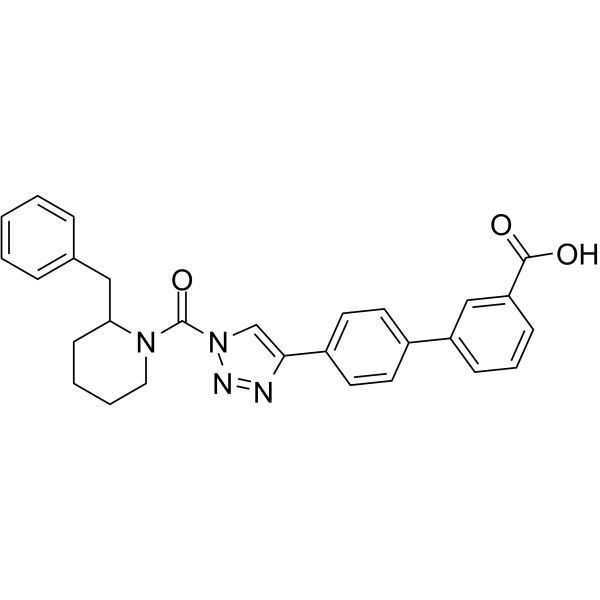
Chemical Structure
KT203
- CAS No.: 1402612-64-9
- Formula:C28H26N4O3
- Molecular Weight:466.53
IUPAC Name: 4'-(1-(2-benzylpiperidine-1-carbonyl)-1H-1,2,3-triazol-4-yl)-[1,1'-biphenyl]-3-carboxylic acid
InChIKey: SSSCOJOXPDDHOO-UHFFFAOYSA-N
SMILES: O=C(N1C(CCCC1)CC2=CC=CC=C2)N3N=NC(C4=CC=C(C=C4)C5=CC=CC(C(O)=O)=C5)=C3
Biological Activity: KT203 is a selective ABHD6 inhibitor. KT203 is peripherally restricted and cannot cross the blood-brain barrier, producing near-complete inhibition of hepatic ABHD6 while brain ABHD6 remains essentially unaffected. KT203 reduces cellular MAG hydrolase activity and blocks the hydrolysis of the endocannabinoid arachidonoylglycerol. KT203 inhibits pro-inflammatory cytokine expression, induces anti-inflammatory interleukin signaling and lipid metabolism gene expression, increases 2-MAG and DHA (HY-B2167)-containing lipid mediators, and reduces circulating TNF-α in LPS-exposed mice. KT203 inhibits PRRSV replication. KT203 can be used for research on NSCLC, obesity-related chronic inflammation, endotoxemia, and porcine reproductive and respiratory syndrome[1][2][3][4][5][6][7][8][9].
| Cat. No. | Product Name | Purity | Description | Pricing | |||||||||||||||||||
|---|---|---|---|---|---|---|---|---|---|---|---|---|---|---|---|---|---|---|---|---|---|---|---|
|
|
KT203 | 99.64% | KT203 is a selective ABHD6 inhibitor. KT203 is peripherally restricted and cannot cross the blood-brain barrier, producing near-complete inhibition of hepatic ABHD6 while brain ABHD6 remains essentially unaffected. KT203 reduces cellular MAG hydrolase activity and blocks the hydrolysis of the endocannabinoid arachidonoylglycerol. KT203 inhibits pro-inflammatory cytokine expression, induces anti-inflammatory interleukin signaling and lipid metabolism gene expression, increases 2-MAG and DHA (HY-B2167)-containing lipid mediators, and reduces circulating TNF-α in LPS-exposed mice. KT203 inhibits PRRSV replication. KT203 can be used for research on NSCLC, obesity-related chronic inflammation, endotoxemia, and porcine reproductive and respiratory syndrome. | ||||||||||||||||||||
|
loading...
/
|
|||||||||||||||||||||||
-
Similarity Score 0.83
 HY-126031(R)-KT109
-
Similarity Score 0.83
 HY-126031A(S)-KT109
-
Similarity Score 0.83
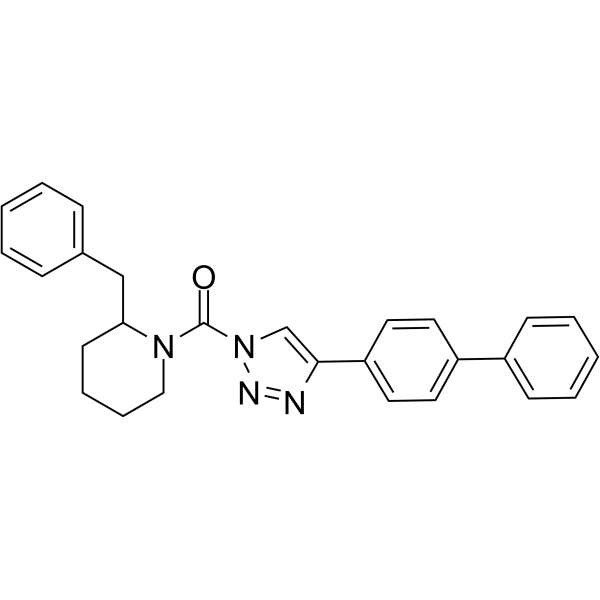 HY-18540KT109
-
Similarity Score 0.78
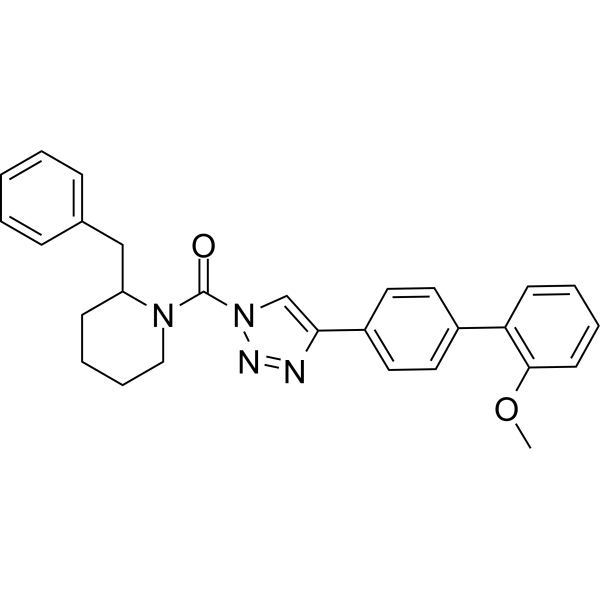 HY-18541KT172
-
Similarity Score 0.72
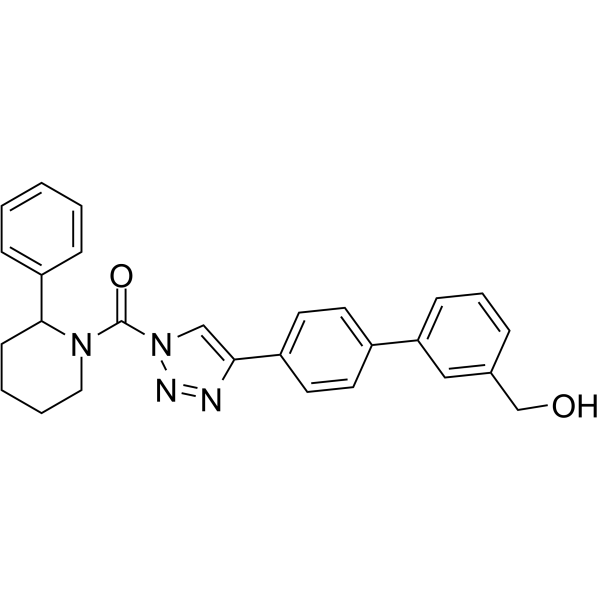 HY-120177KT182
-
Similarity Score 0.68
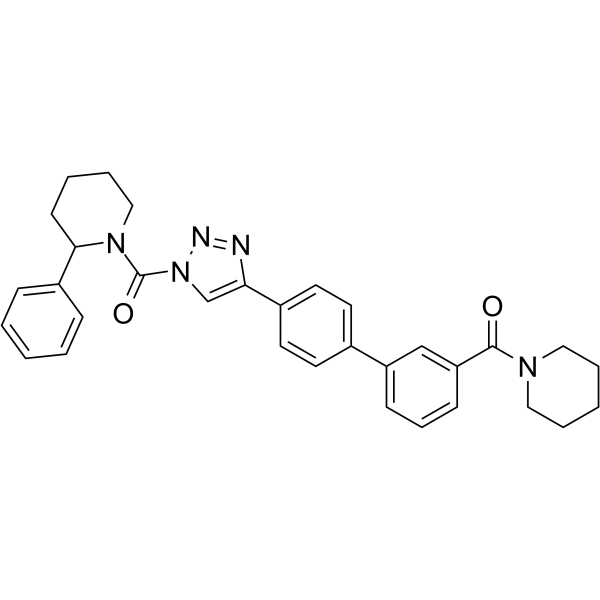 HY-114926KT185
-
Similarity Score 0.65
 HY-18542KT195
-
Similarity Score 0.57
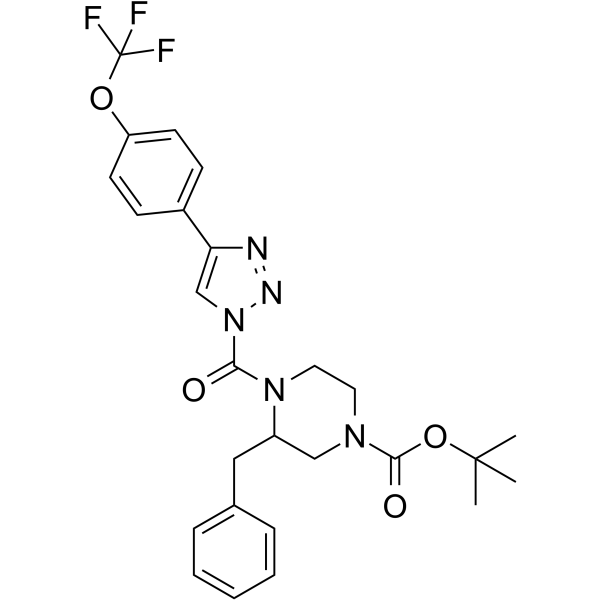 HY-117771DO34
-
Similarity Score 0.51
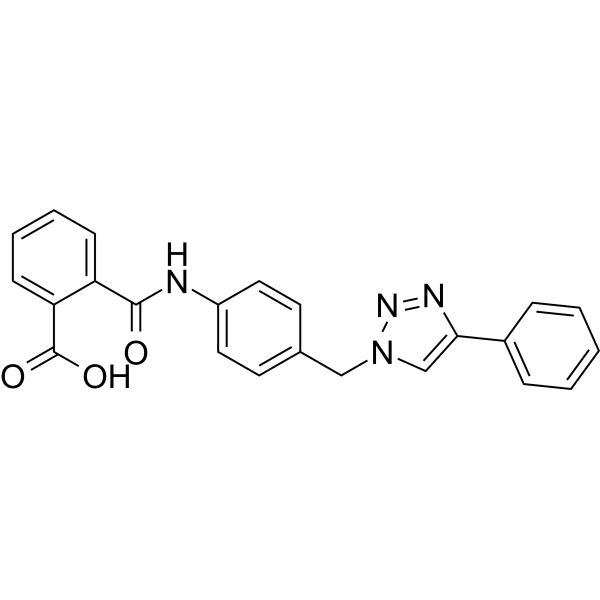 HY-143294sEH inhibitor-2
-

Explore the MedChemAI to find more analogs


References
- [1]. Tang Z, et al. Enhanced monoacylglycerol lipolysis by ABHD6 promotes NSCLC pathogenesis. EBioMedicine. 2020 Mar;53:102696. [Content Brief]
- [2]. Orabi D, et al. The lipid hydrolase ABHD6 is a therapeutic target in metabolic dysfunction-associated steatotic liver disease (MASLD)-related hepatocellular carcinoma. bioRxiv. 2025 Aug 2:2025-07.
- [3]. Healey RD, et al. Discovery and mechanism of action of small molecule inhibitors of ceramidases. Angewandte Chemie International Edition. 2022 Jan 10;61(2):e202109967. [Content Brief]
- [4]. Poursharifi P, et al. ABHD6 suppression promotes anti-inflammatory polarization of adipose tissue macrophages via 2-monoacylglycerol/PPAR signaling in obese mice. Molecular metabolism. 2023 Dec;78:101822.
- [5]. Hsu KL, et al. Discovery and optimization of piperidyl-1,2,3-triazole ureas as potent, selective, and in vivo-active inhibitors of α/β-hydrolase domain containing 6 (ABHD6). Journal of medicinal chemistry. 2013 Nov 14;56(21):8270-9. [Content Brief]
- [6]. Manterola A, et al. Re-examining the potential of targeting ABHD6 in multiple sclerosis: Efficacy of systemic and peripherally restricted inhibitors in experimental autoimmune encephalomyelitis. Neuropharmacology. 2018 Oct 1;141:181-91. [Content Brief]
- [7]. Poursharifi P, et al. ABHD6 suppression attenuates pro-inflammatory responses in mice and promotes anti-inflammatory polarization of macrophages during endotoxin stress. Biochimica et Biophysica Acta (BBA)-Molecular and Cell Biology of Lipids. 2025 Oct 6:159694.
- [8]. He Z, et al. Identification of compounds targeting porcine reproductive and respiratory syndrome virus nsp3 and evaluation of their antiviral efficacy. Virulence. 2025 Dec 31;16(1):2530176. [Content Brief]
- [9]. Maramai S, et al. Targeting Endocannabinoid Metabolism: an Arrow with Multiple Tips Against Multiple Sclerosis. ChemMedChem. 2020 Nov 04;15(21):1985-2003.



