



193475-71-7
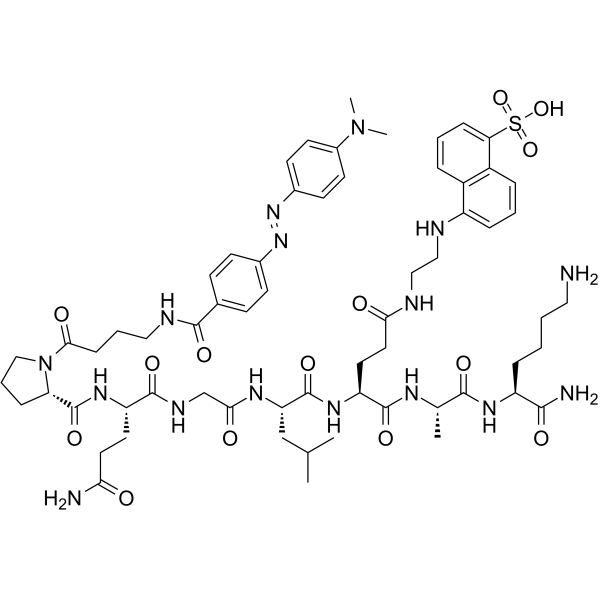
Chemical Structure
TNO211
Synonym(s): Dabcyl-GABA-Pro-Gln-Gly-Leu-Glu(EDANS)-Ala-Lys-NH2
- CAS No.: 193475-71-7
- Formula:C63H88N16O14S
- Molecular Weight:1325.54
InChIKey: SRCLUDHDMWVELQ-UBGKWXCMSA-N
SMILES: O=S(O)(C1=CC=CC2=C1C=CC=C2NCCNC(CC[C@@H](C(N[C@@H](C)C(N[C@H](C(N)=O)CCCCN)=O)=O)NC([C@H](CC(C)C)NC(CNC([C@H](CCC(N)=O)NC([C@H]3N(CCC3)C(CCCNC(C4=CC=C(C=C4)/N=N/C5=CC=C(C=C5)N(C)C)=O)=O)=O)=O)=O)=O)=O)=O
Biological Activity: TNO211 (Dabcyl-GABA-Pro-Gln-Gly-Leu-Glu (EDANS)-Ala-Lys-NH2) is a fluorescent peptide substrate used to detect matrix metalloproteinase (MMP) activity. TNO211 contains a Gly-Leu hydrolysis site recognized by MMPs and is linked to the fluorescent group EDANS and the quenching group Dabcyl, respectively. In the intact substrate, Dabcyl quenches the fluorescence of EDANS; when active MMPs hydrolyze the Gly-Leu peptide bond, the two groups separate, the fluorescence quenching effect weakens, and EDANS restores its fluorescence signal. The increase in fluorescence intensity can be used to reflect the degree of substrate hydrolysis and MMP activity. TNO211 has good selectivity for MMPs and is not readily hydrolyzed by non-MMP proteases such as plasmin, urokinase-type plasminogen activator (u-PA), and elastase (Ex/Em = 340/485 nm)[1].
| Cat. No. | Product Name | Purity | Description | Pricing | |||||||||||||||||||
|---|---|---|---|---|---|---|---|---|---|---|---|---|---|---|---|---|---|---|---|---|---|---|---|
|
|
TNO211 | 99.41% | TNO211 (Dabcyl-GABA-Pro-Gln-Gly-Leu-Glu (EDANS)-Ala-Lys-NH2) is a fluorescent peptide substrate used to detect matrix metalloproteinase (MMP) activity. TNO211 contains a Gly-Leu hydrolysis site recognized by MMPs and is linked to the fluorescent group EDANS and the quenching group Dabcyl, respectively. In the intact substrate, Dabcyl quenches the fluorescence of EDANS; when active MMPs hydrolyze the Gly-Leu peptide bond, the two groups separate, the fluorescence quenching effect weakens, and EDANS restores its fluorescence signal. The increase in fluorescence intensity can be used to reflect the degree of substrate hydrolysis and MMP activity. TNO211 has good selectivity for MMPs and is not readily hydrolyzed by non-MMP proteases such as plasmin, urokinase-type plasminogen activator (u-PA), and elastase (Ex/Em = 340/485 nm). | ||||||||||||||||||||
|
loading...
/
|
|||||||||||||||||||||||



