



18:0 mPEG2000 PE
Based on 1 publication(s) in Google Scholar
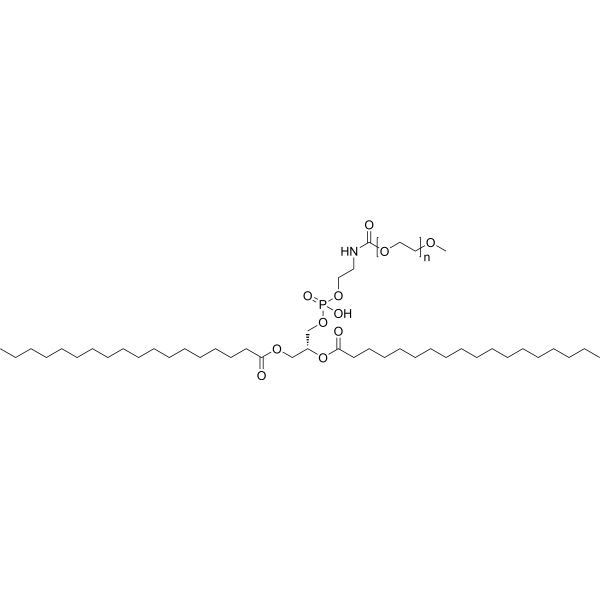
18:0 mPEG2000 PE (DSPE-mPEG2000) ammonium is a kind of amphiphilic polymer material. 18:0 mPEG2000 PE ammonium combines hydrophobic lipids (18:0 stearic acid chain) with hydrophilic polyethylene glycol (2 kDa) chains to form amphiphilic molecules, which are used to construct stable liposomes/nanoparticles, thereby enhancing drug delivery, prolonging circulation time, and achieving targeted effects through its functional terminal groups (usually biotin or carboxyl groups). 18:0 mPEG2000 PE ammonium can be used for the research of nanoprobes and drug delivery.
Nur für Forschungszwecke. Wir verkaufen nicht an Patienten.
- Reinheit : 99.43%
- CAS. Nr.: 156543-00-9
- Formel: (C2H4O)nC43H84NO10P
- Molecular Weight:2000(Average)
-
Speicherung:Powder -20°C, 3 years , 4°C, 2 years ; In solvent -80°C, 6 months , -20°C, 1 month

To place orders, for customer services and technical support, please contact: MedChemExpress USA
Tel: 609-228-6898 E-mail: [email protected] [email protected]


-
 Biologische Aktivität
-
Chemical Information
-
Lösungsmittel & Löslichkeit
- Reinheit & Dokumentation
- Verweise
-
 Help & FAQs


Publications Citing Use of MedChemExpress (MCE) 18:0 mPEG2000 PE
More

Biologische Aktivität
Beschreibung
In Vitro
18:0 mPEG2000 PE ammonium is used to synthesize a highly sensitive and selective fluorescent probe (BANP) for detecting dibutyl phthalate (DBP)[1].
18:0 mPEG2000 PE ammonium is used to prepare near-infrared II (NIR-II) scaffold molecular dye (SYL) and to prepare it into a nanoprobe for tumor imaging and photothermal therapy[2].
18:0 mPEG2000 PE ammonium is used to synthesize organic nanoparticles targeting lysosomes for photoacoustic imaging and photodynamic anticancer research under near-infrared light[3].
18:0 mPEG2000 PE ammonium is used to develop a nanoprobe based on a platinum (II) metal ring in the second near-infrared region (NIR-II), integrating fluorescence imaging and chemotherapy[4].
MedChemExpress (MCE) has not independently confirmed the accuracy of these methods. They are for reference only. .


Chemical Information
-
CAS. Nr. 156543-00-9
-
Appearance Solid
-
Molecular Weight 2000(Average)
-
Formel (C2H4O)nC43H84NO10P
-
Color White to off-white
-
SMILES
O=C(NCCOP(O)(OC[C@@H](COC(CCCCCCCCCCCCCCCCC)=O)OC(CCCCCCCCCCCCCCCCC)=O)=O)OCCOC.[n]
-
Synonyms
DSPE-mPEG2000
-
Versand
Room temperature in continental US; may vary elsewhere.
-
Speicherung
Powder -20°C 3 years 4°C 2 years In solvent -80°C 6 months -20°C 1 month


Publications (1)
-
Journal Impact Factor
-
Most Recent
-
Int J Nanomedicine
IR-820@NBs Combined with MG-132 Enhances the Anti-Hepatocellular Carcinoma Effect of Sonodynamic Therapy. [Abstract]2023 Nov 1:18:6199-6212. PMID: 37933299


Lösungsmittel & Löslichkeit
In Vitro:
Ethanol : 100 mg/mL (Need ultrasonic)
DMSO : 100 mg/mL (Need ultrasonic; Hygroscopic DMSO has a significant impact on the solubility of product, please use newly opened DMSO)


Reinheit & Dokumentation
-
Data Sheet (271 KB)
-
SDS (394 KB)
- English - EN (394 KB)
- Français - FR (394 KB)
- Deutsch - DE (394 KB)
- Norwegian - NO (394 KB)
- Español - ES (394 KB)
- Swedish - SV (394 KB)
- Italian - IT (394 KB)
- Korean - KR (394 KB)
- Portuguese - PT (394 KB)
-
Handling Instructions (2659 KB)
Verweise
[1]. Lu JY, et al. A dye-andrographolide assembly as a turn-on sensor for detection of phthalate in both cells and fish. Anal Chim Acta. 2022 Feb 22;1195:339460. [Content Brief]
[2]. Zhang R, et al. Rational design of a multifunctional molecular dye for dual-modal NIR-II/photoacoustic imaging and photothermal therapy. Chem Sci. 2019 Jul 30;10(36):8348-8353. [Content Brief]
[3]. Hu W, et al. Engineering Lysosome-Targeting BODIPY Nanoparticles for Photoacoustic Imaging and Photodynamic Therapy under Near-Infrared Light. ACS Appl Mater Interfaces. 2016 May 18;8(19):12039-47. [Content Brief]
[4]. Sun Y, et al. Rhomboidal Pt(II) metallacycle-based NIR-II theranostic nanoprobe for tumor diagnosis and image-guided therapy. Proc Natl Acad Sci U S A. 2019 Feb 5;116(6):1968-1973. [Content Brief]

Calculators
Konzentration (Stammlösung) × Volumen (Stammlösung) = Konzentration (Ziellösung) × Volumen (Ziellösung)


18:0 mPEG2000 PE Related Classifications
HY-142978 Related Classifications
 Powered by Bioz