



PI4KIIIbeta-IN-10
Based on 16 publication(s) in Google Scholar
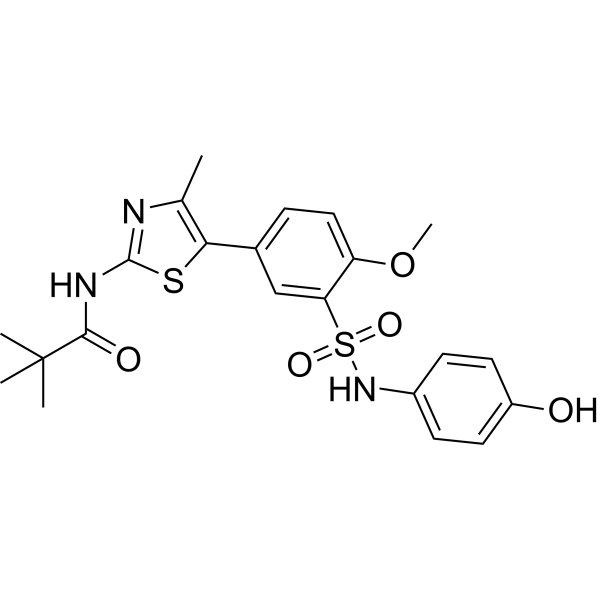
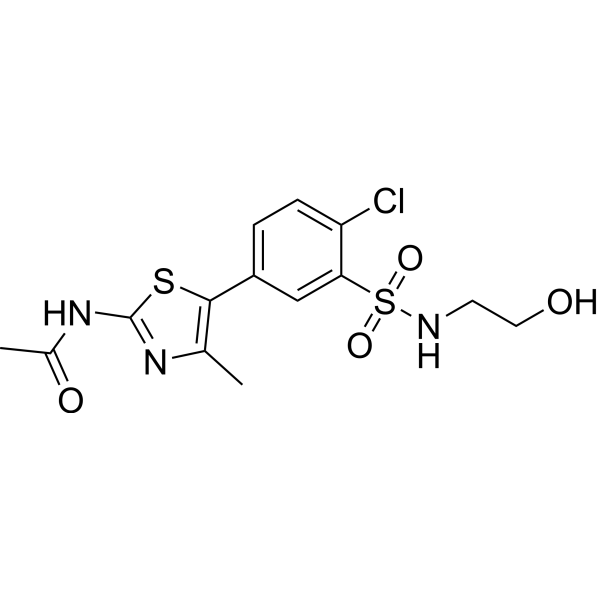
PI4KIIIbeta-IN-10 is a potent PI4KIIIβ inhibitor with an IC50 of 3.6 nM.
Nur für Forschungszwecke. Wir verkaufen nicht an Patienten.
- Reinheit: 99.84%
- CAS. Nr.: 1881233-39-1
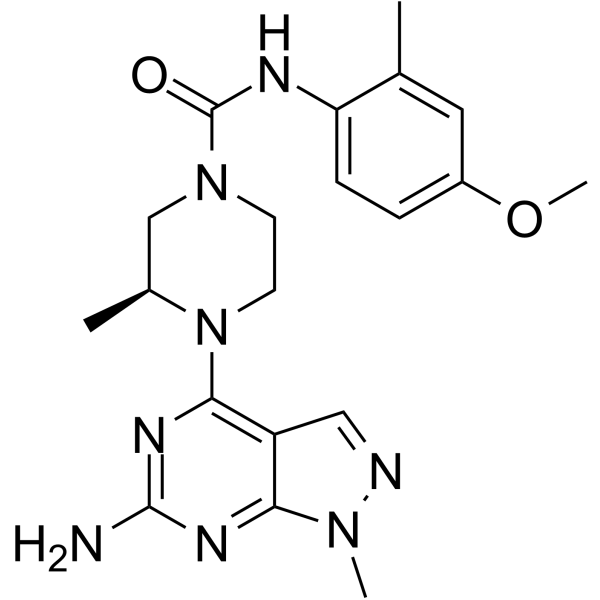
- Formel: C22H25N3O5S2
- Molecular Weight:475.58
-
Speicherung:Powder -20°C, 3 years , 4°C, 2 years ; In solvent -80°C, 2 years , -20°C, 1 year

To place orders, for customer services and technical support, please contact: MedChemExpress USA
Tel: 609-228-6898 E-mail: [email protected] [email protected]


-
 Biologische Aktivität
-
Chemical Information
-
Lösungsmittel & Löslichkeit
- Protokoll
- Reinheit & Dokumentation
- Verweise
-
 Help & FAQs


Publications Citing Use of MedChemExpress (MCE) PI4KIIIbeta-IN-10
More- Nat Immunol. 2023 Jan;24(1):30-41. [Abstract]
- J Extracell Vesicles. 2022 Jun;11(6):e12233. [Abstract]
- Autophagy. 2019 Jul;15(7):1214-1233. [Abstract]
- Nat Chem Biol. 2022 Oct;18(10):1076-1086. [Abstract]
- EMBO J. 2022 Dec 15;41(24):e112677. [Abstract]
- Cell Rep. 2022 Dec 20;41(12):111868. [Abstract]
- J Cell Biol. 2024 Jan 1;223(1):e202307051. [Abstract]
- J Cell Biol. 2023 Sep 4;222(9):e202205128. [Abstract]
- mBio. 2023 Dec 19;14(6):e0191523. [Abstract]
- Sci Rep. 2025 Aug 21;15(1):30805. [Abstract]
- J Cell Sci. 2019 Apr 3;132(7):jcs220061. [Abstract]
- Dresden University of Technology. 2026.
- University of Miami. 2026.
- bioRxiv. 2023 Mar 25.
- Patent. US20220273624A1.
- Elife. 2017 Nov 1:6:e29388. [Abstract]
 Customer Validation & Images

-
WB
-
WB
-
Cell Proliferation/Viability Assay


Biologische Aktivität
Beschreibung
IC50 & Target
[1]|
PI4KIIIβ 3.6 nM (IC50) |
PI4KIIIα 3 μM (IC50) |
PI3Kδ 720 nM (IC50) |
PI3KC2γ 1 μM (IC50) |
PI3Kα 10 μM (IC50) |
PI3Kγ 20 μM (IC50) |
Cellular Effect
|
Cell Line

|
Type | Value | Description | References |
|---|---|---|---|---|
| Huh-7 | IC50 |
1300 nM
Compound: 10
|
Antiviral activity against HCV genotype 2a J6/JFH1 infected in human Huh7.5 cells after 3 days by gaussia luciferase assay
Antiviral activity against HCV genotype 2a J6/JFH1 infected in human Huh7.5 cells after 3 days by gaussia luciferase assay
|
[PMID: 26885694] |
| Huh-7 | CC50 |
32 μM
Compound: 10
|
Cytotoxicity against human Huh7.5 cells after 3 days by presto blue assay
Cytotoxicity against human Huh7.5 cells after 3 days by presto blue assay
|
[PMID: 26885694] |
In Vitro
PI4KIIIbeta-IN-10 (Compound 10) is a potent PI4KIIIβ inhibitor with very minor off-target inhibition of PI4KIIIβ related lipid kinases. PI4KIIIbeta-IN-10 shows weak inhibition of PI3KC2γ (IC50 ~1 μM), PI3Kα (~10 μM), and PI4KIIIα (~3 μM), and <20% inhibition at concentrations up to 20 μM for PI4K2α, PI4K2β, and PI3Kβ[1].
MedChemExpress (MCE) has not independently confirmed the accuracy of these methods. They are for reference only.


Chemical Information
-
CAS. Nr. 1881233-39-1
-
Appearance Solid
-
Molecular Weight 475.58
-
Formel C22H25N3O5S2
-
Color White to off-white
-
SMILES
COC1=CC=C(C2=C(C)N=C(NC(C(C)(C)C)=O)S2)C=C1S(NC3=CC=C(O)C=C3)(=O)=O
-
Versand
Room temperature in continental US; may vary elsewhere.
-
Speicherung
Powder -20°C 3 years 4°C 2 years In solvent -80°C 2 years -20°C 1 year


Publications (16)
-
Journal Impact Factor
-
Most Recent
-
Nat Immunol
2023 Jan;24(1):30-41. PMID: 36443515 -
J Extracell Vesicles
Function of ceramide transfer protein for biogenesis and sphingolipid composition of extracellular vesicles. [Abstract]2022 Jun;11(6):e12233. PMID: 35642450 -
Autophagy
VAMP associated proteins are required for autophagic and lysosomal degradation by promoting a PtdIns4P-mediated endosomal pathway. [Abstract]2019 Jul;15(7):1214-1233. PMID: 30741620
PI4KIIIbeta-IN-10 purchased from MedChemExpress. Usage Cited in: Autophagy. 2019 Jul;15(7):1214-1233. [Abstract]
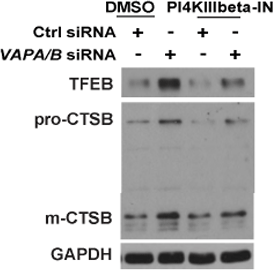
Control or VAPA/B siRNA-transfected HEK293T cells are treated with DMSO or PI4KIIIbeta-IN-10 for 4 h. WB probed for TFEB and CTSB.
PI4KIIIbeta-IN-10 purchased from MedChemExpress. Usage Cited in: Autophagy. 2019 Jul;15(7):1214-1233. [Abstract]
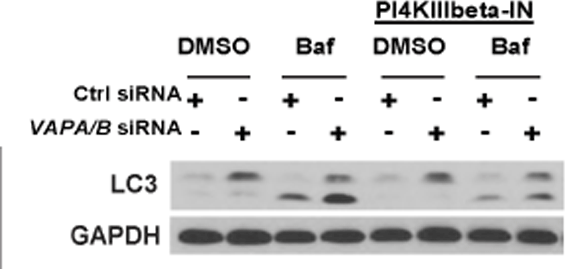
Control or VAPA/B siRNA-transfected HEK293T cells are treated with DMSO or PI4KIIIbeta-IN-10 for 18 h and treated with bafilomycin A1 for 4 h. WBs probed with LC3.
-
Nat Chem Biol
2022 Oct;18(10):1076-1086. PMID: 35788180 -
EMBO J
2022 Dec 15;41(24):e112677. PMID: 36408828 -
Cell Rep
The Golgi-resident protein ACBD3 concentrates STING at ER-Golgi contact sites to drive export from the ER. [Abstract]2022 Dec 20;41(12):111868. PMID: 36543137 -
J Cell Biol
2024 Jan 1;223(1):e202307051. PMID: 37991810 -
J Cell Biol
Arf1-PI4KIIIβ positive vesicles regulate PI(3)P signaling to facilitate lysosomal tubule fission. [Abstract]2023 Sep 4;222(9):e202205128. PMID: 37289133 -
mBio
Early enterovirus translation deficits extend viral RNA replication and elicit sustained MDA5-directed innate signaling. [Abstract]2023 Dec 19;14(6):e0191523. PMID: 37962360 -
Sci Rep
2025 Aug 21;15(1):30805. PMID: 40841827 -
J Cell Sci
VAPB depletion alters neuritogenesis and phosphoinositide balance in motoneuron-like cells: relevance to VAPB-linked amyotrophic lateral sclerosis. [Abstract]2019 Apr 3;132(7):jcs220061. PMID: 30745341 -
-
-
-
-
Elife
2017 Nov 1:6:e29388. PMID: 29091030
PI4KIIIbeta-IN-10 purchased from MedChemExpress. Usage Cited in: Elife. 2017 Nov 1:6:e29388. [Abstract]
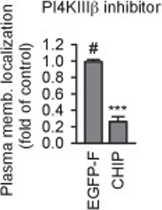
Inhibition of PI4KIIIβ by its specific inhibitor IN-10 for 20 min undocks EGFP-CHIP-K30A, but not farnesylated EGFP (EGFP-F) from cellular membranes.


Lösungsmittel & Löslichkeit
In Vitro:
DMSO : 50 mg/mL (105.13 mM; Need ultrasonic; Hygroscopic DMSO has a significant impact on the solubility of product, please use newly opened DMSO)
Please refer to the solubility information to select the appropriate solvent. Once prepared, please aliquot and store the solution to prevent product inactivation from repeated freeze-thaw cycles.
Storage method and period of stock solution: -80°C, 2 years; -20°C, 1 year. When stored at -80°C, please use it within 2 years. When stored at -20°C, please use it within 1 year.
Please refer to the solubility information to select the appropriate solvent. Once prepared, please aliquot and store the solution to prevent product inactivation from repeated freeze-thaw cycles.
Storage method and period of stock solution: -80°C, 2 years; -20°C, 1 year. When stored at -80°C, please use it within 2 years. When stored at -20°C, please use it within 1 year.
Konzentration (Stammlösung) × Volumen (Stammlösung) = Konzentration (Ziellösung) × Volumen (Ziellösung)
In Vivo:
Select the appropriate dissolution method based on your experimental animal and administration route.
- For the following dissolution methods, please ensure to first prepare a clear stock solution using an In Vitro approach and then sequentially add co-solvents:
- To ensure reliable experimental results, the clarified stock solution can be appropriately stored based on storage conditions. As for the working solution for In Vivo experiments, it is recommended to prepare freshly and use it on the same day.
- The percentages shown for the solvents indicate their volumetric ratio in the final prepared solution. If precipitation or phase separation occurs during preparation, heat and/or sonication can be used to aid dissolution.
Add each solvent one by one: 10% DMSO 40% PEG300 5% Tween-80 45% Saline
Solubility: ≥ 2.5 mg/mL (5.26 mM); Clear solution
This protocol yields a clear solution of ≥ 2.5 mg/mL (saturation unknown).
Taking 1 mL working solution as an example, add 100 μL DMSO stock solution (25.0 mg/mL) to 400 μL PEG300, and mix evenly; then add 50 μL Tween-80 and mix evenly; then add 450 μL Saline to adjust the volume to 1 mL.
Preparation of Saline: Dissolve 0.9 g sodium chloride in ddH₂O and dilute to 100 mL to obtain a clear Saline solution.
Add each solvent one by one: 10% DMSO 90% (20% SBE-β-CD in Saline)
Solubility: ≥ 2.5 mg/mL (5.26 mM); Clear solution
This protocol yields a clear solution of ≥ 2.5 mg/mL (saturation unknown).
Taking 1 mL working solution as an example, add 100 μL DMSO stock solution (25.0 mg/mL) to 900 μL 20% SBE-β-CD in Saline, and mix evenly.
Preparation of 20% SBE-β-CD in Saline (4°C, storage for one week): 2 g SBE-β-CD powder is dissolved in 10 mL Saline, completely dissolve until clear.
In Vivo Dissolution Calculator
Please enter the basic information of animal experiments:
-
-
-
-
Recommended: Prepare an additional quantity of animals to account for potential losses during experiments.
Please enter your animal formula composition:
-
%DMSO +
Recommended: Keep the proportion of DMSO in working solution below 2% if your animal is weak.
-
%+
-
+%Tween-80 + +
-
%Saline +
The co-solvents required include: DMSO, . All of co-solvents are available by MedChemExpress (MCE). , Tween 80. All of co-solvents are available by MedChemExpress (MCE).
Working solution concentration: 0.22 mg/mL
Method for preparing stock solution: mg drug dissolved in μL DMSO. Stock solution concentration: mg/mL.
1. Take μL DMSO stock solution;
2. Add μL .
μL , mix evenly;
3. Then add μL Tween 80, mix evenly;
4. Then add μL
Please ensure that the stock solution in the first step is dissolved to a clear state, and add co-solvents in sequence. You can use ultrasonic heating (ultrasonic cleaner, recommended frequency 20-40 kHz), vortexing, etc. to assist dissolution.

Protokoll
Kinase Assay[1]
Lipid kinase assays are preformed using recombinant enzyme, phosphoinositides and γ32P-ATP in a membrane capture assay. Each inhibitor (e.g., PI4KIIIbeta-IN-10) is diluted into 10% DMSO and kinase assay buffer. Upon completion of the reaction, 4 µL is spotted onto 0.2 µm nitrocellulose. The membrane is dried for 5 minutes under a heat lamp followed by 1×30 second wash and 6×5 min washes in 1M NaCl /1% Phosphoric Acid. The membrane is dried for 20 minutes under a heat lamp followed by overnight exposure to a phosphor screen and phosphorimaging followed on a Typhoon 9500. Intensities are quantified using SPOT. Specifications for each enzyme follow. L-α-Phosphatidylinositol and DOPS:DOPC lipids are sonicated in water to generate 1mg/mL PI:DOPS:DOPC. Reaction is set-up as follows 1) kinase assay buffer, PI:DOPS:DOPC, BSA and PI4KIIIβ, are combined in a total volume of 10 µL (2.5x solution); 2) 5 µL of inhibitor solution is added (5x solution) and incubated with enzyme mixture for 15 minutes; 3) 10 µL cold ATP and γ32P-ATP are added (2.5x solution) to initiate the reaction which ran for 30 minutes. Final conditions are as follows: 20 mM Bis-Tris Propane pH 7.5, 10 mM MgCl2, 0.075 mM Triton X-100, 0.5 mM EGTA, 1 mM DTT, 100 µM PI, 500 ng/µL BSA, 2.5 nM PI4KIIIβ, 2% DMSO, 10 µM ATP and 1 uCi γ32P-ATP[1].
MedChemExpress (MCE) has not independently confirmed the accuracy of these methods. They are for reference only.


Reinheit & Dokumentation
-
Data Sheet (278 KB)
-
SDS (393 KB)
- English - EN (393 KB)
- Français - FR (393 KB)
- Deutsch - DE (393 KB)
- Norwegian - NO (393 KB)
- Español - ES (393 KB)
- Swedish - SV (393 KB)
- Italian - IT (393 KB)
- Korean - KR (393 KB)
- Portuguese - PT (393 KB)
-
Handling Instructions (2659 KB)
Verweise


Complete Stock Solution Preparation Table
Please refer to the solubility information to select the appropriate solvent. Once prepared, please aliquot and store the solution to prevent product inactivation from repeated freeze-thaw cycles.
Storage method and period of stock solution: -80°C, 2 years; -20°C, 1 year. When stored at -80°C, please use it within 2 years. When stored at -20°C, please use it within 1 year.
| Optional Solvent | Concentration Solvent Mass | 1 mg | 5 mg | 10 mg | 25 mg |
|---|---|---|---|---|---|
| DMSO | 1 mM | 2.1027 mL | 10.5135 mL | 21.0270 mL | 52.5674 mL |
| 5 mM | 0.4205 mL | 2.1027 mL | 4.2054 mL | 10.5135 mL | |
| 10 mM | 0.2103 mL | 1.0513 mL | 2.1027 mL | 5.2567 mL | |
| 15 mM | 0.1402 mL | 0.7009 mL | 1.4018 mL | 3.5045 mL | |
| 20 mM | 0.1051 mL | 0.5257 mL | 1.0513 mL | 2.6284 mL | |
| 25 mM | 0.0841 mL | 0.4205 mL | 0.8411 mL | 2.1027 mL | |
| 30 mM | 0.0701 mL | 0.3504 mL | 0.7009 mL | 1.7522 mL | |
| 40 mM | 0.0526 mL | 0.2628 mL | 0.5257 mL | 1.3142 mL | |
| 50 mM | 0.0421 mL | 0.2103 mL | 0.4205 mL | 1.0513 mL | |
| 60 mM | 0.0350 mL | 0.1752 mL | 0.3504 mL | 0.8761 mL | |
| 80 mM | 0.0263 mL | 0.1314 mL | 0.2628 mL | 0.6571 mL | |
| 100 mM | 0.0210 mL | 0.1051 mL | 0.2103 mL | 0.5257 mL |


PI4KIIIbeta-IN-10 Related Classifications
HY-100198 Related Classifications
 Powered by Bioz