



AMG2850 (Standard)
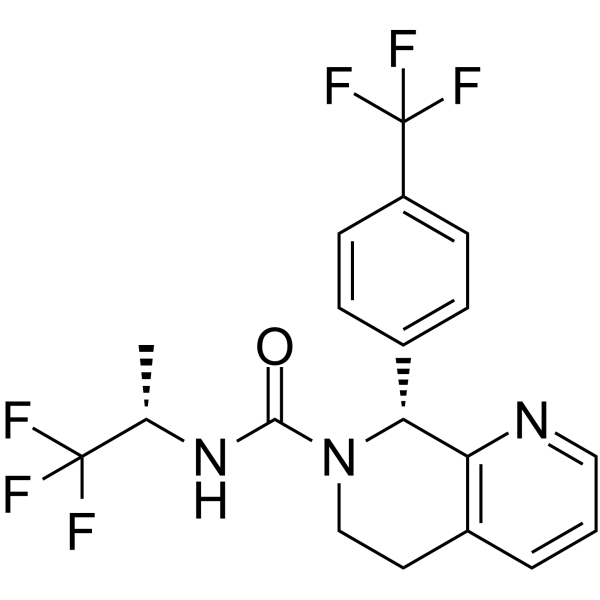
AMG2850 (Standard) is the analytical standard of AMG2850 (HY-104059). This product is intended for research and analytical applications. AMG2850 is an orally active, blood-brain barrier-permeable selective TRPM8 competitive antagonist. AMG2850 abolishes the counterirritant effect of TRPM8 agonists, blocks TRPM8 activation induced by cold, (-)-Menthol (HY-75161) and Icilin (HY-11062), and exhibits selectivity over TRPA1, TRPV1, TRPV3 and TRPV4. AMG2850 is applicable for pain-related research.
Nur für Forschungszwecke. Wir verkaufen nicht an Patienten.
- CAS. Nr.: 1470018-52-0
- Formel: C19H17F6N3O
- Molecular Weight:417.35
-
Speicherung:
Please store the product under the recommended conditions in the Certificate of Analysis.


To place orders, for customer services and technical support, please contact: MedChemExpress USA
Tel: 609-228-6898 E-mail: [email protected] [email protected]


-
 Product Information
-
Chemical Information
- Reinheit & Dokumentation
-
 Help & FAQs




Product Information
Information
Anwendung
The compound is the grade of analytical standard, which is the reference standard supplied assay. It is commonly used in qualitative, quantitative and methodological research experiments in HPLC, GC and MS.


Chemical Information
-
CAS. Nr. 1470018-52-0
-
Molecular Weight 417.35
-
Formel C19H17F6N3O
-
SMILES
O=C(N1CCC2=C(N=CC=C2)[C@H]1C3=CC=C(C(F)(F)F)C=C3)N[C@@H](C)C(F)(F)F
-
Versand
Room temperature in continental US; may vary elsewhere.
-
Speicherung
Please store the product under the recommended conditions in the Certificate of Analysis.


Reinheit & Dokumentation
Verweise
[1]. Ha MA, et al. Menthol attenuates respiratory irritation and elevates blood cotinine in cigarette smoke exposed mice. PloS one. 2015;10(2):e0117128. [Content Brief]
[2]. Gavva NR, et al. Transient receptor potential melastatin 8 (TRPM8) channels are involved in body temperature regulation. Molecular pain. 2012 May 09;8:36. [Content Brief]
[3]. Lehto SG, et al. AMG2850, a potent and selective TRPM8 antagonist, is not effective in rat models of inflammatory mechanical hypersensitivity and neuropathic tactile allodynia. Naunyn-Schmiedeberg's archives of pharmacology. 2015 Apr;388(4):465-76. [Content Brief]

Calculators
Konzentration (Stammlösung) × Volumen (Stammlösung) = Konzentration (Ziellösung) × Volumen (Ziellösung)


AMG2850 (Standard) Related Classifications
HY-104059R Related Classifications
 Powered by Bioz