



AMG2850
Based on 1 publication(s) in Google Scholar
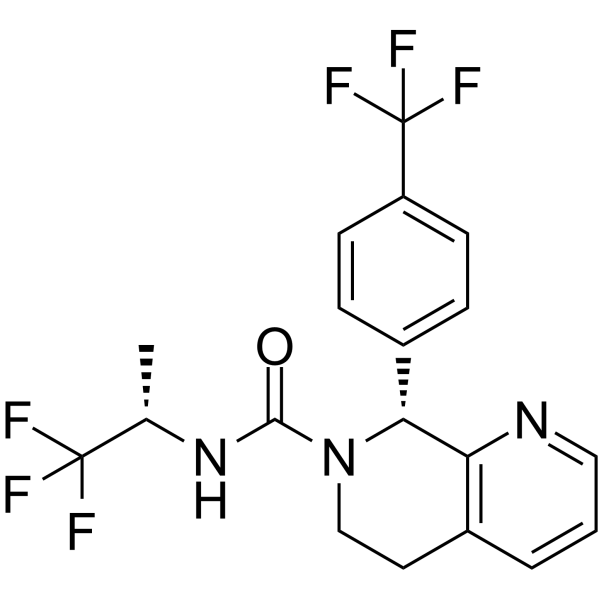
AMG2850 is an orally active, blood-brain barrier-permeable selective TRPM8 competitive antagonist. AMG2850 abolishes the counterirritant effect of TRPM8 agonists, blocks TRPM8 activation induced by cold, (-)-Menthol (HY-75161) and Icilin (HY-11062), and exhibits selectivity over TRPA1, TRPV1, TRPV3 and TRPV4. AMG2850 is applicable for pain-related research.
For research use only. We do not sell to patients.
- Purity : 99.89%
- CAS No.: 1470018-52-0
- Formula: C19H17F6N3O
- Molecular Weight:417.35
-
Storage:Powder -20°C, 3 years , 4°C, 2 years ; In solvent -80°C, 6 months , -20°C, 1 month

To place orders, for customer services and technical support, please contact: MedChemExpress USA
Tel: 609-228-6898 E-mail: [email protected] [email protected]


-
 Biological Activity
-
Chemical Information
-
Solvent & Solubility
- Purity & Documentation
- References
-
 Help & FAQs




Publications Citing Use of MedChemExpress (MCE) AMG2850
More

Biological Activity
Description
IC50 & Target
TRPM8[1].
Cellular Effect
|
Cell Line

|
Type | Value | Description | References |
|---|---|---|---|---|
| CHO | IC50 |
115 nM
Compound: 42
|
Antagonist activity at rat TRPM8 expressed in CHO cells assessed as inhibition of icilin-induced Ca2+ influx incubated 2.5 mins prior to icilin challenge by luminometry
Antagonist activity at rat TRPM8 expressed in CHO cells assessed as inhibition of icilin-induced Ca2+ influx incubated 2.5 mins prior to icilin challenge by luminometry
|
[PMID: 24597733] |
In Vitro
AMG2850 is a potent, selective inhibitor of rat TRPM8 in CHO cells, with greater potency against cold-induced activation (IC50 7.3 nM) than Menthol ((-)-Menthol) (HY-75161)-induced activation (IC50 156 nM), and no activity at other tested TRP channels[2].
AMG2850 (2.5 min) potently and selectively inhibits rat TRPM8 in CHO cells, with IC50 values of 41 nM against cold activation and 204 nM against Icilin (HY-11062) activation, and shows minimal activity against other TRP channels[3].
AMG2850 (2 min pre-incubation; 2 min agonist/45Ca2+ incubation) inhibits agonist-induced calcium uptake in rat TRPM8-expressing CHO cells[3].
MedChemExpress (MCE) has not independently confirmed the accuracy of these methods. They are for reference only. .
In Vivo
AMG2850 (30 mg/kg; i.p.; single dose; 10 min prior to smoke exposure) completely blocks the TRPM8-mediated counterirritant effect of L-menthol on cigarette smoke-induced respiratory irritation in female C57Bl/6J mice[1].
AMG2850 (100 mg/kg; p.o.; single dose) causes a maximum body temperature decrease of 0.98°C in male Sprague Dawley rats[2].
AMG2850 (100 mg/kg; p.o.; single dose) causes a maximum body temperature decrease of 0.73°C in male C57BL/6 mice[2].
AMG2850 (1-10 mg/kg; p.o.; single dose) dose-dependently and fully inhibits Icilin-induced wet-dog shakes in rats, with an ED50 of 1.8 mg/kg and an unbound in vivo IC90 of 99 nM[3].
AMG2850 (100 mg/kg; p.o.; single dose) does not reverse complete Freund's adjuvant-induced mechanical hypersensitivity in rats[3].
AMG2850 (100 mg/kg; p.o.; single dose) does not reverse sciatic nerve ligation-induced tactile allodynia in rats[3].
AMG2850 (10-100 mg/kg; p.o.; single dose) at doses up to 100 mg/kg p.o. does not affect open field locomotor activity in rats[3].
AMG2850 (30 mg/kg; i.g.; single dose) attenuates cold-defense mechanisms in rats, resulting in a 1.8°C nadir reduction in deep body temperature during severe cold exposure[4].
AMG2850 (0.3-10 mg/kg; p.o.; single dose) at 10 mg/kg p.o. fully blocks cold-induced increases in mean blood pressure in rats[3].
MedChemExpress (MCE) has not independently confirmed the accuracy of these methods. They are for reference only.
-
Animal Model:C57Bl/6J (female, 8-14 weeks of age, exposed to 3 ppm acrolein)[1]
-
Dosage:15 mg/kg
-
Administration:i.p.; single dose; 10 min prior to acrolein exposure
-
Result:Abolished the counterirritant effect of L-Menthol on acrolein-induced respiratory irritation, restoring the duration of braking to levels equivalent to acrolein exposure alone.
-
Animal Model:C57Bl/6J (female, 8-14 weeks of age, exposed to 9 mg/m3 cigarette smoke)[1]
-
Dosage:30 mg/kg
-
Administration:i.p.; single dose; 10 min prior to smoke exposure
-
Result:Abolished the counterirritant effect of L-Menthol on cigarette smoke-induced respiratory irritation, restoring the duration of braking to levels equivalent to smoke exposure alone.
-
Animal Model:Sprague Dawley (male, 6-12 weeks, 200-350 g)[2]
-
Dosage:100 mg/kg
-
Administration:p.o.; single dose
-
Result:Produced a decrease in body temperature starting at 40 minutes post-dosing, lasting until 4 hours post-dosing.
Reached a maximum decrease in body temperature of 0.98°C at 140 minutes post-dosing.
Achieved a plasma concentration of 22 μM at 4 hours post-dosing.
-
Animal Model:C57BL/6 (male, 10-15 weeks, 24-38 g)[2]
-
Dosage:100 mg/kg
-
Administration:p.o.; single dose
-
Result:Produced a decrease in body temperature starting at 40 minutes post-dosing, lasting until 140 minutes post-dosing.
Reached a maximum decrease in body temperature of 0.73°C at 100 minutes post-dosing.
Achieved a plasma concentration of 54 μM at 4 hours post-dosing.
-
Animal Model:Sprague-Dawley (male, 220-300 g, icilin-induced wet-dog shakes)[3]
-
Dosage:1 mg/kg; 3 mg/kg; 10 mg/kg
-
Administration:p.o.; single dose
-
Result:Dose-dependently inhibited icilin-induced wet-dog shakes.
Fully prevented wet-dog shakes at 10 mg/kg, with an unbound plasma concentration of 192 nM and a calculated unbound mean in vivo IC90 value of 99 nM.
Achieved an ED50 of 1.8 mg/kg.
-
Animal Model:Sprague-Dawley (male, 220-300 g, cold pressor test)[3]
-
Dosage:0.3 mg/kg; 1 mg/kg; 3 mg/kg; 10 mg/kg
-
Administration:p.o.; single dose
-
Result:Fully blocked the cold pressor-induced increase in mean blood pressure at 10 mg/kg, with an unbound plasma concentration of 488 nM.
-
Animal Model:Sprague-Dawley (male, 220-300 g, complete Freund's adjuvant injection)[3]
-
Dosage:100 mg/kg
-
Administration:p.o.; single dose
-
Result:Produced no significant effect on rearing time relative to vehicle, with a mean unbound plasma concentration of 4.3 μM.
-
Animal Model:Sprague-Dawley (male, 220-300 g, sciatic nerve ligation of L5 and L6 spinal nerves)[3]
-
Dosage:100 mg/kg
-
Administration:p.o.; single dose
-
Result:Produced no significant effect on von Frey withdrawal threshold relative to vehicle, with a tactile threshold of 5.8 g and a mean unbound plasma concentration of 2.1 μM.
-
Animal Model:Sprague-Dawley (male, 220-300 g, healthy)[3]
-
Dosage:10 mg/kg; 30 mg/kg; 100 mg/kg
-
Administration:p.o.; single dose
-
Result:Produced no significant difference in total distance traveled relative to vehicle at 100 mg/kg, with a total distance traveled of 13,640 cm and a mean unbound plasma concentration of 2.59 μM.
-
Animal Model:Sprague Dawley (male, 220-300 g)[4]
-
Dosage:30 mg/kg
-
Administration:i.g.; single dose
-
Result:Marked decreased deep colonic body temperature, with a nadir reduction of 1.8°C.
Suppressed the initial transient rise in body temperature typically seen in cold-exposed rats.


Chemical Information
-
CAS No. 1470018-52-0
-
Appearance Solid
-
Molecular Weight 417.35
-
Formula C19H17F6N3O
-
Color White to off-white
-
SMILES
O=C(N1CCC2=C(N=CC=C2)[C@H]1C3=CC=C(C(F)(F)F)C=C3)N[C@@H](C)C(F)(F)F
-
Shipping
Room temperature in continental US; may vary elsewhere.
-
Storage
Powder -20°C 3 years 4°C 2 years In solvent -80°C 6 months -20°C 1 month


Publications (1)
-
Journal Impact Factor
-
Most Recent
-
Commun Biol
2025 May 10;8(1):724. PMID: 40348921


Solvent & Solubility
In Vitro:
DMSO : 100 mg/mL (239.61 mM; Need ultrasonic; Hygroscopic DMSO has a significant impact on the solubility of product, please use newly opened DMSO)
Please refer to the solubility information to select the appropriate solvent. Once prepared, please aliquot and store the solution to prevent product inactivation from repeated freeze-thaw cycles.
Storage method and period of stock solution: -80°C, 6 months; -20°C, 1 month. When stored at -80°C, please use it within 6 months. When stored at -20°C, please use it within 1 month.
Please refer to the solubility information to select the appropriate solvent. Once prepared, please aliquot and store the solution to prevent product inactivation from repeated freeze-thaw cycles.
Storage method and period of stock solution: -80°C, 6 months; -20°C, 1 month. When stored at -80°C, please use it within 6 months. When stored at -20°C, please use it within 1 month.
Concentration (start) × Volume (start) = Concentration (final) × Volume (final)
In Vivo:
Select the appropriate dissolution method based on your experimental animal and administration route.
- For the following dissolution methods, please ensure to first prepare a clear stock solution using an In Vitro approach and then sequentially add co-solvents:
- To ensure reliable experimental results, the clarified stock solution can be appropriately stored based on storage conditions. As for the working solution for In Vivo experiments, it is recommended to prepare freshly and use it on the same day.
- The percentages shown for the solvents indicate their volumetric ratio in the final prepared solution. If precipitation or phase separation occurs during preparation, heat and/or sonication can be used to aid dissolution.
In Vivo Dissolution Calculator
Please enter the basic information of animal experiments:
-
-
-
-
Recommended: Prepare an additional quantity of animals to account for potential losses during experiments.
Please enter your animal formula composition:
-
%DMSO +
Recommended: Keep the proportion of DMSO in working solution below 2% if your animal is weak.
-
%+
-
+%Tween-80 + +
-
%Saline +
The co-solvents required include: DMSO, . All of co-solvents are available by MedChemExpress (MCE). , Tween 80. All of co-solvents are available by MedChemExpress (MCE).
Working solution concentration: 0.22 mg/mL
Method for preparing stock solution: mg drug dissolved in μL DMSO. Stock solution concentration: mg/mL.
1. Take μL DMSO stock solution;
2. Add μL .
μL , mix evenly;
3. Then add μL Tween 80, mix evenly;
4. Then add μL
Please ensure that the stock solution in the first step is dissolved to a clear state, and add co-solvents in sequence. You can use ultrasonic heating (ultrasonic cleaner, recommended frequency 20-40 kHz), vortexing, etc. to assist dissolution.


Purity & Documentation
-
Data Sheet (297 KB)
-
SDS (251 KB)
- English - EN (251 KB)
- Français - FR (251 KB)
- Deutsch - DE (251 KB)
- Norwegian - NO (251 KB)
- Español - ES (251 KB)
- Swedish - SV (251 KB)
- Italian - IT (251 KB)
- Korean - KR (251 KB)
- Portuguese - PT (251 KB)
-
Handling Instructions (2659 KB)
References
[1]. Ha MA, et al. Menthol attenuates respiratory irritation and elevates blood cotinine in cigarette smoke exposed mice. PloS one. 2015;10(2):e0117128. [Content Brief]
[2]. Gavva NR, et al. Transient receptor potential melastatin 8 (TRPM8) channels are involved in body temperature regulation. Molecular pain. 2012 May 09;8:36. [Content Brief]
[3]. Lehto SG, et al. AMG2850, a potent and selective TRPM8 antagonist, is not effective in rat models of inflammatory mechanical hypersensitivity and neuropathic tactile allodynia. Naunyn-Schmiedeberg's archives of pharmacology. 2015 Apr;388(4):465-76. [Content Brief]


Complete Stock Solution Preparation Table
Please refer to the solubility information to select the appropriate solvent. Once prepared, please aliquot and store the solution to prevent product inactivation from repeated freeze-thaw cycles.
Storage method and period of stock solution: -80°C, 6 months; -20°C, 1 month. When stored at -80°C, please use it within 6 months. When stored at -20°C, please use it within 1 month.
| Optional Solvent | Concentration Solvent Mass | 1 mg | 5 mg | 10 mg | 25 mg |
|---|---|---|---|---|---|
| DMSO | 1 mM | 2.3961 mL | 11.9804 mL | 23.9607 mL | 59.9018 mL |
| 5 mM | 0.4792 mL | 2.3961 mL | 4.7921 mL | 11.9804 mL | |
| 10 mM | 0.2396 mL | 1.1980 mL | 2.3961 mL | 5.9902 mL | |
| 15 mM | 0.1597 mL | 0.7987 mL | 1.5974 mL | 3.9935 mL | |
| 20 mM | 0.1198 mL | 0.5990 mL | 1.1980 mL | 2.9951 mL | |
| 25 mM | 0.0958 mL | 0.4792 mL | 0.9584 mL | 2.3961 mL | |
| 30 mM | 0.0799 mL | 0.3993 mL | 0.7987 mL | 1.9967 mL | |
| 40 mM | 0.0599 mL | 0.2995 mL | 0.5990 mL | 1.4975 mL | |
| 50 mM | 0.0479 mL | 0.2396 mL | 0.4792 mL | 1.1980 mL | |
| 60 mM | 0.0399 mL | 0.1997 mL | 0.3993 mL | 0.9984 mL | |
| 80 mM | 0.0300 mL | 0.1498 mL | 0.2995 mL | 0.7488 mL | |
| 100 mM | 0.0240 mL | 0.1198 mL | 0.2396 mL | 0.5990 mL |


AMG2850 Related Classifications
HY-104059 Related Classifications
 Powered by Bioz