



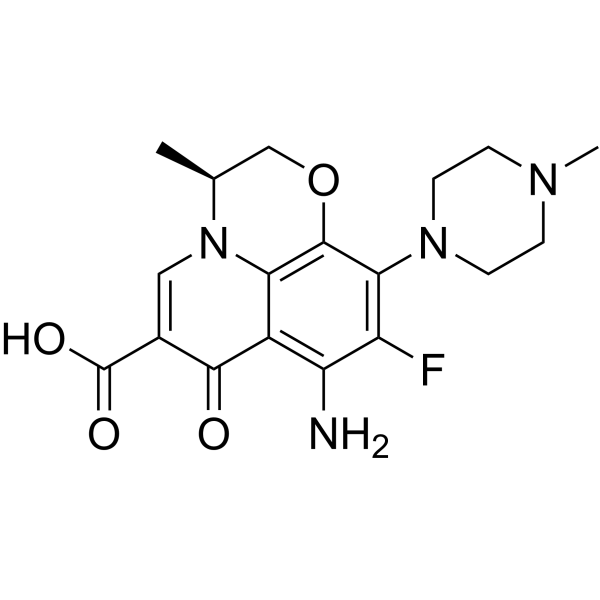
Antofloxacin
Antofloxacin is a well tolerate, orally active and broad-spectrum 8-amino-fluoroquinolone with potent antibacterial activities. Antofloxacin shows superior antibacterial activity against gyrA mutation-positive H. pylori strains, especially in Asn87- mutated strains, compared to levofloxacin. Antofloxacin is a weak, reversible inhibitor of CYP1A2 for the research of infections caused by a diverse group of bacterial species.
Nur für Forschungszwecke. Wir verkaufen nicht an Patienten.
- CAS. Nr.: 119354-43-7
- Formel: C18H21FN4O4
- Molecular Weight:376.38
-
Speicherung:
Please store the product under the recommended conditions in the Certificate of Analysis.

To place orders, for customer services and technical support, please contact: MedChemExpress USA
Tel: 609-228-6898 E-mail: [email protected] [email protected]


-
 Biologische Aktivität
-
Chemical Information
- Protokoll
- Reinheit & Dokumentation
- Verweise
-
 Help & FAQs


Alle Antibiotic Isoform-spezifische Produkte anzeigen
More

Biologische Aktivität
Beschreibung
IC50 & Target
|
Quinolone |
In Vivo
MedChemExpress (MCE) has not independently confirmed the accuracy of these methods. They are for reference only.
-
Animal Model:Mice[3]
-
Dosage:2.5~160 mg/kg (Pharmacokinetic Analysis)
-
Administration:S.c.; 24 hours
-
Result:Penetration ratio ranged from 1.22 to 1.54 for the total drug concentrations and was independent of the dose levels.


Chemical Information
-
CAS. Nr. 119354-43-7
-
Molecular Weight 376.38
-
Formel C18H21FN4O4
-
SMILES
O=C1C2=C(N)C(F)=C(N3CCN(CC3)C)C4=C2N(C=C1C(O)=O)[C@@H](C)CO4
-
Versand
Room temperature in continental US; may vary elsewhere.
-
Speicherung
Please store the product under the recommended conditions in the Certificate of Analysis.

Protokoll
-
Research Protocol for Infectious Diseases
Infectious-disease experiments test how pathogens interact with host barriers, innate immune receptors, inflammatory signaling, pathogen replication, and tissue injury; pattern-recognition receptors such as TLRs, RIG-I-like receptors, NOD-like receptors, and inflammasomes detect microbial molecules and activate NF-κB, interferon, and cytokine responses. The central hypothesis is that infection severity reflects the balance between pathogen burden and host response: protective inflammation restricts pathogen growth, whereas excessive or mislocalized inflammation contributes to tissue damage and disease phenotype. Unresolved questions include which host pathways are protective versus pathogenic, why some infection models fail to translate to human disease, and which combined readouts best predict clinically relevant infection outcomes.
-
Bacterial live/dead nucleic-acid viability staining
The LIVE/DEAD bacterial viability staining method is based on differential permeability of nucleic-acid-binding fluorescent dyes, most commonly SYTO 9 and propidium iodide (PI), which enables discrimination of bacterial populations with intact versus compromised cytoplasmic membranes. SYTO 9 penetrates both intact and damaged bacterial membranes and binds nucleic acids to produce green fluorescence, whereas propidium iodide penetrates only cells with compromised membranes and fluoresces red while also reducing SYTO 9 signal through competitive binding and fluorescence interactions. The resulting fluorescence pattern is interpreted as a proxy for membrane integrity, which is widely used as an indicator of bacterial viability in microscopy, flow cytometry, and spectroscopic platforms. However, mechanistic studies show that SYTO 9 and PI interactions involve displacement and fluorescence resonance energy transfer effects, which can influence signal interpretation depending on dye ratios a
-
Genotoxicity/Mutagenicity Study
The bacterial reverse mutation assay detects point mutations that restore amino-acid prototrophy in auxotrophic Salmonella typhimurium or Escherichia coli tester strains; after exposure to a test article, mutagenic activity is read out as an increased number of revertant colonies on minimal agar compared with the vehicle control. The assay uses tester strains with different mutation targets so that base-substitution and frameshift mutagens can be detected, and testing is performed with and without exogenous mammalian metabolic activation because some chemicals require biotransformation to become mutagenic.


Reinheit & Dokumentation
Verweise
[1]. He XJ, et al. Efficacy and Safety of Antofloxacin-Based Triple Therapy for Helicobacter pylori Eradication Failure in China [published online ahead of print, 2021 Feb 8]. Dig Dis Sci. 2021;10.1007/s10620-021-06856-z. [Content Brief]
[2]. Liu L, et al. Modulation of pharmacokinetics of theophylline by antofloxacin, a novel 8-amino-fluoroquinolone, in humans. Acta Pharmacol Sin. 2011;32(10):1285-1293. [Content Brief]
[3]. Zhou YF, et al. In Vivo Pharmacokinetic and Pharmacodynamic Profiles of Antofloxacin against Klebsiella pneumoniae in a Neutropenic Murine Lung Infection Model. Antimicrob Agents Chemother. 2017;61(5):e02691-16. Published 2017 Apr 24. [Content Brief]

Calculators
Konzentration (Stammlösung) × Volumen (Stammlösung) = Konzentration (Ziellösung) × Volumen (Ziellösung)


Antofloxacin Related Classifications
HY-123319A Related Classifications
 Powered by Bioz