



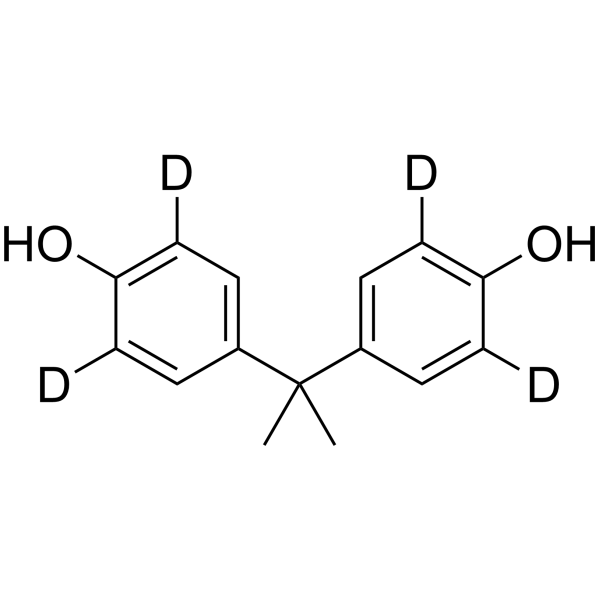
Bisphenol A-d4-1

Based on 1 Customer Validation
Bisphenol A-d4-1 is the deuterium labeled Bisphenol A. Bisphenol A is a phenolic, organic synthetic compound widely used in the production of polycarbonate plastics and epoxy resins. Bisphenol A is a reproductive, developmental, and systemic toxicant, often classified as an endocrine-disrupting compound (EDC). Bisphenol A is associated with many diseases, including cardiovascular diseases, respiratory diseases, diabetes, kidney diseases, obesity, and reproductivedisorders.
Nur für Forschungszwecke. Wir verkaufen nicht an Patienten.
- Reinheit : 99.53%
- CAS. Nr.: 347841-41-2
- Formel: C15H12D4O2
- Molecular Weight:232.31
-
Speicherung:
4°C, sealed storage, away from moisture
* In solvent : -80°C, 6 months; -20°C, 1 month (sealed storage, away from moisture)

To place orders, for customer services and technical support, please contact: MedChemExpress USA
Tel: 609-228-6898 E-mail: [email protected] [email protected]


-
 Biologische Aktivität
-
Chemical Information
-
Lösungsmittel & Löslichkeit
- Protokoll
- Reinheit & Dokumentation
- Verweise
-
 Help & FAQs


Alle Endogenous Metabolite Isoform-spezifische Produkte anzeigen
More

Biologische Aktivität
Beschreibung
In Vitro
Stable heavy isotopes of hydrogen, carbon, and other elements have been incorporated into drug molecules, largely as tracers for quantitation during the drug development process. Deuteration has gained attention because of its potential to affect the pharmacokinetic and metabolic profiles of drugs[1].
MedChemExpress (MCE) has not independently confirmed the accuracy of these methods. They are for reference only. Further protocols information, click here.
Anwendung
1. This compound can be used as a tracer
2. This compound can be used as an internal standard for quantitative analysis by NMR, GC-MS, or LC-MS.


Chemical Information
-
CAS. Nr. 347841-41-2
-
Unlabeled CAS 80-05-7
-
Appearance Solid
-
Molecular Weight 232.31
-
Formel C15H12D4O2
-
SMILES
CC(C1=CC([2H])=C(C([2H])=C1)O)(C2=CC([2H])=C(C([2H])=C2)O)C
-
Versand
Room temperature in continental US; may vary elsewhere.
-
Speicherung
4°C, sealed storage, away from moisture
* In solvent : -80°C, 6 months; -20°C, 1 month (sealed storage, away from moisture)


Lösungsmittel & Löslichkeit
In Vitro:
DMSO : 50 mg/mL (215.23 mM; Need ultrasonic; Hygroscopic DMSO has a significant impact on the solubility of product, please use newly opened DMSO)
Please refer to the solubility information to select the appropriate solvent. Once prepared, please aliquot and store the solution to prevent product inactivation from repeated freeze-thaw cycles.
Storage method and period of stock solution: -80°C, 6 months; -20°C, 1 month (sealed storage, away from moisture). When stored at -80°C, please use it within 6 months. When stored at -20°C, please use it within 1 month.
Please refer to the solubility information to select the appropriate solvent. Once prepared, please aliquot and store the solution to prevent product inactivation from repeated freeze-thaw cycles.
Storage method and period of stock solution: -80°C, 6 months; -20°C, 1 month (sealed storage, away from moisture). When stored at -80°C, please use it within 6 months. When stored at -20°C, please use it within 1 month.
Konzentration (Stammlösung) × Volumen (Stammlösung) = Konzentration (Ziellösung) × Volumen (Ziellösung)

Protokoll
-
Research Protocol for Metabolic Diseases
AMP-activated protein kinase, AMPK, is a conserved cellular energy sensor that responds to reduced cellular energy status and coordinates metabolism by increasing ATP-generating catabolic pathways while suppressing ATP-consuming anabolic processes. In metabolic disease research, the AMPK pathway is experimentally relevant because it regulates hepatic lipid synthesis, fatty acid oxidation, glucose production, skeletal-muscle glucose disposal, mTORC1-linked biosynthesis, autophagy, mitochondrial homeostasis, and whole-body energy balance. The central pathway logic is that energy stress, metformin, exercise-like stimulation, or direct AMPK activators increase AMPKα Thr172 phosphorylation and downstream substrate phosphorylation, including ACC and RAPTOR. Phosphorylation of ACC suppresses lipogenesis and supports fatty acid oxidation, whereas phosphorylation of RAPTOR suppresses mTORC1 signaling and links cellular energy status to growth and protein synthesis control. The pathway is linked


Reinheit & Dokumentation
Verweise
[1]. Russak EM, et al. Impact of Deuterium Substitution on the Pharmacokinetics of Pharmaceuticals. Ann Pharmacother. 2019 Feb;53(2):211-216. [Content Brief]
[2]. Huang M, et al. Bisphenol A and its analogues bisphenol S, bisphenol F and bisphenol AF induce oxidative stress and biomacromolecular damage in human granulosa KGN cells. Chemosphere. 2020 Apr 9;253:126707. [Content Brief]
[3]. Rubin BS, et al. Bisphenol A: an endocrine disruptor with widespread exposure and multiple effects. J Steroid Biochem Mol Biol. 2011 Oct;127(1-2):27-34. [Content Brief]


Complete Stock Solution Preparation Table
Please refer to the solubility information to select the appropriate solvent. Once prepared, please aliquot and store the solution to prevent product inactivation from repeated freeze-thaw cycles.
Storage method and period of stock solution: -80°C, 6 months; -20°C, 1 month (sealed storage, away from moisture). When stored at -80°C, please use it within 6 months. When stored at -20°C, please use it within 1 month.
| Optional Solvent | Concentration Solvent Mass | 1 mg | 5 mg | 10 mg | 25 mg |
|---|---|---|---|---|---|
| DMSO | 1 mM | 4.3046 mL | 21.5230 mL | 43.0459 mL | 107.6148 mL |
| 5 mM | 0.8609 mL | 4.3046 mL | 8.6092 mL | 21.5230 mL | |
| 10 mM | 0.4305 mL | 2.1523 mL | 4.3046 mL | 10.7615 mL | |
| 15 mM | 0.2870 mL | 1.4349 mL | 2.8697 mL | 7.1743 mL | |
| 20 mM | 0.2152 mL | 1.0761 mL | 2.1523 mL | 5.3807 mL | |
| 25 mM | 0.1722 mL | 0.8609 mL | 1.7218 mL | 4.3046 mL | |
| 30 mM | 0.1435 mL | 0.7174 mL | 1.4349 mL | 3.5872 mL | |
| 40 mM | 0.1076 mL | 0.5381 mL | 1.0761 mL | 2.6904 mL | |
| 50 mM | 0.0861 mL | 0.4305 mL | 0.8609 mL | 2.1523 mL | |
| 60 mM | 0.0717 mL | 0.3587 mL | 0.7174 mL | 1.7936 mL | |
| 80 mM | 0.0538 mL | 0.2690 mL | 0.5381 mL | 1.3452 mL | |
| 100 mM | 0.0430 mL | 0.2152 mL | 0.4305 mL | 1.0761 mL |


Bisphenol A-d4-1 Related Classifications
HY-18260S5 Related Classifications
 Powered by Bioz