



JT002

Based on 1 Customer Validation
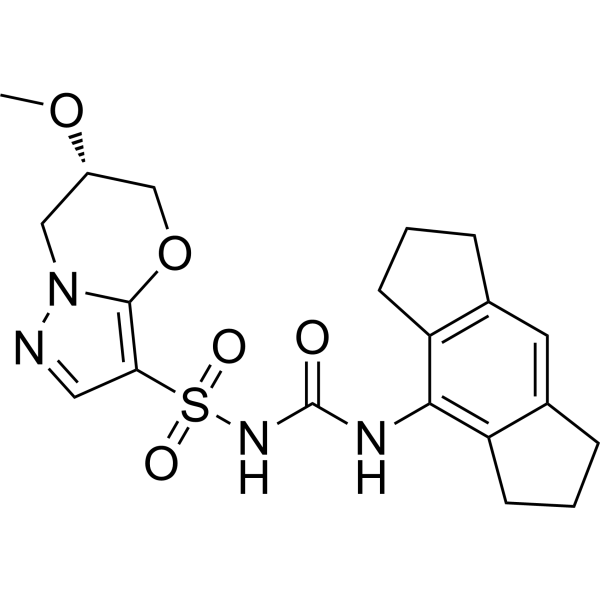
JT002 is an orally active and selective NLRP3 inflammasome assembly inhibitor. JT002 reduces NLRP3-dependent proinflammatory cytokine (such as IL-1β, IL-1α, IL-18) production and pyroptosis. JT002 blocks NLRP3 inflammasome complex formation. JT002 reduces airway hyperresponsiveness and airway neutrophilia in mice. JT002 can be used for the study of a variety of inflammatory diseases, such as Muckle-Wells syndrome (MWS).
Nur für Forschungszwecke. Wir verkaufen nicht an Patienten.
- Reinheit : 99.54%
- CAS. Nr.: 2238820-43-2
- Formel: C20H24N4O5S
- Molecular Weight:432.49
-
Speicherung:Powder -20°C, 3 years , 4°C, 2 years ; In solvent -80°C, 6 months , -20°C, 1 month

To place orders, for customer services and technical support, please contact: MedChemExpress USA
Tel: 609-228-6898 E-mail: [email protected] [email protected]


-
 Biologische Aktivität
-
Chemical Information
-
Lösungsmittel & Löslichkeit
- Protokoll
- Reinheit & Dokumentation
- Verweise
-
 Help & FAQs




Biologische Aktivität
Beschreibung
In Vitro
In human peripheral blood mononuclear cells (hPBMCs) treated with Lipopolysaccharides (HY-D1056) (LPS) and activated with ATP (HY-B2176), JT002 shows concentration-dependent inhibition of IL-1α, IL-1β and IL-18 production with mean IC50 values of 3 nM, 4 nM and 4 nM, respectively, with no effect on TNFα production[1].
Under LPS plus Nigericin (HY-127019) stimulating conditions, JT002 inhibits IL-1β production from human, mouse and rat PBMCs with mean IC50 values of 6, 25 and 159 nM, respectively[1].
In human and mouse blood stimulated with LPS plus ATP, JT002 shows concentration-dependent inhibition of IL-1β production with mean IC50 values of 100 nM and 94 nM, respectively[1].
JT002 inhibits pyroptosis in LPS plus nigericin stimulated mouse bone-marrow derived macrophages (mBMDMs) as measured by cellular ATP content, with a mean IC50 value of 7 nM[1].
JT002 blocks canonical NLRP3-dependent IL-1β production activated downstream of ATP, Nigericin, cholesterol crystals (CHC) or monosodium urate (MSU) with mean IC50 values of 5 nM, 23 nM, 2 nM and 3 nM, respectively and inhibits non-canonical induced IL-1β production with a mean IC50 value of 30 nM[1].
JT002 shows no inhibition of IL-1β production after NLRP1, NLRC4 or AIM2 activation at concentrations up to 10 µM[1].
JT002 blocks NLRP3 inflammasome complex formation and downstream pathway activation. JT002 inhibits cellular caspase-1 activity with an IC50 of 8 nM in human PBMCs[1].
MedChemExpress (MCE) has not independently confirmed the accuracy of these methods. They are for reference only.
Parmacokinetics
| Species | Dose | Route | Plasma Concentration | T1/2 | AUC | Clearance (CL) | Vd | Tmax | Bioavailability |
|---|---|---|---|---|---|---|---|---|---|
| Dog[1] | 1 mg/kg | i.v. | 7.0 μg/mL | 1.1 h | 10.6 μg·h/mL | 1.8 mL/min/kg | 0.2 L/kg | / | / |
| Dog[1] | 1 mg/kg | p.o. | 4.0 μg/mL | 1.4 h | 11.6 μg·h/mL | / | / | 1.0 h | 100 % |
| Rat[1] | 1 mg/kg | i.v. | 10.6 μg/mL | 2.8 h | 16.2 μg·h/mL | 1.0 mL/min/kg | 0.2 L/kg | - h | - % |
| Rat[1] | 5 mg/kg | p.o. | 15.6 μg/mL | 23.4 h | 59.2 μg·h/mL | - mL/min/kg | / | 0.5 h | 73.2 % |
In Vivo
JT002 (2.5-25 mg/kg; oral gavage; once daily; from Day 23-29) in ovalbumin (OVA)-sensitized, OVA-challenged, and induced regulatory T cell (iTreg)-transferred CD8a-/- mice (mimicking IL-17-dependent neutrophilic asthma). The 25 mg/kg dose of JT002 significantly reduces airway hyperresponsiveness and airway neutrophilia, decreases submucosal inflammatory cell infiltration, reduces the concentrations of IL-6 and IL-17 in bronchoalveolar lavage fluid, and increases the INFγ concentration. The 2.5 mg/kg dose of JT002 has no significant effect[1].
JT002 (2.5 mg/kg and 25 mg/kg; oral gavage; once daily; 4 days) in female C57BL6/J mice (a model of ozone - induced neutrophilic asthma). The 25 mg/kg dose of JT002 prevents ozone-induced airway hyperresponsiveness, significantly reduces the number of neutrophils in bronchoalveolar lavage fluid, and reduces airway epithelial desquamation. The 2.5 mg/kg dose of JT002 has no significant effect[1].
MedChemExpress (MCE) has not independently confirmed the accuracy of these methods. They are for reference only.
-
Animal Model:Nlrp3A350V/+CreT knock-in mice (male and female, 6-8 weeks ol)[1].
-
Dosage:30 mg/kg
-
Administration:Oral gavage, once daily, for 30 days starting on Day 1
-
Result:Prevented body weight loss.
Significantly reduced the liver weight as a percentage of body weight.
Serum levels of alanine aminotransferase were decreased.
Hepatic expression of pro-inflammatory and profibrotic genes was downregulated.
-
Animal Model:CD8a-/- C57BL6/j female mice (6-8 weeks old). The mice were sensitized by intraperitoneal injection of 20 μg OVA emulsified in 2.25 mg alum hydroxide on Days 0 and 14, and then received aerosol challenges with 1% OVA in PBS for 20 min each day on three consecutive days (Days 26-28)[1].
-
Dosage:2.5 mg/kg and 25 mg/kg
-
Administration:Oral gavage, once daily, from Day 23-29
-
Result:The high dose significantly decreased airway hyperresponsiveness and airway neutrophilia, visibly decreased submucosal inflammatory cell infiltration, decreased the concentrations of BAL IL-6 and IL-17, and increased BAL INFγ concentrations.
-
Animal Model:Female C57BL6/J mice (8-12 weeks old). Mice were exposed to 1.0 ppm of O3 for 3 h[1].
-
Dosage:2.5 mg/kg and 25 mg/kg
-
Administration:Oral gavage, once daily, for 4 days
-
Result:The high dose prevented ozone-induced airway hyperresponsiveness, significantly reduced BAL fluid neutrophil numbers, and visibly reduced the appearance of epithelial cells in the airway lumen
Clinical Trial
| NCT Number | Sponsor | Condition | Start Date |
Phase

|
|---|---|---|---|---|
| NCT01329991 | 2011-05 | PHASE1 |


Chemical Information
-
CAS. Nr. 2238820-43-2
-
Appearance Solid
-
Molecular Weight 432.49
-
Formel C20H24N4O5S
-
Color White to off-white
-
SMILES
O=C(NS(=O)(C1=C(OC[C@@H](OC)C2)N2N=C1)=O)NC3=C(CCC4)C4=CC5=C3CCC5
-
Versand
Room temperature in continental US; may vary elsewhere.
-
Speicherung
Powder -20°C 3 years 4°C 2 years In solvent -80°C 6 months -20°C 1 month


Lösungsmittel & Löslichkeit
In Vitro:
DMSO : 100 mg/mL (231.22 mM; Need ultrasonic; Hygroscopic DMSO has a significant impact on the solubility of product, please use newly opened DMSO)
Please refer to the solubility information to select the appropriate solvent. Once prepared, please aliquot and store the solution to prevent product inactivation from repeated freeze-thaw cycles.
Storage method and period of stock solution: -80°C, 6 months; -20°C, 1 month. When stored at -80°C, please use it within 6 months. When stored at -20°C, please use it within 1 month.
Please refer to the solubility information to select the appropriate solvent. Once prepared, please aliquot and store the solution to prevent product inactivation from repeated freeze-thaw cycles.
Storage method and period of stock solution: -80°C, 6 months; -20°C, 1 month. When stored at -80°C, please use it within 6 months. When stored at -20°C, please use it within 1 month.
Konzentration (Stammlösung) × Volumen (Stammlösung) = Konzentration (Ziellösung) × Volumen (Ziellösung)
In Vivo:
Select the appropriate dissolution method based on your experimental animal and administration route.
- For the following dissolution methods, please ensure to first prepare a clear stock solution using an In Vitro approach and then sequentially add co-solvents:
- To ensure reliable experimental results, the clarified stock solution can be appropriately stored based on storage conditions. As for the working solution for In Vivo experiments, it is recommended to prepare freshly and use it on the same day.
- The percentages shown for the solvents indicate their volumetric ratio in the final prepared solution. If precipitation or phase separation occurs during preparation, heat and/or sonication can be used to aid dissolution.
In Vivo Dissolution Calculator
Please enter the basic information of animal experiments:
-
-
-
-
Recommended: Prepare an additional quantity of animals to account for potential losses during experiments.
Please enter your animal formula composition:
-
%DMSO +
Recommended: Keep the proportion of DMSO in working solution below 2% if your animal is weak.
-
%+
-
+%Tween-80 + +
-
%Saline +
The co-solvents required include: DMSO, . All of co-solvents are available by MedChemExpress (MCE). , Tween 80. All of co-solvents are available by MedChemExpress (MCE).
Working solution concentration: 0.22 mg/mL
Method for preparing stock solution: mg drug dissolved in μL DMSO. Stock solution concentration: mg/mL.
1. Take μL DMSO stock solution;
2. Add μL .
μL , mix evenly;
3. Then add μL Tween 80, mix evenly;
4. Then add μL
Please ensure that the stock solution in the first step is dissolved to a clear state, and add co-solvents in sequence. You can use ultrasonic heating (ultrasonic cleaner, recommended frequency 20-40 kHz), vortexing, etc. to assist dissolution.


Reinheit & Dokumentation
-
Data Sheet (284 KB)
-
SDS (254 KB)
- English - EN (254 KB)
- Français - FR (254 KB)
- Deutsch - DE (254 KB)
- Norwegian - NO (254 KB)
- Español - ES (254 KB)
- Swedish - SV (254 KB)
- Italian - IT (254 KB)
- Korean - KR (254 KB)
- Portuguese - PT (254 KB)
-
Handling Instructions (2659 KB)
Verweise


Complete Stock Solution Preparation Table
Please refer to the solubility information to select the appropriate solvent. Once prepared, please aliquot and store the solution to prevent product inactivation from repeated freeze-thaw cycles.
Storage method and period of stock solution: -80°C, 6 months; -20°C, 1 month. When stored at -80°C, please use it within 6 months. When stored at -20°C, please use it within 1 month.
| Optional Solvent | Concentration Solvent Mass | 1 mg | 5 mg | 10 mg | 25 mg |
|---|---|---|---|---|---|
| DMSO | 1 mM | 2.3122 mL | 11.5610 mL | 23.1219 mL | 57.8048 mL |
| 5 mM | 0.4624 mL | 2.3122 mL | 4.6244 mL | 11.5610 mL | |
| 10 mM | 0.2312 mL | 1.1561 mL | 2.3122 mL | 5.7805 mL | |
| 15 mM | 0.1541 mL | 0.7707 mL | 1.5415 mL | 3.8537 mL | |
| 20 mM | 0.1156 mL | 0.5780 mL | 1.1561 mL | 2.8902 mL | |
| 25 mM | 0.0925 mL | 0.4624 mL | 0.9249 mL | 2.3122 mL | |
| 30 mM | 0.0771 mL | 0.3854 mL | 0.7707 mL | 1.9268 mL | |
| 40 mM | 0.0578 mL | 0.2890 mL | 0.5780 mL | 1.4451 mL | |
| 50 mM | 0.0462 mL | 0.2312 mL | 0.4624 mL | 1.1561 mL | |
| 60 mM | 0.0385 mL | 0.1927 mL | 0.3854 mL | 0.9634 mL | |
| 80 mM | 0.0289 mL | 0.1445 mL | 0.2890 mL | 0.7226 mL | |
| 100 mM | 0.0231 mL | 0.1156 mL | 0.2312 mL | 0.5780 mL |


JT002 Related Classifications
HY-149478 Related Classifications
 Powered by Bioz