



MS21

Based on 1 Customer Validation
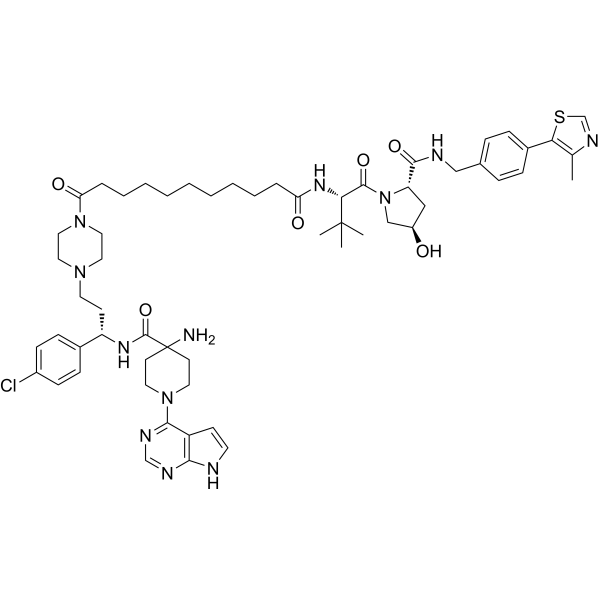
MS21 is an effective AKT PROTAC degrader. MS21 can inhibit mutations in the PI3K/PTEN pathway, suppress the proliferation and induce cell cycle arrest of tumor cells. MS21 has anti-tumor activity. (Pink: AKT ligand-2 (HY-48682); Black: Linker (HY-W014125); Blue: (S,R,S)-AHPC (HY-125845)).
(Pink: Akt ligand (HY-48682); Blue: VHL ligand (HY-125845); Black: linker (HY-W014125)).
Nur für Forschungszwecke. Wir verkaufen nicht an Patienten.
- Reinheit : 99.64%
- CAS. Nr.: 2376137-05-0
- Formel: C58H79ClN12O6S
- Molecular Weight:1107.84
-
Speicherung:
4°C, sealed storage, away from moisture
* In solvent : -80°C, 6 months; -20°C, 1 month (sealed storage, away from moisture)

To place orders, for customer services and technical support, please contact: MedChemExpress USA
Tel: 609-228-6898 E-mail: [email protected] [email protected]


-
 Biologische Aktivität
-
Chemical Information
-
Lösungsmittel & Löslichkeit
- Protokoll
- Reinheit & Dokumentation
- Verweise
-
 Help & FAQs


Alle PROTACs Isoform-spezifische Produkte anzeigen
More

Biologische Aktivität
Beschreibung
In Vitro
MS21 (1-1000 nM; 24 h) inhibits AKT protein levels and downstream signaling in PC-3 (DC50: 8.8 nM) and BT474 cells[1].
MS21 (0.1-10 μM; 2-17 days) can inhibit the proliferation of various cell lines such as PC-3 and MDA-MB-468 and induce cell cycle arrest[1].
MedChemExpress (MCE) has not independently confirmed the accuracy of these methods. They are for reference only.
-
Cell Line:PC-3 cells
-
Concentration:1, 3, 10, 30, 100, 300 and 1000 nM
-
Incubation Time:24 h
-
Result:Inhibited the level of T-Akt in a concentration‐dependent manner.
In Vivo
MedChemExpress (MCE) has not independently confirmed the accuracy of these methods. They are for reference only.
-
Animal Model:PC-3/MDA-MB-468 treated Nude mice[1]
-
Dosage:75 mg/kg
-
Administration:Intraperitoneal injection (i.p.); 21 days
-
Result:Led to more than 90% tumor growth inhibition relative to vehicle treatment in PC-3 xenograft model and more than 80% in MDA-MB-468 xenograft model.
Reduced T-AKT protein levels in tumors, inhibited downstream signaling such as p-S6, decreased Ki67 staining, and somewhat upregulated the apoptosis marker cleaved caspase-3.
Did not cause significant weight loss or other overt toxicities, and the increase in blood glucose levels after treatment was less than that of AZD5363 (HY-15431).


Chemical Information
-
CAS. Nr. 2376137-05-0
-
Appearance Solid
-
Molecular Weight 1107.84
-
Formel C58H79ClN12O6S
-
Color White to off-white
-
SMILES
NC1(CCN(C2=NC=NC3=C2C=CN3)CC1)C(N[C@@H](CCN4CCN(C(CCCCCCCCCC(N[C@@H](C(C)(C)C)C(N5C[C@H](O)C[C@H]5C(NCC6=CC=C(C7=C(C)N=CS7)C=C6)=O)=O)=O)=O)CC4)C8=CC=C(Cl)C=C8)=O
-
Versand
Room temperature in continental US; may vary elsewhere.
-
Speicherung
4°C, sealed storage, away from moisture
* In solvent : -80°C, 6 months; -20°C, 1 month (sealed storage, away from moisture)


Lösungsmittel & Löslichkeit
In Vitro:
Methanol : 95 mg/mL (85.75 mM; Need ultrasonic)
Please refer to the solubility information to select the appropriate solvent. Once prepared, please aliquot and store the solution to prevent product inactivation from repeated freeze-thaw cycles.
Storage method and period of stock solution: -80°C, 6 months; -20°C, 1 month (sealed storage, away from moisture). When stored at -80°C, please use it within 6 months. When stored at -20°C, please use it within 1 month.
Please refer to the solubility information to select the appropriate solvent. Once prepared, please aliquot and store the solution to prevent product inactivation from repeated freeze-thaw cycles.
Storage method and period of stock solution: -80°C, 6 months; -20°C, 1 month (sealed storage, away from moisture). When stored at -80°C, please use it within 6 months. When stored at -20°C, please use it within 1 month.
Konzentration (Stammlösung) × Volumen (Stammlösung) = Konzentration (Ziellösung) × Volumen (Ziellösung)


Reinheit & Dokumentation
-
Data Sheet (273 KB)
-
SDS (252 KB)
- English - EN (252 KB)
- Français - FR (252 KB)
- Deutsch - DE (252 KB)
- Norwegian - NO (252 KB)
- Español - ES (252 KB)
- Swedish - SV (252 KB)
- Italian - IT (252 KB)
- Korean - KR (252 KB)
- Portuguese - PT (252 KB)
-
Handling Instructions (2659 KB)
Verweise


Complete Stock Solution Preparation Table
Please refer to the solubility information to select the appropriate solvent. Once prepared, please aliquot and store the solution to prevent product inactivation from repeated freeze-thaw cycles.
Storage method and period of stock solution: -80°C, 6 months; -20°C, 1 month (sealed storage, away from moisture). When stored at -80°C, please use it within 6 months. When stored at -20°C, please use it within 1 month.
| Optional Solvent | Concentration Solvent Mass | 1 mg | 5 mg | 10 mg | 25 mg |
|---|---|---|---|---|---|
| Methanol | 1 mM | 0.9027 mL | 4.5133 mL | 9.0266 mL | 22.5664 mL |
| 5 mM | 0.1805 mL | 0.9027 mL | 1.8053 mL | 4.5133 mL | |
| 10 mM | 0.0903 mL | 0.4513 mL | 0.9027 mL | 2.2566 mL | |
| 15 mM | 0.0602 mL | 0.3009 mL | 0.6018 mL | 1.5044 mL | |
| 20 mM | 0.0451 mL | 0.2257 mL | 0.4513 mL | 1.1283 mL | |
| 25 mM | 0.0361 mL | 0.1805 mL | 0.3611 mL | 0.9027 mL | |
| 30 mM | 0.0301 mL | 0.1504 mL | 0.3009 mL | 0.7522 mL | |
| 40 mM | 0.0226 mL | 0.1128 mL | 0.2257 mL | 0.5642 mL | |
| 50 mM | 0.0181 mL | 0.0903 mL | 0.1805 mL | 0.4513 mL | |
| 60 mM | 0.0150 mL | 0.0752 mL | 0.1504 mL | 0.3761 mL | |
| 80 mM | 0.0113 mL | 0.0564 mL | 0.1128 mL | 0.2821 mL |


MS21 Related Classifications
HY-141807 Related Classifications
 Powered by Bioz