



Rbin-1
Based on 3 publication(s) in Google Scholar
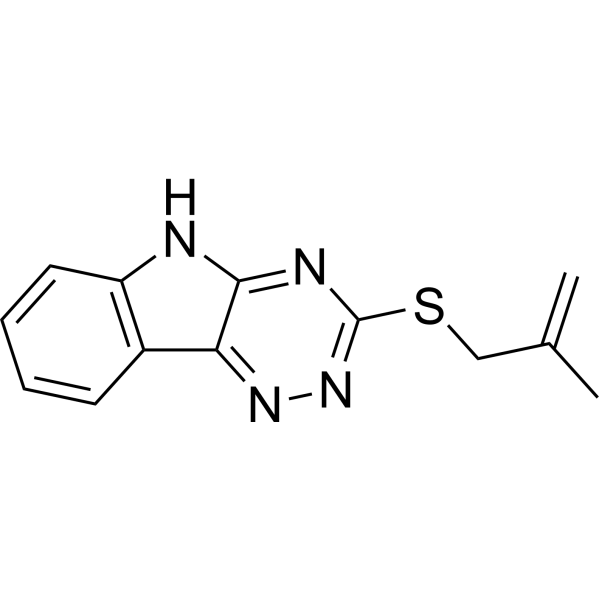
Rbin-1 is a potent, reversible, and specific chemical inhibitor of eukaryotic ribosome biogenesis. Rbin-1 inhibits the ATPase with GI50 of 136 nM. Rbin-1 is a potent and selective chemical inhibitor of Midasin (Mdn1).
Nos produits utilisent uniquement pour la recherche. Nous ne vendons pas aux patients.
- Pureté : 99.85%
- CAS No.: 328023-11-6
- Formule: C13H12N4S
- Masse moléculaire:256.33
-
Stockage:Powder -20°C, 3 years , 4°C, 2 years ; In solvent -80°C, 2 years , -20°C, 1 year

To place orders, for customer services and technical support, please contact: MedChemExpress USA
Tel: 609-228-6898 E-mail: [email protected] [email protected]


-
 Activité biologique
-
Chemical Information
-
Solvant et solubilité
- Pureté et documentation
- Références
-
 Help & FAQs



Publications Citing Use of MedChemExpress (MCE) Rbin-1
More

Activité biologique
Description
IC50 & Target
GI50: 136±7 nM (ATPase)[1]
In Vitro
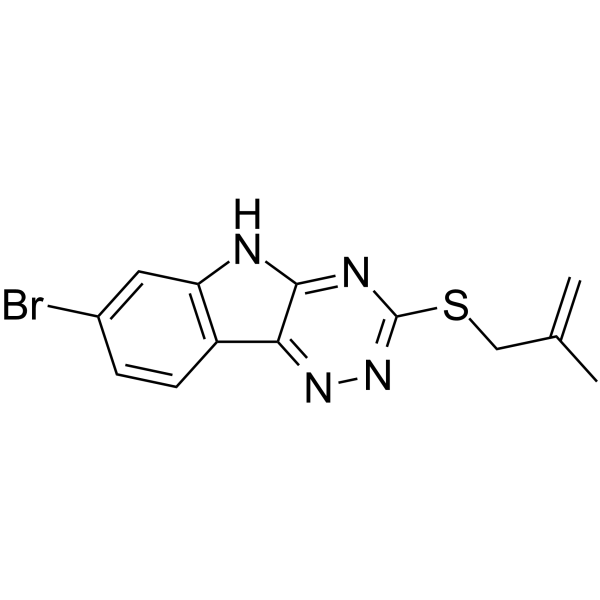
Rbin-1 is a potent and reversible triazinoindole-based inhibitors of eukaryotic ribosome biogenesis. Rbin-1 inhibits recombinant full-length Mdn1’s ATPase activity. Two of the active analogs (Rbin-1 and Rbin-2) inhibit the ATPase activity by 40% at 1 uM. In particular, an analog (Rbin-2) with a bromine substituent at postion-7 is 10-fold more active than Rbin-1 (GI50=14±1 nM (Rbin-2); 136±7 nM (Rbin-1), n=4, mean±SD)[1].
MedChemExpress (MCE) has not independently confirmed the accuracy of these methods. They are for reference only. .


Chemical Information
-
CAS No. 328023-11-6
-
Appearance Solid
-
Masse moléculaire 256.33
-
Formule C13H12N4S
-
Color Light yellow to yellow
-
SMILES
C=C(C)CSC1=NN=C2C(NC3=C2C=CC=C3)=N1
-
Synonyms
Ribozinoindole-1
-
Livraison
Room temperature in continental US; may vary elsewhere.
-
Stockage
Powder -20°C 3 years 4°C 2 years In solvent -80°C 2 years -20°C 1 year


Publications (3)
-
Journal Impact Factor
-
Most Recent
-
PLoS Genet
Fzr regulates silk gland growth by promoting endoreplication and protein synthesis in the silkworm. [Abstract]2023 Jan 18;19(1):e1010602. PMID: 36652497 -
Exp Cell Res
NOP14 promotes proliferative diabetic retinopathy through ribosome biogenesis and endothelial dysfunction via Wnt/β-catenin signaling activation. [Abstract]2026 Apr 1;457(1):114922. PMID: 41638389 -
Mol Microbiol
Sulfur restriction extends fission yeast chronological lifespan through Ecl1 family genes by downregulation of ribosome. [Abstract]2017 Jul;105(1):84-97. PMID: 28388826


Solvant et solubilité
In Vitro:
DMSO : ≥ 31 mg/mL (120.94 mM; Hygroscopic DMSO has a significant impact on the solubility of product, please use newly opened DMSO)
* "≥" means soluble, but saturation unknown.
Please refer to the solubility information to select the appropriate solvent. Once prepared, please aliquot and store the solution to prevent product inactivation from repeated freeze-thaw cycles.
Storage method and period of stock solution: -80°C, 2 years; -20°C, 1 year. When stored at -80°C, please use it within 2 years. When stored at -20°C, please use it within 1 year.
Please refer to the solubility information to select the appropriate solvent. Once prepared, please aliquot and store the solution to prevent product inactivation from repeated freeze-thaw cycles.
Storage method and period of stock solution: -80°C, 2 years; -20°C, 1 year. When stored at -80°C, please use it within 2 years. When stored at -20°C, please use it within 1 year.
Concentration (start) × Volume (start) = Concentration (final) × Volume (final)
In Vivo:
Select the appropriate dissolution method based on your experimental animal and administration route.
- For the following dissolution methods, please ensure to first prepare a clear stock solution using an In Vitro approach and then sequentially add co-solvents:
- To ensure reliable experimental results, the clarified stock solution can be appropriately stored based on storage conditions. As for the working solution for In Vivo experiments, it is recommended to prepare freshly and use it on the same day.
- The percentages shown for the solvents indicate their volumetric ratio in the final prepared solution. If precipitation or phase separation occurs during preparation, heat and/or sonication can be used to aid dissolution.
Add each solvent one by one: 10% DMSO 40% PEG300 5% Tween-80 45% Saline
Solubility: 1.67 mg/mL (6.52 mM); Suspended solution; Need ultrasonic
This protocol yields a suspended solution of 1.67 mg/mL. Suspended solution can be used for oral and intraperitoneal injection.
Taking 1 mL working solution as an example, add 100 μL DMSO stock solution (16.7 mg/mL) to 400 μL PEG300, and mix evenly; then add 50 μL Tween-80 and mix evenly; then add 450 μL Saline to adjust the volume to 1 mL.
Preparation of Saline: Dissolve 0.9 g sodium chloride in ddH₂O and dilute to 100 mL to obtain a clear Saline solution.
In Vivo Dissolution Calculator
Please enter the basic information of animal experiments:
-
-
-
-
Recommended: Prepare an additional quantity of animals to account for potential losses during experiments.
Please enter your animal formula composition:
-
%DMSO +
Recommended: Keep the proportion of DMSO in working solution below 2% if your animal is weak.
-
%+
-
+%Tween-80 + +
-
%Saline +
The co-solvents required include: DMSO, . All of co-solvents are available by MedChemExpress (MCE). , Tween 80. All of co-solvents are available by MedChemExpress (MCE).
Working solution concentration: 0.22 mg/mL
Method for preparing stock solution: mg drug dissolved in μL DMSO. Stock solution concentration: mg/mL.
1. Take μL DMSO stock solution;
2. Add μL .
μL , mix evenly;
3. Then add μL Tween 80, mix evenly;
4. Then add μL
Please ensure that the stock solution in the first step is dissolved to a clear state, and add co-solvents in sequence. You can use ultrasonic heating (ultrasonic cleaner, recommended frequency 20-40 kHz), vortexing, etc. to assist dissolution.


Pureté et documentation
-
Fiche technique (276 KB)
-
SDS (393 KB)
- English - EN (393 KB)
- Français - FR (393 KB)
- Deutsch - DE (393 KB)
- Norwegian - NO (393 KB)
- Español - ES (393 KB)
- Swedish - SV (393 KB)
- Italian - IT (393 KB)
- Korean - KR (393 KB)
- Portuguese - PT (393 KB)
-
Instruction de manipulation (2659 KB)
Références


Complete Stock Solution Preparation Table
Please refer to the solubility information to select the appropriate solvent. Once prepared, please aliquot and store the solution to prevent product inactivation from repeated freeze-thaw cycles.
Storage method and period of stock solution: -80°C, 2 years; -20°C, 1 year. When stored at -80°C, please use it within 2 years. When stored at -20°C, please use it within 1 year.
| Optional Solvent | Concentration Solvent Mass | 1 mg | 5 mg | 10 mg | 25 mg |
|---|---|---|---|---|---|
| DMSO | 1 mM | 3.9012 mL | 19.5061 mL | 39.0122 mL | 97.5305 mL |
| 5 mM | 0.7802 mL | 3.9012 mL | 7.8024 mL | 19.5061 mL | |
| 10 mM | 0.3901 mL | 1.9506 mL | 3.9012 mL | 9.7531 mL | |
| 15 mM | 0.2601 mL | 1.3004 mL | 2.6008 mL | 6.5020 mL | |
| 20 mM | 0.1951 mL | 0.9753 mL | 1.9506 mL | 4.8765 mL | |
| 25 mM | 0.1560 mL | 0.7802 mL | 1.5605 mL | 3.9012 mL | |
| 30 mM | 0.1300 mL | 0.6502 mL | 1.3004 mL | 3.2510 mL | |
| 40 mM | 0.0975 mL | 0.4877 mL | 0.9753 mL | 2.4383 mL | |
| 50 mM | 0.0780 mL | 0.3901 mL | 0.7802 mL | 1.9506 mL | |
| 60 mM | 0.0650 mL | 0.3251 mL | 0.6502 mL | 1.6255 mL | |
| 80 mM | 0.0488 mL | 0.2438 mL | 0.4877 mL | 1.2191 mL | |
| 100 mM | 0.0390 mL | 0.1951 mL | 0.3901 mL | 0.9753 mL |


Rbin-1 Related Classifications
HY-100816 Related Classifications
 Powered by Bioz