



Mecasermin

Based on 1 Customer Validation
Mecasermin (Human IGF-I; FK 780) is a recombinant human insulin-like growth factor I (IGF-I). Mecasermin has the potential for the study of the growth failure of growth hormone (GH) insensitivity caused by GH receptor defects or GH-inhibiting antibodies.
Nos produits utilisent uniquement pour la recherche. Nous ne vendons pas aux patients.
- CAS No.: 68562-41-4
- Formule: C331H512N94O101S7
- Masse moléculaire:7645.68
-
Stockage:
Please store the product under the recommended conditions in the Certificate of Analysis.

To place orders, for customer services and technical support, please contact: MedChemExpress USA
Tel: 609-228-6898 E-mail: [email protected] [email protected]


-
 Activité biologique
-
Chemical Information
- Protocole
- Pureté et documentation
- Références
-
 Help & FAQs




Activité biologique
Description
In Vivo
MedChemExpress (MCE) has not independently confirmed the accuracy of these methods. They are for reference only.
-
Animal Model:Mecp2 hemizygous KO mice[2]
-
Dosage:0.25 mg/kg
-
Administration:i.p.; daily; 6 weeks
-
Result:Improved lifespan, locomotor activity, heart rate, respiration patterns, and social and anxiety behavior.
Essai clinique
| NCT Number | Sponsor | Condition | Start Date |
Phase

|
|---|---|---|---|---|
| NCT01329991 | Plexxikon| | 2011-05 | PHASE1 |


Chemical Information
-
CAS No. 68562-41-4
-
Appearance Liquid
-
Masse moléculaire 7645.68
-
Formule C331H512N94O101S7
-
Color Colorless to light yellow
-
Synonyms
Human IGF-I; FK 780
-
Sequence
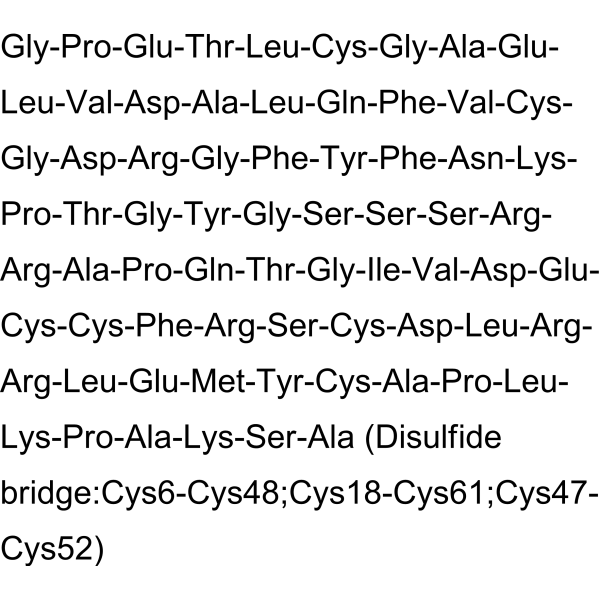
Gly-Pro-Glu-Thr-Leu-Cys-Gly-Ala-Glu-Leu-Val-Asp-Ala-Leu-Gln-Phe-Val-Cys-Gly-Asp-Arg-Gly-Phe-Tyr-Phe-Asn-Lys-Pro-Thr-Gly-Tyr-Gly-Ser-Ser-Ser-Arg-Arg-Ala-Pro-Gln-Thr-Gly-Ile-Val-Asp-Glu-Cys-Cys-Phe-Arg-Ser-Cys-Asp-Leu-Arg-Arg-Leu-Glu-Met-Tyr-Cys-Ala-Pro-Leu-Lys-Pro-Ala-Lys-Ser-Ala (Disulfide bridge:Cys6-Cys48;Cys18-Cys61;Cys47-Cys52)
-
Sequence Shortening
GPETLCGAELVDALQFVCGDRGFYFNKPTGYGSSSRRAPQTGIVDECCFRSCDLRRLEMYCAPLKPAKSA (Disulfide bridge:Cys6-Cys48;Cys18-Cys61;Cys47-Cys52)
-
Livraison
Room temperature in continental US; may vary elsewhere.
-
Stockage
Please store the product under the recommended conditions in the Certificate of Analysis.

Protocole
-
Research Protocol for Endocrine Diseases
Endocrine diseases often arise from disrupted hormone production, hormone signaling, or target-tissue responsiveness; for diabetes-focused endocrine disease models, insulin signaling regulates glucose uptake, hepatic glucose output, lipid metabolism, and β-cell compensation. Type 2 diabetes develops through interacting defects in insulin resistance, β-cell dysfunction, adipose inflammation, hepatic glucose overproduction, altered incretin signaling, and ectopic lipid metabolism. A major unresolved question is whether endocrine dysfunction is driven primarily by target-tissue insulin resistance, intrinsic β-cell failure, immune/inflammatory stress, or combined multi-organ failure that differs by disease stage.


Pureté et documentation
-
Fiche technique (263 KB)
-
SDS (251 KB)
- English - EN (251 KB)
- Français - FR (251 KB)
- Deutsch - DE (251 KB)
- Norwegian - NO (251 KB)
- Español - ES (251 KB)
- Swedish - SV (251 KB)
- Italian - IT (251 KB)
- Korean - KR (251 KB)
- Portuguese - PT (251 KB)
-
Instruction de manipulation (2659 KB)
Références
[1]. Arlan L Rosenbloom. Mecasermin (recombinant human insulin-like growth factor I). Adv Ther. 2009 Jan;26(1):40-54. [Content Brief]
[2]. Jorge Castro, et al. Functional recovery with recombinant human IGF1 treatment in a mouse model of Rett Syndrome. Proc Natl Acad Sci U S A. 2014 Jul 8;111(27):9941-6. [Content Brief]

Calculators
Concentration (start) × Volume (start) = Concentration (final) × Volume (final)


Mecasermin Related Classifications
HY-108905 Related Classifications
 Powered by Bioz