



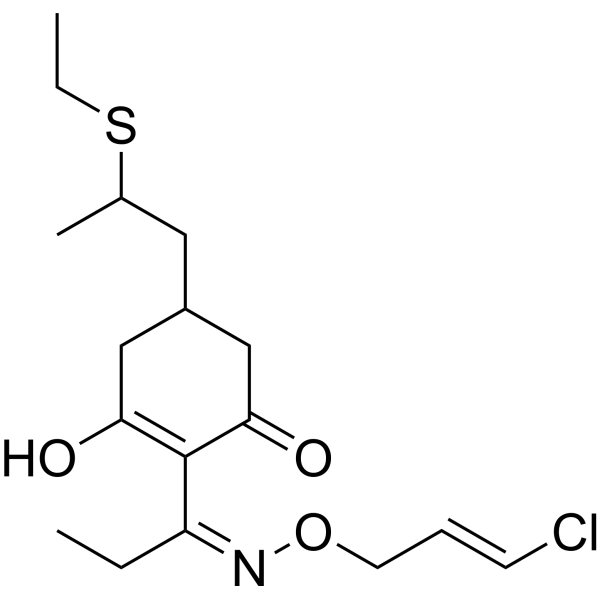
Clethodim

Based on 1 Customer Validation
Clethodim is a potent acetyl-CoA A carboxylase (ACCase) inhibitor and herbicide. Clethodim inhibits ACCase in plants, thereby blocking fatty acid biosynthesis required for cell membrane and secondary metabolite production. Clethodim exhibits developmental toxicity and neurotoxicity in zebrafish embryos and larvae. Clethodim is used in studies on agricultural herbicides and developmental toxicity.
For research use only. We do not sell to patients.
- Purity : 95.0%
- CAS No.: 99129-21-2
- Formula: C17H26ClNO3S
- Molecular Weight:359.91
-
Storage:
-20°C, protect from light, stored under nitrogen
* In solvent : -80°C, 6 months; -20°C, 1 month (protect from light, stored under nitrogen)

To place orders, for customer services and technical support, please contact: MedChemExpress USA
Tel: 609-228-6898 E-mail: [email protected] [email protected]


-
 Biological Activity
-
Chemical Information
-
Solvent & Solubility
- Protocols
- Purity & Documentation
- References
-
 Help & FAQs




Biological Activity
Description
In Vitro
Clethodim (0.96-1.92 g/L; 96 h) inhibits seed germination and root growth, induces micronucleus formation and nucleolar enlargement, induces oxidative stress, increases CAT and APX enzyme activities, and inhibits root tip cell elongation in Allium cepa cells[3].
Clethodim (76.5 g a.i. ha-1; 21 days) exhibits complete lethal and growth-inhibitory activity in Shattercane and Johnsongrass plant cells[2].
Clethodim (0.1%-0.5%; 1-3 h) reduces pollen fertility and induces cell fusion and multinucleate formation in pollen mother cells of Pisum sativum L.[4].
Clethodim (30 days) exhibits lethal activity in perennial Lolium perenne L. cells[5].
Clethodim (192 g a.i. ha-1; 24 h) inhibits the relative expression of the EPSPS gene in EPSPS-overexpressing perennial Lolium perenne L.[5].
Product (192 g a.i. ha-1; 72 h) in combination with Glyphosate (HY-B0863) (1000 g a.e. ha-1) significantly increases shikimate accumulation in sensitive and EPSPS-overexpressing perennial ryegrass cells[5].
MedChemExpress (MCE) has not independently confirmed the accuracy of these methods. They are for reference only. Further protocols information, click here.
-
Cell Line:Allium cepa root tip meristematic cells
-
Concentration:0.06, 0.12, 0.24, 0.48, 0.96, 1.92 g/L
-
Incubation Time:96 h
-
Result:Did not significantly alter the mitotic index, but significantly increased the frequency of micronucleus formation at doses of 0.24 and 1.92 g/L, and induced an increase in the number and size of nucleoli.
-
Cell Line:Lolium perenne L. leaves cells
-
Concentration:192 g a.i. ha-1 alone or combined with Glyphosate (1000 g a.e. ha-1)
-
Incubation Time:24 h
-
Result:Significantly inhibited relative EPSPS gene expression in the EPSPS-overexpressing biotype, reducing it to a level similar to or lower than that of the susceptible biotype.
In Vivo
Clethodim (10-30 mg/L; waterborne exposure; single continuous exposure; 24 h) induces developmental malformations of the head and cardiovascular system, inhibits AChE and ATPase enzyme activities, and triggers oxidative stress and apoptosis in the zebrafish embryo model[6].
Clethodim (10-30 mg/L; waterborne exposure; single continuous exposure; 24 h) decreases swimming distance and velocity, increases angular velocity of movement, and interferes with multiple neurotransmitter signaling pathways in a zebrafish larval model (6 dpf)[6].
Clethodim (100 μg/L; waterborne exposure; solution renewed daily; continuous exposure until 5 days post-fertilization) induces neurobehavioral dysfunction, reduces locomotor activity, and inhibits AChE activity in a zebrafish larval model[6].
MedChemExpress (MCE) has not independently confirmed the accuracy of these methods. They are for reference only.
-
Animal Model:Wild type AB strain, Tg (lyz: DsRed) transgenic line, Tg (rag2: DsRed) transgenic line, and albino zebrafish (embryos at 6 hpf)[1]
-
Dosage:10, 50, 100, 300, and 500 μg/L
-
Administration:Water immersion; continuous; 120 hpf
-
Result:Reduced survival rate to 20% (8/40) at 24 hpf and almost all embryos were dead at 96 hpf at 500 μg/L.
Exhibited an LC50 of 100 μg/L at 120 hpf.
Decreased body lengths by 6.8%, 7.4%, 10.6%, and 12.8% at 50, 100, 300, and 500 μg/L, respectively.
Inhibited heart rate at 72 hpf at 50 μg/L or higher.
Induced spinal deformities in 20% (8/40) of larvae at 48 hpf and yolk sac edemas in 30% (12/40) at 96 hpf at 300 μg/L.
Reduced the number of neutrophils and macrophages and decreased thymus area in a dose-dependent manner.
Increased ROS and MDA contents and CAT and SDH enzymatic activities.
Increased Bax and cleaved caspase-3 protein levels and reduced Bcl-2 expression.
Up-regulated TLR4, MyD88, NF-κB p65, IRF4, IRF5, and IRF8 mRNA levels and down-regulated TRIF and IRF3.
Increased pro-inflammatory cytokines TNF-α, IL-1β, IL6, IL8, and IFN-γ in a dose-dependent manner.
Improved survival rate in TLR4-KD larvae at 300 μg/L.
Decreased total distance moved and mean velocity at 100 μg/L at 5 dpf.
Inhibited AChE enzymatic activities.
Decreased HDAC1 mRNA levels and increased acetylated histone H3 levels in a dose-dependent manner.
Partially rescued neurobehavioral disorders with carbachol (10 μg/L), showing slight increase in locomotor behavior and improved total distance moved and mean velocity.
-
Animal Model:Wild-type AB strain and Tg(elavl3: YC2), Tg(SOX10: EGFP), Tg(fli: EGFP) transgenic lines[6]
-
Dosage:10, 20, 30 mg/L
-
Administration:immersion; single dose, 24 h
-
Result:Reduced the frequency of spontaneous tail coiling in 24 hpf embryos.
Increased the deformity rate.
Inhibited AChE activity in a concentration-dependent manner.
Reduced Na+K+- and Ca2+Mg2+-ATPase activities.
Markedly increased SOD activity in the medium (20 mg/L) and high (30 mg/L) concentration-treated groups.
Showed a significant decline in CAT activity in the high concentration-treated group (30 mg/L).
Increased the contents of MDA and ROS gradually.
Increased the number of apoptotic cells with increasing concentration.
Decreased the expression level of anti-apoptotic gene bcl2, while increased pro-apoptotic gene caspase 3.
Significantly elevated expression levels of epha4, hoxb1a, neurogenin1, and gfap in the high concentration (30 mg/L)-treated group, while dropped the expression of synapsinIIa.
Reduced total movement distance, average movement speed, and movement time in 6 dpf larvae.
Increased angular velocity and sinuosity of larval motion with increasing concentration.
Reduced AChE activity and down-regulated expression levels of gabra1, gat1, gria2b, gad1b, grin1b, and glsa.


Chemical Information
-
CAS No. 99129-21-2
-
Appearance Liquid (Density: 1.18±0.1 g/cm3)
-
Molecular Weight 359.91
-
Formula C17H26ClNO3S
-
Color Colorless to light yellow
-
SMILES
O=C1C(/C(CC)=N\OC/C=C/Cl)=C(O)CC(CC(SCC)C)C1
-
Shipping
Room temperature in continental US; may vary elsewhere.
-
Storage
-20°C, protect from light, stored under nitrogen
* In solvent : -80°C, 6 months; -20°C, 1 month (protect from light, stored under nitrogen)


Solvent & Solubility
In Vitro:
DMSO : ≥ 100 mg/mL (277.85 mM; Hygroscopic DMSO has a significant impact on the solubility of product, please use newly opened DMSO)
* "≥" means soluble, but saturation unknown.
Please refer to the solubility information to select the appropriate solvent. Once prepared, please aliquot and store the solution to prevent product inactivation from repeated freeze-thaw cycles.
Storage method and period of stock solution: -80°C, 6 months; -20°C, 1 month (protect from light, stored under nitrogen). When stored at -80°C, please use it within 6 months. When stored at -20°C, please use it within 1 month.
Please refer to the solubility information to select the appropriate solvent. Once prepared, please aliquot and store the solution to prevent product inactivation from repeated freeze-thaw cycles.
Storage method and period of stock solution: -80°C, 6 months; -20°C, 1 month (protect from light, stored under nitrogen). When stored at -80°C, please use it within 6 months. When stored at -20°C, please use it within 1 month.
Concentration (start) × Volume (start) = Concentration (final) × Volume (final)

Protocols
-
Reproductive and Developmental Toxicity Study
Reproductive and developmental toxicity studies detect adverse effects of prenatal or peri/postnatal exposure on maternal condition, pregnancy maintenance, embryo-fetal survival, fetal growth, structural development, and offspring reproductive or developmental endpoints; classic rat protocols generate readouts by comparing treated groups with vehicle, pair-fed, or untreated controls for implantation, resorption, fetal weight, crown-rump length, external morphology, visceral morphology, skeletal ossification, anogenital distance, nipple/areola retention, and postnatal cohort outcomes.
-
Neurotoxicity Study
This protocol assesses in vitro neurotoxicity by combining neuronal viability, mitochondrial/metabolic activity, neurite outgrowth, and optional neuronal network function readouts. Calcein-AM or resazurin/PrestoBlue readouts estimate viable or metabolically active cells; βIII-tubulin immunofluorescence detects neuronal morphology and neurite networks; TMRE detects mitochondrial membrane potential; and MEA recordings detect functional changes in neuronal network activity.


Purity & Documentation
-
Data Sheet (296 KB)
-
SDS (394 KB)
- English - EN (394 KB)
- Français - FR (394 KB)
- Deutsch - DE (394 KB)
- Norwegian - NO (394 KB)
- Español - ES (394 KB)
- Swedish - SV (394 KB)
- Italian - IT (394 KB)
- Korean - KR (394 KB)
- Portuguese - PT (394 KB)
-
Handling Instructions (2659 KB)
References
[1]. Xiong G, et al. Clethodim exposure induces developmental immunotoxicity and neurobehavioral dysfunction in zebrafish embryos. Fish & shellfish immunology. 2019 Mar;86:549-558. [Content Brief]
[6]. Wang H, et al. Clethodim exposure induced development toxicity and behaviour alteration in early stages of zebrafish life. Environmental pollution (Barking, Essex : 1987). 2019 Dec;255(Pt 1):113218. [Content Brief]


Complete Stock Solution Preparation Table
Please refer to the solubility information to select the appropriate solvent. Once prepared, please aliquot and store the solution to prevent product inactivation from repeated freeze-thaw cycles.
Storage method and period of stock solution: -80°C, 6 months; -20°C, 1 month (protect from light, stored under nitrogen). When stored at -80°C, please use it within 6 months. When stored at -20°C, please use it within 1 month.
| Optional Solvent | Concentration Solvent Mass | 1 mg | 5 mg | 10 mg | 25 mg |
|---|---|---|---|---|---|
| DMSO | 1 mM | 2.7785 mL | 13.8924 mL | 27.7847 mL | 69.4618 mL |
| 5 mM | 0.5557 mL | 2.7785 mL | 5.5569 mL | 13.8924 mL | |
| 10 mM | 0.2778 mL | 1.3892 mL | 2.7785 mL | 6.9462 mL | |
| 15 mM | 0.1852 mL | 0.9262 mL | 1.8523 mL | 4.6308 mL | |
| 20 mM | 0.1389 mL | 0.6946 mL | 1.3892 mL | 3.4731 mL | |
| 25 mM | 0.1111 mL | 0.5557 mL | 1.1114 mL | 2.7785 mL | |
| 30 mM | 0.0926 mL | 0.4631 mL | 0.9262 mL | 2.3154 mL | |
| 40 mM | 0.0695 mL | 0.3473 mL | 0.6946 mL | 1.7365 mL | |
| 50 mM | 0.0556 mL | 0.2778 mL | 0.5557 mL | 1.3892 mL | |
| 60 mM | 0.0463 mL | 0.2315 mL | 0.4631 mL | 1.1577 mL | |
| 80 mM | 0.0347 mL | 0.1737 mL | 0.3473 mL | 0.8683 mL | |
| 100 mM | 0.0278 mL | 0.1389 mL | 0.2778 mL | 0.6946 mL |


Clethodim Related Classifications
HY-119896 Related Classifications
 Powered by Bioz