



Dalargin

Based on 1 Customer Validation
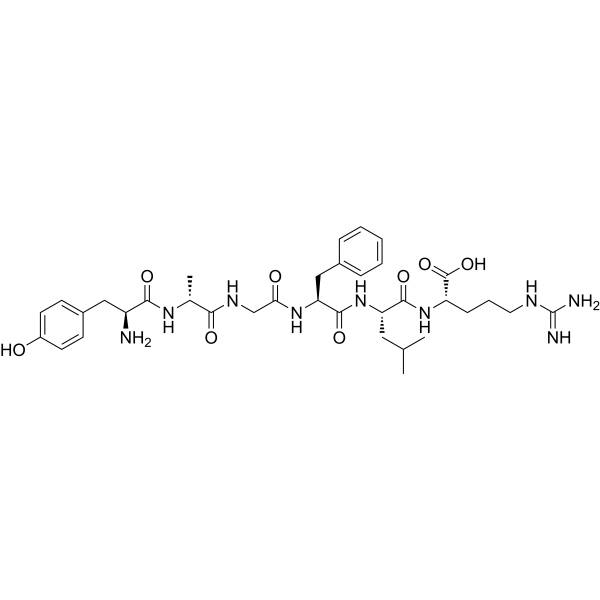
Dalargin is a potent δ-opioid receptor agonist. Dalargin mitigates Gentamicin (HY-A0276)-induced cell death. Dalargin shows nephroprotective effects on Gentamicin (HY-A0276A)-induced kidney injury. Dalargin shows antiulcer activity.
For research use only. We do not sell to patients.
- Purity : 98.12%
- CAS No.: 81733-79-1
- Formula: C35H51N9O8
- Molecular Weight:725.83
-
Storage:
Sealed storage, away from moisture.
Powder -80°C, 2 years , -20°C, 1 year* In solvent : -80°C, 6 months; -20°C, 1 month (sealed storage, away from moisture)

To place orders, for customer services and technical support, please contact: MedChemExpress USA
Tel: 609-228-6898 E-mail: [email protected] [email protected]


-
 Biological Activity
-
Chemical Information
-
Solvent & Solubility
- Protocols
- Purity & Documentation
- References
-
 Help & FAQs


All Opioid Receptor Isoforms
More

Biological Activity
Description
IC50 & Target
[2]|
δ Opioid Receptor/DOR |
In Vitro
Dalargin (100 µg/mL; 1 h) mitigates Gentamicin (HY-A0276A)-induced cell death of renal epithelium in vitro[2].
MedChemExpress (MCE) has not independently confirmed the accuracy of these methods. They are for reference only.
-
Cell Line:Kidney cells
-
Concentration:100 µg/mL
-
Incubation Time:1 h (prior to treatment with 1.2–2.5 mg/ml gentamicin for 24 h)
-
Result:Reduced kidney cells death.
In Vivo
MedChemExpress (MCE) has not independently confirmed the accuracy of these methods. They are for reference only.
-
Animal Model:290-350 g, White male rats[2]
-
Dosage:25, 50 µg/kg
-
Administration:I.p. (3 h before each gentamicin injection)
-
Result:Mitigated gentamicin-induced acutekidney injury, attenuated ROS generation and oxidative stress, alleviated histopathological changes in a renal tissue.
Clinical Trial
| NCT Number | Sponsor | Condition | Start Date |
Phase

|
|---|---|---|---|---|
| NCT01329991 | 2011-05 | PHASE1 |


Chemical Information
-
CAS No. 81733-79-1
-
Appearance Solid
-
Molecular Weight 725.83
-
Formula C35H51N9O8
-
Color White to off-white
-
Sequence Shortening
YAGFLR
-
Shipping
Room temperature in continental US; may vary elsewhere.
-
Storage
Sealed storage, away from moisture
Powder -80°C 2 years -20°C 1 year * In solvent : -80°C, 6 months; -20°C, 1 month (sealed storage, away from moisture)


Solvent & Solubility
In Vitro:
DMSO : ≥ 100 mg/mL (137.77 mM; Hygroscopic DMSO has a significant impact on the solubility of product, please use newly opened DMSO)
* "≥" means soluble, but saturation unknown.
Please refer to the solubility information to select the appropriate solvent. Once prepared, please aliquot and store the solution to prevent product inactivation from repeated freeze-thaw cycles.
Storage method and period of stock solution: -80°C, 6 months; -20°C, 1 month (sealed storage, away from moisture). When stored at -80°C, please use it within 6 months. When stored at -20°C, please use it within 1 month.
Please refer to the solubility information to select the appropriate solvent. Once prepared, please aliquot and store the solution to prevent product inactivation from repeated freeze-thaw cycles.
Storage method and period of stock solution: -80°C, 6 months; -20°C, 1 month (sealed storage, away from moisture). When stored at -80°C, please use it within 6 months. When stored at -20°C, please use it within 1 month.
Concentration (start) × Volume (start) = Concentration (final) × Volume (final)


Purity & Documentation
-
Data Sheet (273 KB)
-
SDS (252 KB)
- English - EN (252 KB)
- Français - FR (252 KB)
- Deutsch - DE (252 KB)
- Norwegian - NO (252 KB)
- Español - ES (252 KB)
- Swedish - SV (252 KB)
- Italian - IT (252 KB)
- Korean - KR (252 KB)
- Portuguese - PT (252 KB)
-
Handling Instructions (2659 KB)
References
[1]. Titov MI, et al. Dalargin--a peptidnyĭ preparat s tsitoprotektivnym deĭstviem [Dalargin--a peptide preparation with cytoprotective action]. Biull Vsesoiuznogo Kardiol Nauchn Tsentra AMN SSSR. 1985;8(2):72-6. [Content Brief]
[2]. Plotnikov EY, et al. Nephroprotective effect of GSK-3β inhibition by lithium ions and δ-opioid receptor agonist dalargin on gentamicin-induced nephrotoxicity. Toxicol Lett. 2013 Jul 18;220(3):303-8. [Content Brief]
[3]. Polonskiĭ VM, et al. Mesto prilozheniia (tsentral'noe ili perifericheskoe) protivoiazvennogo deĭstviia sinteticheskogo analoga éndogennykh opioidov dalargina v éksperimental'noĭ modeli tsisteaminovykh duodenal'nykh iazv u krys [The site (central or peripheral) of the anti-ulcer action of dalargin, a synthetic analog of endogenous opioids in an experimental model of cysteamine-induced duodenal ulcer in rats]. Biull Eksp Biol Med. 1987 Apr;103(4):433-4. [Content Brief]


Complete Stock Solution Preparation Table
Please refer to the solubility information to select the appropriate solvent. Once prepared, please aliquot and store the solution to prevent product inactivation from repeated freeze-thaw cycles.
Storage method and period of stock solution: -80°C, 6 months; -20°C, 1 month (sealed storage, away from moisture). When stored at -80°C, please use it within 6 months. When stored at -20°C, please use it within 1 month.
| Optional Solvent | Concentration Solvent Mass | 1 mg | 5 mg | 10 mg | 25 mg |
|---|---|---|---|---|---|
| DMSO | 1 mM | 1.3777 mL | 6.8887 mL | 13.7773 mL | 34.4433 mL |
| 5 mM | 0.2755 mL | 1.3777 mL | 2.7555 mL | 6.8887 mL | |
| 10 mM | 0.1378 mL | 0.6889 mL | 1.3777 mL | 3.4443 mL | |
| 15 mM | 0.0918 mL | 0.4592 mL | 0.9185 mL | 2.2962 mL | |
| 20 mM | 0.0689 mL | 0.3444 mL | 0.6889 mL | 1.7222 mL | |
| 25 mM | 0.0551 mL | 0.2755 mL | 0.5511 mL | 1.3777 mL | |
| 30 mM | 0.0459 mL | 0.2296 mL | 0.4592 mL | 1.1481 mL | |
| 40 mM | 0.0344 mL | 0.1722 mL | 0.3444 mL | 0.8611 mL | |
| 50 mM | 0.0276 mL | 0.1378 mL | 0.2755 mL | 0.6889 mL | |
| 60 mM | 0.0230 mL | 0.1148 mL | 0.2296 mL | 0.5741 mL | |
| 80 mM | 0.0172 mL | 0.0861 mL | 0.1722 mL | 0.4305 mL | |
| 100 mM | 0.0138 mL | 0.0689 mL | 0.1378 mL | 0.3444 mL |


Dalargin Related Classifications
HY-P4053 Related Classifications
 Powered by Bioz